


Opthamologists yesterday warned that wearing contact lens for prolonged periods of time and the improper cleaning of lens can lead to corneal damage.
The “care network for corneal health” was promoted by the Ophthalmological Society of Taiwan and the Taiwan Academy of Ophthalmology yesterday, in a bid to increase public awareness of corneal health.
They advised contact lens wearers to protect their eyes with “3C corneal protection:” Follow a doctor’s recommendations on usage, clean lenses everyday and undergo regular eye check ups.
A case was mentioned in which a 22-year-old office worker surnamed Chen (陳) regularly wore her contact lenses for more than 12 hours a day nearly everyday and sometimes slept with her lenses on. She only went to see a doctor when her vision became blurry and her right eye started to hurt and was diagnosed with visual deterioration, leaving her with 0.02 vision — or the ability to see clearly only one arm’s length from her body.
The improper cleaning of her contact lenses also resulted in a pyocyanus corneal ulcer which was only fixed with a corneal transplant this month.
Another case involved a 31-year-old junior-high school teacher who regularly wore contact lens for more than 14 hours everyday. She frequently wore daily disposable contacts during the week, sometimes without even changing the contact lens solution.
After red veins appeared in her eyes and experiencing discomfort even without wearing contact lens, she went to see a doctor and was diagnosed with corneal erosion caused by long-term corneal oxygen deficiency.
Ophthalmological Society of Taiwan Secretary-General Lin Szu-yuan (林思源) said prolonged wearing of contact lenses and improper cleaning can cause eye damage — which often starts with swollen eyes or diminished eyesight. In such situations, if an individual does not seek medical advice from a doctor, the cornea can be damaged by bacteria or fungal infection, potentially causing a corneal ulcer.
According to a 2009 survey on contact lens wearers, more than 50 percent of Taiwanese surveyed who use them said they had fallen asleep with their contact lenses on, and many wear them for as long as 14 hours a day or spend long hours staring at computer screens.

LOUD AND PROUD Taiwan might have taken a drubbing against Australia and Japan, but you might not know it from the enthusiasm and numbers of the fans Taiwan might not be expected to win the World Baseball Classic (WBC) but their fans are making their presence felt in Tokyo, with tens of thousands decked out in the team’s blue, blowing horns and singing songs. Taiwanese fans have packed out the Tokyo Dome for all three of their games so far and even threatened to drown out home team supporters when their team played Japan on Friday. They blew trumpets, chanted for their favorite players and had their own cheerleading squad who dance on a stage during the game. The team struggled to match that exuberance on the field, with
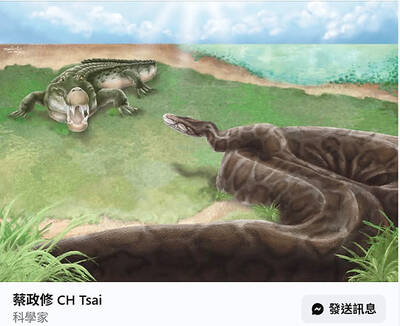
Taiwanese paleontologists have discovered fossil evidence that pythons up to 4m long inhabited Taiwan during the Pleistocene epoch, reporting their findings in the international scientific journal Historical Biology. National Taiwan University (NTU) Institute of Ecology and Evolutionary Biology associate professor Tsai Cheng-hsiu (蔡政修) led the team that discovered the largest snake fossil ever found in Taiwan. The single trunk vertebra was discovered in Tainan at the Chiting Formation, dated to between 400,000 and 800,000 years ago in the Middle Pleistocene, the paper said. The area also produced Taiwan’s first avian fossil, as well as crocodile, mammoth, saber-toothed cat and rhinoceros fossils, it said. Discoveries

Taiwanese paleontologists have discovered fossil evidence that pythons up to 4m long inhabited Taiwan during the Pleistocene epoch, reporting their findings in the international scientific journal Historical Biology. National Taiwan University (NTU) Institute of Ecology and Evolutionary Biology associate professor Tsai Cheng-hsiu (蔡政修) led the team that discovered the largest snake fossil ever found in Taiwan. A single trunk vertebra was discovered in Tainan at the Chiting Formation, dated to between 800,000 to 400,000 years ago in the Middle Pleistocene, the paper said. The area also produced Taiwan’s first avian fossil, as well as crocodile, mammoth, sabre-toothed cat and rhinoceros fossils, it said. Discoveries

Whether Japan would help defend Taiwan in case of a cross-strait conflict would depend on the US and the extent to which Japan would be allowed to act under the US-Japan Security Treaty, former Japanese minister of defense Satoshi Morimoto said. As China has not given up on the idea of invading Taiwan by force, to what extent Japan could support US military action would hinge on Washington’s intention and its negotiation with Tokyo, Morimoto said in an interview with the Liberty Times (sister paper of the Taipei Times) yesterday. There has to be sufficient mutual recognition of how Japan could provide


 RSS
RSS