


A fisherman who dredged up a petrified ivory tusk from the ocean trench off Dongji Island (東吉嶼) in Penghu County donated it to a Matsu (媽祖) temple on Wednesday out of gratitude for the deity’s blessing and protection.
The rare fossilized ivory tusk was snagged in a net at about 200m depth in the sea off eastern Dongji Island by Wang Chiu-tang (王秋堂), from Greater Tainan’s Annan District (安南) earlier this year.
Although well aware of the potential financial value of his finding, Wang offered it to Tainan’s Luerhmen Tian Ho Temple (鹿耳門天后宮), dedicated to the goddess of the seas, to thank her for having kept him safe during his decades at sea.
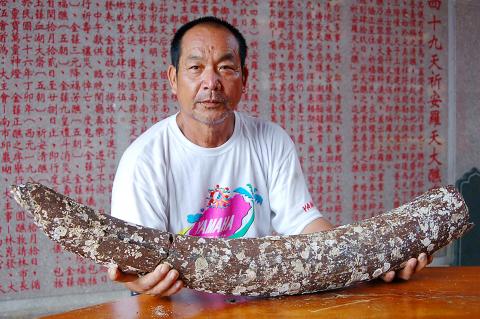
Photo: Tsai Wen-chu, Taipei Times
Putting the fossil ivory, which was accidentally broken in two after being dragged up out of the sea, on display at the temple will allow more people to enter Taiwan’s paleontological fossil world, Wang said.
During his three decades at sea, Wang said he had fished up innumerable animal bone fossils and antiquities, including petrified antlers, buffalo bones and seashell fossils.
“At first I assumed they were just [animal] skeletons and gave them away to just anyone. Only after I started studying the methods to accurately distinguish petrified objects from ordinary stone under an academic in the field did I become a fossil collector myself,” Wang said.
Wang Liang-chieh (王良傑), a consultant with the Tsailiao Fossil Museum and chairman of the Natural History and Fossil Research Association in Greater Tainan, said that scores of fossils have been found in Penghu’s sea trench, including animal and human fossils, with most of them 20,000 to 30,000 years old.
“However, the discovery of a complete petrified object is fairly rare,” he added.
The value of petrified objects hinge mainly on their texture, antiquity and completeness, the fossil expert said, and could range from tens of thousands of New Taiwan dollars to as much as NT$1 million.
Translated by Stacy Hsu, Staff Writer

FUKUOKA SITUATION: Japanese media reported that the pathogen is expected to be identified by the summer, while the CDC downplayed the idea that it was hMPV A “mysterious cold-like illness” reported in Japan’s Fukuoka Prefecture does not seem to be a new disease, but Japanese authorities have been asked about the situation, the Centers for Disease Control (CDC) said yesterday. The Fukuoka Prefectural Medical Association on Wednesday told a news conference that a “mystery cold” that has become a hot topic on social media is “highly likely to be caused by some kind of viral infection,” Japan’s KBC News reported. “Many people are experiencing symptoms starting with a sore throat, followed by a runny nose, phlegm and a severe cough,” KBC News reported, citing association officials. Health authorities are

Nvidia Corp CEO Jensen Huang (黃仁勳) arrived in Taiwan yesterday ahead of upcoming AI and technology events, saying he plans to meet with clients and Taiwan Semiconductor Manufacturing Co Chairman C.C. Wei (魏哲家) during his visit. After landing at Taipei Songshan Airport, Huang posed for photos with fans and handed out Yakult drinks to reporters and supporters waiting at the scene, saying he has “a lot to do” during the trip. Asked about reports that Nvidia’s planned headquarters site in Taipei’s Beitou Shilin Technology Park could break ground on May 27, Huang said that if the company holds an event, he would

Carrefour Taiwan is to begin using a new name from the start of July, but it cannot divulge the name until then, the chairman of the supermarket chain's parent company said today. President Chain Store Co chairman Lo Chih-hsien (羅智先) was asked by reporters after a shareholders' meeting to confirm whether the company has settled on a new name for the supermarket brand. In March, the government-registered name of two Carrefour Taiwan branches was quietly changed to "Le Chia Kang" (樂家康) in Chinese, raising speculation that has been selected as the name. Lo said that because of local regulations and contractual obligations, the

The Philippines would likely be involved in any conflict over Taiwan due to its proximity to the democracy claimed by China, President Ferdinand Marcos Jr said, reiterating a stance that risks angering Beijing. “In the Philippines, we do not have a choice because Taiwan is so close to the Philippines and we have almost 200,000 Filipino nationals living and working in Taiwan,” Marcos said in an interview with Japanese media in Manila on Monday. The Philippine leader’s comments come ahead of a state visit to Japan next week, where he is to meet with Japanese Prime Minister Sanae Takaichi to discuss security


 RSS
RSS