


An infant red poodle clumsily walks around the offices of the Kaohisung Concern for Stray Animals Association. Unfamiliar with its surroundings, the animal bumps into chairs and tables, but resolutely tries to familiarize itself with its new home. The little dog was born without eyes.
The association says a man called last week seeking help in caring for the newlborn puppy.
The man — who owns a store selling roast chicken in Kaohisung’s Kangshan District (岡山) — said he would not be able to take care of the puppy due to work commitments and did not want dog-breeders to get their hands on her, fearing that then more dogs would be born with the disability. The man said he had agreed to have his poodle inseminated because a relative wanted a red poodle puppy.
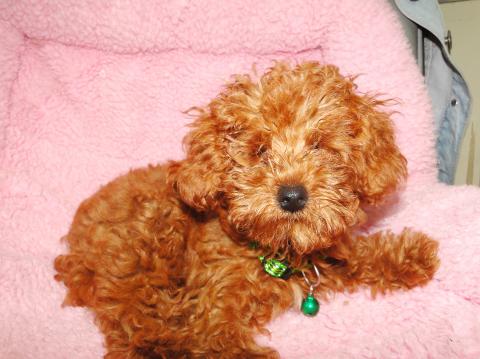
Photo: Tung Han-ni, Taipei Times
Wang Hsiao-hua (王小華), chairwoman of the animal association, said that people who really want to own a dog should do so to cherish a living being rather than for just liking the look of a certain breed.
Red poodles have become a must-have item on the pet market and rushed breeding to keep up with demand has led to many puppies being born with disfiguring defects, Wang said, adding that if the poodle pup somehow ended up in the clutches of ruthless dog-breeders, she would end up giving birth to more dogs with the same defect.
These dogs would be unsellable and would most likely be tossed on a roadside and left to fend for themselves, Wang said, adding that they would almost certainly perish.
The red poodle puppy is now being kept at the association and Wang said it was destined to be its new home as chances were slim that anyone would want to adopt an eye-less dog.
Feng Tsung-hung (馮宗宏), chief at the Hungli Animal Clinic, said that in-breeding was one cause of genetic mutations. Sometimes this caused no changes in the physical appearance of the animal, but their immune systems were weaker and they had shorter lifespans compared with other dogs, he added.
Feng also said that, in addition to the eye-less red poodle, he had seen puppies missing a leg and with deficiencies in brain development.
One of the reasons dog-breeders undertake the practice, is that the genetic mutations may also produce a stronger species. However, the chances of natural defects far outweigh the possibility of having a canine with superior traits, said Feng.
“We don’t know how dog breeders deal with the pups born with birth defects and whether they keep them, administer euthanasia or cast them out on the street,” Feng said, adding that this was why he opposed in-breeding.
Household pets also exhibit the tendency to in-breed and if pups from the same litter procreate, it is very possible that a genetically mutated dog with some sort of deficiency would be born, Feng said.
Translated by Jake Chung, staff writer

NATIONAL SECURITY: Authorities are working to confirm the identities of the military personnel involved and investigating possible illegal conduct and regulatory violations Authorities are probing possible national security implications after Kinmen police and immigration officers on Sunday found a Chinese woman allegedly posing as a tourist while engaging in prostitution involving more than 10 military personnel. The woman, surnamed Chen (陳), has since been deported, authorities said, adding that investigators are still working to confirm the identities of those implicated, as the records only listed code names and aliases. The case stemmed from a report received by the Kinmen District Prosecutors’ Office on Friday last week from the Jinhu Precinct of the Kinmen County Police Bureau. On Sunday, police, along with the National Immigration

GLOBALGIVING: ‘ Caving to external pressure is not acceptable for an organization that has cultivated justice reform and human rights for 30 years,’ one NGO said A slew of non-government organizations (NGOs) have withdrawn from the GlobalGiving fundraising platform after it announced it would use “Chinese Taipei” instead of “Taiwan” from next month. The Taiwan Good Rice Association wrote on Facebook on Friday that it was informed on April 28 via a teleconference call of the change, which was made because the platform wanted to operate in China. Taiwan Good Rice is to terminate all cooperative relationships with GlobalGiving in response to the platform’s “unilateral and non-negotiable” decision to remove references to Taiwan, the NGO said. “Taiwan is in the official name of Taiwan Good Rice Association and the

HEAVY WEATHER: Typhoon Jangmi is due to crash straight into the Ryukyus as airlines look to shift flights to larger aircraft or cancel flights to Okinawa entirely Taiwan’s international air carriers announced flight adjustments over the weekend as Typhoon Jangmi is forecast to hit the Ryukyu Islands today and tomorrow. The Central Weather Administration (CWA) upgraded Jangmi from a tropical storm to a typhoon at 8am yesterday, with the eye located 580km south of Naha city. It was moving north at 19kph. Today, China Airlines’ CI-120, CI-121, CI-122 and CI-123 flights between Taoyuan and Naha, Okinawa, have been canceled as well as CI-132 and CI-133 between Kaohsiung and Naha. EVA Air’s BR-112, BR-113, BR-186 and BR-185 flights between Taoyuan and Naha are also canceled. Low-cost carrier Tigerair Taiwan canceled IT-230,

Chinese Nationalist Party (KMT) Chairwoman Cheng Li-wun (鄭麗文) yesterday briefed her party’s Central Standing Committee regarding her scheduled visit to the US between Monday next week and June 16, saying that her purpose would be to persuade the US that the Republic of China (ROC) Constitution was a “one China” constitution that would foster stable and peaceful cross-strait relations. The ROC Constitution is the most important defense for all Taiwanese citizens, as it upholds our democracy and has contributed to our robust economy, which aligns with international and US interests, she said. “We would not be troublemakers and drag the US under,”


 RSS
RSS