


A new type of Chinese missile corvette, the principal role for which might be to project power in the South China Sea, could be launched “within days,” military watchers said on the weekend.
Talk of a Type 056 class first emerged in late 2010. So far, little technical information has been released about the corvettes, which are believed to lie in the 1,400-to-1,700-tonne category.
Two shipyards, Hudong Shipyard in Shanghai and Huangpu Shipyard in Guangzhou, are engaged in what appears to be a race to complete the vessels.
Officials at Hudong reportedly announced late last week that the first Type 056 corvette could be launched “within days,” with possible commissioning at the end of this year.
A total of four hulls are known to be under construction, with completion expected to follow soon after the delivery of the lead ship.
Designs of the Type 056 show fin stabilization for high seas navigation with weapons including a 76mm main gun, four surface-to-surface missile (SSM) launchers — reportedly for the YJ-83 SSM, the latest Chinese design — and one FL-1000 surface-to-air missile launcher.
The corvette could also come equipped with torpedoes for limited anti-submarine capability.
It also has a helipad large enough to accommodate vertical takeoff and landing for unmanned aerial vehicles.
Analysts believe the Type 056 could replace or augment the six Type 037 Houjian 528 fast-attack craft that have been based in Hong Kong since 1997, with future production for other People’s Liberation Army Navy (PLAN) fleets, where they could replace aging attack craft and frigates. The corvette could also be intended for export markets, with reports that the Bangladeshi navy has already expressed interest in its acquisition.
The new corvettes will fill a gap between smaller offshore patrol vessels and larger frigates and could be ideal for action in the South China Sea, where China is embroiled in disputes with Vietnam and the Philippines.
Analysts believe medium-sized ships like the Type 056 are better suited to combat light missile frigates with similar displacement already deployed by competitors in the volatile, mineral-rich body of water.
Beyond China’s disputes with the Philippines and Vietnam in the South China Sea, the new corvettes could also play a role in a conflict with Taiwan.
“The Type 056 looks like a rough match for the Taiwan Navy’s Lafayette frigates on a one-to-one basis,” James Holmes of the US Naval War College told the Taipei Times by e-mail last night. “Operated in ‘distributed’ fashion — multiple units networked to act in concert, combining their sensors and armaments — it would pose a serious challenge to Taiwan’s surface fleet in high-intensity combat.”
However, warships like the Type 056 are intended more to serve in a flotilla than to take part in major naval actions, Holmes said.
"Their armament is modest, but they outgun most competitors they’re likely to encounter in the South China Sea. They’re less useful in the Yellow and East China seas, where the competition is stiffer since the Japan Maritime Self-Defense Force and the US Seventh Fleet are there,” he said.
In related developments, reports said on the weekend that the FFG 572 Yueyang — the 14th Type 054A destroyer in the PLAN — is scheduled to be commissioned with the 9th Destroyer Squadron in the South Sea Fleet sometime next year.
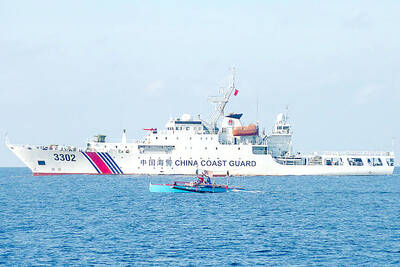
EXPANSIONIST: China deploys an average of 40 to 50 warships and coast guard vessels daily in the South China Sea, despite pledges not to militarize the region, an official said China is attempting to expand its influence across the First Island Chain and increase pressure on Japan by sending coast guard vessels into waters off of Taiwan under the pretext of maritime negotiations with Japan and the Philippines, a national security official said yesterday. China’s recent actions in the waters east of Taiwan and Japan and the Philippines’ exclusive economic zones (EEZ) are attempts to establish dominance in First Island Chain waters, said the official who declined to be named, adding that this is “expansion disguised as law enforcement.” Framing China’s actions solely as a cross-strait issue is a serious misjudgment that
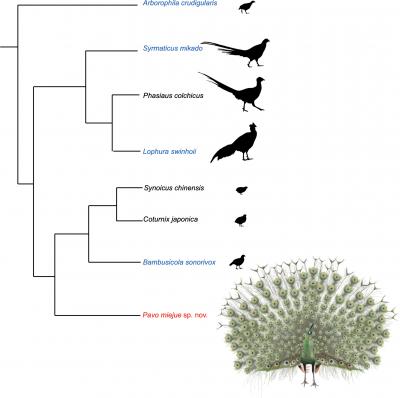
Through analyzing fossil evidence, a research team at National Taiwan University (NTU) discovered the largest endemic bird to have lived in Taiwan, naming it Pavo miejue, or extinct peafowl (滅絕孔雀). The Mikado pheasant, which is printed on the back of the NT$1,000 bank note, was previously believed to be the biggest endemic bird to Taiwan. The research team’s findings suggest that Pavo miejue lived during the Pleistocene epoch tens of thousands of years ago. It is the first endemic extinct bird species discovered and formally named in Taiwan. The study was coauthored by NTU Institute of Ecology and Evolutionary Biology professor Tsai Cheng-hsiu (蔡政修),
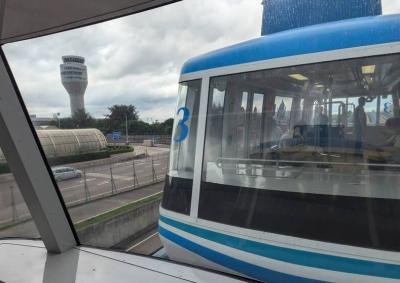
Taiwan Taoyuan International Airport is to suspend its automated Skytrain service connecting Terminal 1 and Terminal 2 starting on July 1 to facilitate connection works for the upcoming Terminal 3, the airport operator said today. Passengers and staff who need to travel between the two terminals after the suspension can instead use the Taoyuan MRT or the airport's 24-hour shuttle bus service, Taoyuan International Airport Corp said. The Taoyuan MRT Airport Line directly links the two terminals, while the shuttle buses are to operate around the clock, the company added. The Skytrain provides free transportation between the airport’s two terminals for travelers and
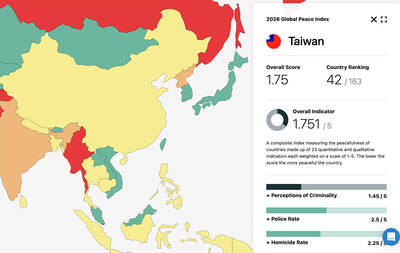
Taiwan ranked 42nd in terms of peacefulness among 163 countries, down five places from last year, according to this year’s Global Peace Index. With an overall score of 1.751, Taiwan dropped from 37th last year, the report published by the global Institute for Economics and Peace showed. The overall score measures a country’s level of peacefulness using 23 quantitative and qualitative indicators across three domains — ongoing domestic and international conflict, societal safety and security, and militarization. While Taiwan ranked 42nd worldwide, it was listed in ninth place among the 19 Asian-Pacific countries in the report, after New Zealand, Singapore, Japan, Malaysia,


 RSS
RSS