


A tour bus driver fractured both his legs and 35 passengers suffered light injuries after their vehicle hit the wall of a house and ended up in a rice paddy.
The accident occurred at about 11am, when the bus was on its way to Meihua Lake (梅花湖) in Dongshan Township (東山), Yilan County, the Directorate-General of Highways (DGH) said.
The DGH said the passengers were members of the Evergreen Society of the Chengde Community in Taipei. Most of them were senior citizens.

Photo: CNA
The passengers, who sustained minor injuries, were treated at Poh-Ai Hospital and Saint Mary’s Hospital. Television news footage showed the rescuers had a hard time pulling the driver out from his seat because his legs were trapped in front.
Tour group leader Chen Chou-ping (陳洲平) said that 86 people participated in the day trip to Yilan County. He said they rented two buses for the tour to visit Aboriginal villages in Dongshan Township first and later the temples near Meihua Lake.
The DGH said the driver was 55-year-old Fu Pao-sheng (傅寶勝), who holds valid licenses to operate large passenger vehicles and tour buses.
According to DGH records, Fu had nine traffic violations and had been fined once for not having his license checked, as required every three months.
Fu owns the tour bus, which is registered under the Taipei-based New Aloha Tour Bus Co, it added.
The tour bus was manufactured in 2001 and does not have any record of traffic violations.
The DGH said the accident was not caused by blown-out tires.
On Wednesday a tour bus slid off a precipitous road at Taroko Gorge National Park in Hualien County. Its driver, 59-year-old Chen Cheng-chin (陳正欽), was found to own a license to drive large trucks, but not tour buses.
In view of the recent accidents involving tour buses, the DGH said it would work with the National Joint Tour Bus Association to draft measures to enhance tour bus safety and educate tour bus drivers.
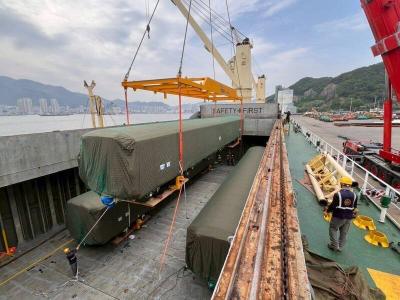
The first of 10 new high-capacity trains purchased from South Korea’s Hyundai Rotem arrived at the Port of Taipei yesterday to meet the demands of an expanding metro network, Taipei Rapid Transit Corp (TRTC) said yesterday. The train completed a three-day, 1,200km voyage from the Port of Masan in South Korea, the company said. Costing NT$590 million (US$18.79 million) each, the new six-carriage trains feature a redesigned interior based on "human-centric" transportation concepts, TRTC said. The design utilizes continuous longitudinal seating to widen the aisles and optimize passenger flow, while also upgrading passenger information displays and driving control systems for a more comfortable
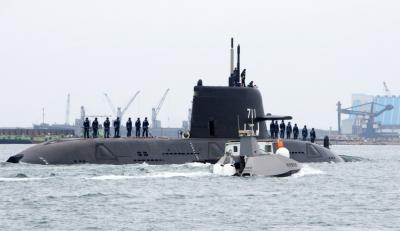
Taiwan's first indigenous defense submarine, the SS-711 Hai Kun (海鯤, or Narwhal), departed for its 13th sea trial at 7am today, marking its seventh submerged test, with delivery to the navy scheduled for July. The outing also marked its first sea deployment since President William Lai (賴清德) boarded the submarine for an inspection on March 19, drawing a crowd of military enthusiasts who gathered to show support. The submarine this morning departed port accompanied by CSBC Corp’s Endeavor Manta (奮進魔鬼魚號) uncrewed surface vessel and a navy M109 assault boat. Amid public interest in key milestones such as torpedo-launching operations and overnight submerged trials,
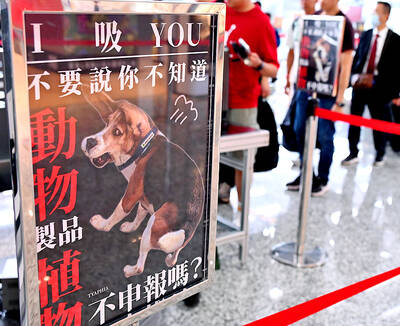
Quarantine awareness posters at Taiwan Taoyuan International Airport have gone viral for their use of wordplay. Issued by the airport branch of the Animal and Plant Health Inspection Agency, the posters feature sniffer dogs making a range of facial expressions, paired with advisory messages built around homophones. “We update the messages for holidays and campaign needs, periodically refreshing materials to attract people’s attention,” quarantine officials said. “The aim is to use the dogs’ appeal to draw focus to quarantine regulations.” A Japanese traveler visiting Taiwan has posted a photo on X of a poster showing a quarantine dog with a

SECURITY RISK: A university student sent a general alarm signal to THSRC’s control center on April 5, causing four operating trains to temporarily halt services The Ministry of Transportation and Communications yesterday pledged to submit a report on ways to harden the communication security of railway systems after a university student hacked into Taiwan High Speed Rail Corp’s (THSRC) radio communications system and disrupted operations of four high-speed rail trains last month. Investigation by the police and prosecutors found that the university student and radio enthusiast, surnamed Lin (林), first used a software-defined radio (SDR) filter to analyze THSRC signals, downloaded the data to a computer, cracked the parameters and then programmed the codes into his radio devices. Lin then sent a general alarm signal to


 RSS
RSS