


The Democratic Progressive Party (DPP) yesterday filed a lawsuit against Premier Wu Den-yih (吳敦義) for his comments accusing DPP presidential candidate Tsai Ing-wen (蔡英文) of corruption.
The party said it filed the lawsuit because Wu, who is on leave to concentrate on his campaign as President Ma Ying-jeou’s (馬英九) running mate, had violated the Presidential and Vice Presidential Election and Recall Act (總統副總統選舉罷免法) by spreading a rumor or false statement for the purpose of getting a candidate elected or impeding a candidate’s election chances.
At a campaign rally on Friday, Wu accused Tsai of corruption in the so-called “Yu Chang case” during her time as vice premier in 2007, when she approved separate government investments of NT$875 million (US$28.8 million) and US$20 million — about NT$1.4 billion in total — for the bio-technology start-up before leaving office and serving as Yu Chang’s chairperson.
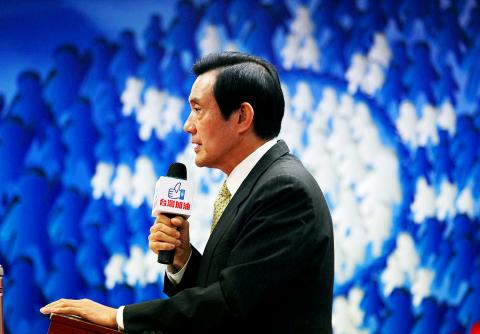
Photo: CNA
The National Development Fund’s (NDF) investment in Yu Chang was a lot less than NT$1.4 billion and Wu’s comments were an “obvious smear,” DPP spokesman Chuang Ruei-hsiung (莊瑞雄) said.
The NDF deposited its initial investment of NT$264 million in Yu Chang,now known as TaiMed Biologics Co, and approved the second phase investment of NT$875 million in March 2008, but the second deposit never went through after the change in government in May 2008, he said.
“No matter how you calculate it, the sum would not be NT$1.4 billion,” Chuang said.
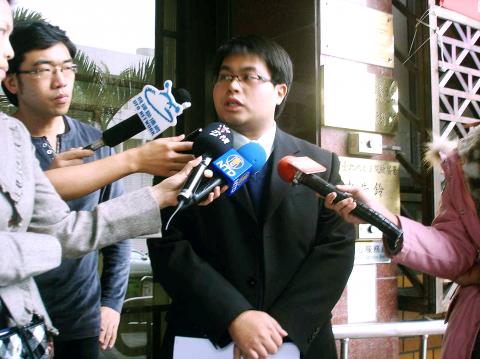
Photo: Lin Chun-hung, Taipei Times
Wu failed to get the time right either because the NT$875 million investment was approved by the NDF in March 2008, 10 months after Tsai left office in May 2007, DPP lawyer Huang Di-ying (黃帝穎) said.
Huang said it was strange that Wu’s comments came after his wife, Tsai Ling-yi (蔡令怡), had apologized for citing incorrect information at a KMT rally on Dec. 11 to accuse Tsai Ing-wen of transferring NT$1.1 billion in public funds to the accounts of her family’s businesses.
Including Wu, the DPP has now filed lawsuits against eight KMT politicians or political analysts over the Yu Chang case since Wednesday as the party insisted Tsai was not involved in any wrongdoing.
The DPP sued Council for Economic Planning and Development (CEPD) Minister Christina Liu (劉憶如) over allegedly forging documents that were used to smear Tsai and KMT legislators Chiu Yi (邱毅), Hsieh Kuo-liang (謝國樑), Lin Yi-shih (林益世) and Hung Hsiu-chu (洪秀柱), as well as political commentator Clara Chou (周玉蔻), for spreading rumors.
At a separate setting yesterday, DPP legislative candidate Juan Chao-hsiung (阮昭雄) filed a lawsuit with the Taipei District Prosecutors’ Office against Hon Hai chairman Terry Gou (郭台銘), alleging recent remarks by Gou may have violated election laws.
Juan, who represents the party in Taipei’s Wenshan District (文山), said Gou had said he supported Ma’s election and added that he planned to hire charter flights to return his staff from China to vote.
Juan said such measures could constitute vote buying.
Gou also joined a campaign rally for independent legislative candidate Lin Pin-kuan (林炳坤) on Penghu and told Lin that if he was elected, he would invest in a film company to make a movie in Penghu and that he would also provide funds so National Penghu University of Science and Technology could send people to attend the world energy investment competition, Juan said.
Those remarks also might have broken vote-buying regulations, Juan said.
Additional reporting by Rich Chang

NATIONAL SECURITY: Authorities are working to confirm the identities of the military personnel involved and investigating possible illegal conduct and regulatory violations Authorities are probing possible national security implications after Kinmen police and immigration officers on Sunday found a Chinese woman allegedly posing as a tourist while engaging in prostitution involving more than 10 military personnel. The woman, surnamed Chen (陳), has since been deported, authorities said, adding that investigators are still working to confirm the identities of those implicated, as the records only listed code names and aliases. The case stemmed from a report received by the Kinmen District Prosecutors’ Office on Friday last week from the Jinhu Precinct of the Kinmen County Police Bureau. On Sunday, police, along with the National Immigration

GLOBALGIVING: ‘ Caving to external pressure is not acceptable for an organization that has cultivated justice reform and human rights for 30 years,’ one NGO said A slew of non-government organizations (NGOs) have withdrawn from the GlobalGiving fundraising platform after it announced it would use “Chinese Taipei” instead of “Taiwan” from next month. The Taiwan Good Rice Association wrote on Facebook on Friday that it was informed on April 28 via a teleconference call of the change, which was made because the platform wanted to operate in China. Taiwan Good Rice is to terminate all cooperative relationships with GlobalGiving in response to the platform’s “unilateral and non-negotiable” decision to remove references to Taiwan, the NGO said. “Taiwan is in the official name of Taiwan Good Rice Association and the

HEAVY WEATHER: Typhoon Jangmi is due to crash straight into the Ryukyus as airlines look to shift flights to larger aircraft or cancel flights to Okinawa entirely Taiwan’s international air carriers announced flight adjustments over the weekend as Typhoon Jangmi is forecast to hit the Ryukyu Islands today and tomorrow. The Central Weather Administration (CWA) upgraded Jangmi from a tropical storm to a typhoon at 8am yesterday, with the eye located 580km south of Naha city. It was moving north at 19kph. Today, China Airlines’ CI-120, CI-121, CI-122 and CI-123 flights between Taoyuan and Naha, Okinawa, have been canceled as well as CI-132 and CI-133 between Kaohsiung and Naha. EVA Air’s BR-112, BR-113, BR-186 and BR-185 flights between Taoyuan and Naha are also canceled. Low-cost carrier Tigerair Taiwan canceled IT-230,

Chinese Nationalist Party (KMT) Chairwoman Cheng Li-wun (鄭麗文) yesterday briefed her party’s Central Standing Committee regarding her scheduled visit to the US between Monday next week and June 16, saying that her purpose would be to persuade the US that the Republic of China (ROC) Constitution was a “one China” constitution that would foster stable and peaceful cross-strait relations. The ROC Constitution is the most important defense for all Taiwanese citizens, as it upholds our democracy and has contributed to our robust economy, which aligns with international and US interests, she said. “We would not be troublemakers and drag the US under,”


 RSS
RSS