


The delay to President Ma Ying-jeou’s (馬英九) re-election campaign headquarters’ sixth youth camp was a result of its disorganization, one would-be participant said on Sunday.
The sixth “Democratic Election’s Great” youth camp event was scheduled to be held in Taipei on Saturday and Sunday to coincide with the birthday of Republic of China founding father Sun Yat-sen (孫逸仙).
The event was planned to educate participants about Chiang Wei-shui (蔣渭水), a formative figure in Taiwan’s colonial resistance movement against Japan who holds the title “Taiwanese Sun Yat-sen.”
However, a student named Arthur Wong, who enrolled in the camp, said he received a short message from the Ma campaign headquarters the day before the event saying that the event would be postponed by one week because of poor weather and the fact that some students were taking midterm exams.
Ma’s campaign headquarters spokesperson Yin Wei (殷瑋) said yesterday that campaign events, including the youth camp, were expected to hold seven rounds across the nation.
Yin said an average of 70 people applied to take part in each event.
Fifty people had applied to attend the sixth youth camp, Yin said, adding that a number of those applicants had called his office to request the event be postponed.
Yin said the youth camps, the KMT Youth League and the Institute on Policy Research and Development camps have been attended by more than 1,000 people and that the other symposiums held in Taipei and New Taipei City (新北市) attracted at least 60 and at most 150 attendees.
Yin said the youth camps are a success and they would continue to be held to raise youth participation in public matters as well as increase interaction with the younger generation.
However, Wong said that after telephoning the campaign headquarters he discovered the true reason the event was postponed was because it had not even received 25 applications of the allotted 60.
Wong said the camp program kept being altered, adding that when one female participant asked the campaign headquarters where they would be staying, she was told: “We can only tell you that it’s in Banciao District (板橋), [New Taipei City], but all other information is still classified.”
Wong said he and his friend signed up for the event because they had received confirmation that the chief executive of Ma’s re-election campaign, King Pu-tsung (金溥聰), would give a talk at the camp.
After the event was rescheduled, the speech was canceled, Wong said.
“Ma wishes to attract the support of first-time voters in this election, but after personally being involved with this event, I have seen the ridiculous and outrageous mistakes the Ma campaign office has made,” Wong said.
Using students’ midterm exams as a reason to postpone the event was ridiculous, as Ma once chatted with National University of Kaohsiung students the night before their midterms, Wong said, adding that the campaign office’s response to the female student’s inquiry was ludicrous.
“Ma says he has more than 200,000 fans on his Facebook page, but it is stunning that he could not even get 60 people to show up for his event,” Wong said.
Wong wrote about the event on his blog on Friday and received a lot of feedback from other netizens. One, named Andie Li, commented that the KMT’s youth vote would “dissolve like bubbles.”
Translated by Jake Chung, staff writer

SECURITY: Starlink owner Elon Musk has taken pro-Beijing positions, and allowing pro-China companies to control Taiwan’s critical infrastructure is risky, a legislator said Starlink was reluctant to offer services in Taiwan because of the nation’s extremely high penetration rates in 4G and 5G services, the Ministry of Digital Affairs said yesterday. The ministry made the comments at a meeting of the legislature’s Transportation Committee, which reviewed amendments to Article 36 of the Telecommunications Management Act (電信管理法). Article 36 bans foreigners from holding more than 49 percent of shares in public telecommunications networks, while shares foreigners directly and indirectly hold are also capped at 60 percent of the total, unless specified otherwise by law. The amendments, sponsored by Chinese Nationalist Party (KMT) Legislator Ko
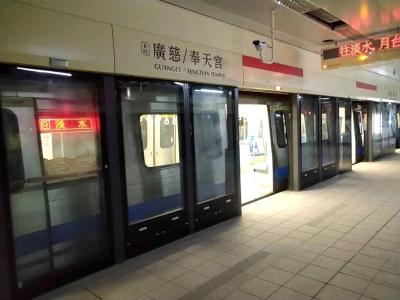
The eastern extension of the Taipei MRT Red Line could begin operations as early as late June, the Taipei Department of Rapid Transit Systems said yesterday. Taipei Rapid Transit Corp said it is considering offering one month of free rides on the new section to mark its opening. Construction progress on the 1.4km extension, which is to run from the current terminal Xiangshan Station to a new eastern terminal, Guangci/Fengtian Temple Station, was 90.6 percent complete by the end of last month, the department said in a report to the Taipei City Council's Transportation Committee. While construction began in October 2016 with an
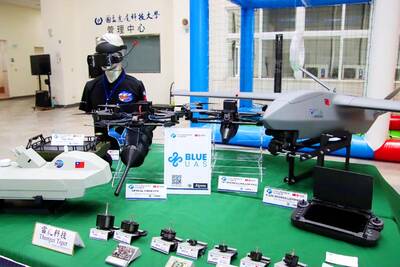
NON-RED SUPPLY: Boosting the nation’s drone industry is becoming increasingly urgent as China’s UAV dominance could become an issue in a crisis, an analyst said Taiwan’s drone exports to Europe grew 41.7-fold from 2024 to last year, with demand from Ukraine’s fight against Russian aggression the most likely driver of growth, a study showed. The Institute for Democracy, Society and Emerging Technology (DSET) in a statement on Wednesday said it found that many of Taiwan’s uncrewed aerial vehicle (UAV) sales were from Poland and the Czech Republic. These countries likely transferred the drones to Ukraine to aid it in its fight against the Russian invasion that started in 2022, it said. Despite the gains, Taiwan is not the dominant drone exporter to these markets, ranking second and fourth
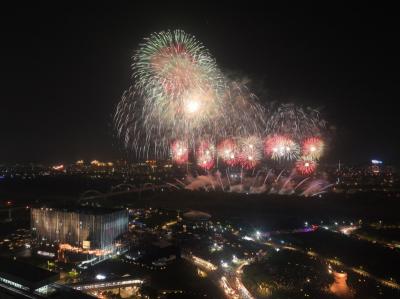
The New Taipei City Art Museum this weekend plans to celebrate its first anniversary with a two-day extravaganza featuring live concerts and a large-scale synchronized fireworks and drone display, the New Taipei City Cultural Affairs Department said. The two-day celebrations are to take place in the museum’s outdoor park, with markets and live performances by singers including Ann Bai (白安), Bii (畢書盡) and the Cosmos People (宇宙人), the department said. The highlight on both evenings would be the "Echoes of Light" show, an aerial spectacle combining fireworks and drone performances designed around the concept of "dual stages in the sky," it


 RSS
RSS