


Democratic Progressive Party (DPP) presidential candidate Tsai Ing-wen (蔡英文) yesterday announced her Aboriginal affairs policy, pledging to establish a national investigation and settlement commission, implement Aboriginal autonomy, create just and equal chances for Aborigines in cities and revitalize the tribal economy.
Tsai, while attending the launch of a support group formed by Aborigines in New Taipei City’s (新北市) Shulin District (樹林), said the DPP’s 10-year policy guidelines stated that the most important goal is to “realize justice” to lead to a future where all ethnicities live in harmony.
Tsai said that when the DPP was in power, it did its best to stand by the side of Aborigines. However, the Chinese Nationalist Party (KTM), after taking power, not only failed to propose new laws to benefit Aborigines, it even blocked the DPP’s proposed Aboriginal land and marine spaces act (原住民土地及海域法), she said.
The KMT wished to forcefully pass the indigenous people’s autonomous area act even when the contents of the draft were not considered acceptable by the majority of Aboriginal people, she said, adding that the KMT government should not pass laws in haste just to have something to show for its policies when it has not given Aborigines real power or peace.
Tsai pledged to set up a national investigation and settlement commission to investigate the loss of Aboriginal land and culture and various other unequal treatments and would compensate Aboriginal people for past misdeeds.
The president should apologize to Aboriginal people for their losses during the colonial era on behalf of the government, she said, adding that the move would show that the government is willing to change and “to re-establish relations between the Aboriginal people and the nation.”
“The president should take the lead and set an example for all other government chiefs and give back to the Aboriginal people the respect they deserve; and on a new basis of mutual benefit, the government should establish policies and take the first step in establishing friendly relations with Aboriginal tribes,” Tsai said.
Tsai said she would recognize the rights of Aboriginal tribes and implement an Aboriginal autonomous government, establishing autonomous areas for tribes who wish it.
The autonomous areas would be given steady funding, giving Aboriginals “true autonomous rule, unlike the KMT’s unwillingness to give a steady source of funding and autonomy over natural resources,” Tsai said.
There should be equal and just chances for development of Aboriginal populations in urban areas, Tsai said.
Because more than half of the Aboriginal population currently lives in cities and remit money back to their elders in tribal areas, Tsai said there should be systems put in place to help pass on Aboriginal culture and language in the future and also provide an active job market, good education, housing opportunities and chances to participate in politics for Aboriginal people.
Jobs have to be created for the revitalization of tribal economies, Tsai said, adding that funds and plans have to be developed to let tribes develop their local economies in accordance with their characteristics.
Aboriginal-only industries and Aboriginal-based financial loans should also be put in place so that they no longer have to be other people’s workers, but can have the chance to develop their own businesses and be their own masters, she said.
Translated by Jake Chung, Staff Writer
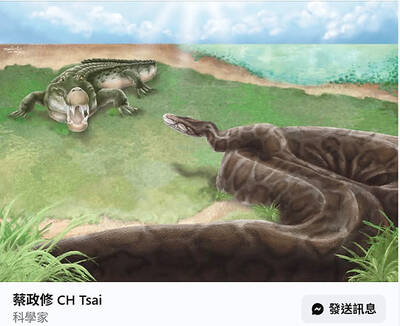
Taiwanese paleontologists have discovered fossil evidence that pythons up to 4m long inhabited Taiwan during the Pleistocene epoch, reporting their findings in the international scientific journal Historical Biology. National Taiwan University (NTU) Institute of Ecology and Evolutionary Biology associate professor Tsai Cheng-hsiu (蔡政修) led the team that discovered the largest snake fossil ever found in Taiwan. The single trunk vertebra was discovered in Tainan at the Chiting Formation, dated to between 400,000 and 800,000 years ago in the Middle Pleistocene, the paper said. The area also produced Taiwan’s first avian fossil, as well as crocodile, mammoth, saber-toothed cat and rhinoceros fossils, it said. Discoveries

Taiwanese paleontologists have discovered fossil evidence that pythons up to 4m long inhabited Taiwan during the Pleistocene epoch, reporting their findings in the international scientific journal Historical Biology. National Taiwan University (NTU) Institute of Ecology and Evolutionary Biology associate professor Tsai Cheng-hsiu (蔡政修) led the team that discovered the largest snake fossil ever found in Taiwan. A single trunk vertebra was discovered in Tainan at the Chiting Formation, dated to between 800,000 to 400,000 years ago in the Middle Pleistocene, the paper said. The area also produced Taiwan’s first avian fossil, as well as crocodile, mammoth, sabre-toothed cat and rhinoceros fossils, it said. Discoveries
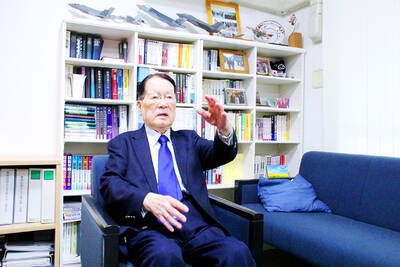
Whether Japan would help defend Taiwan in case of a cross-strait conflict would depend on the US and the extent to which Japan would be allowed to act under the US-Japan Security Treaty, former Japanese minister of defense Satoshi Morimoto said. As China has not given up on the idea of invading Taiwan by force, to what extent Japan could support US military action would hinge on Washington’s intention and its negotiation with Tokyo, Morimoto said in an interview with the Liberty Times (sister paper of the Taipei Times) yesterday. There has to be sufficient mutual recognition of how Japan could provide
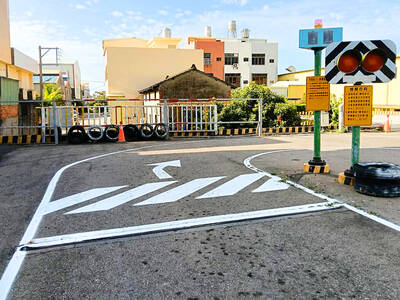
UPDATED TEST: The new rules aim to assess drivers’ awareness of risky behaviors and how they respond under certain circumstances, the Highway Bureau said Driver’s license applicants who fail to yield to pedestrians at intersections or to check blind spots, or omit pointing-and-calling procedures would fail the driving test, the Highway Bureau said yesterday. The change is set to be implemented at the end of the month, and is part of the bureau’s reform of the driving portion of the test, which has been criticized for failing to assess whether drivers can operate vehicles safely. Sedan drivers would be tested regarding yielding to pedestrians and turning their heads to check blind spots, while drivers of large vehicles would be tested on their familiarity with pointing-and-calling


 RSS
RSS