


The “disappearance” from the public eye of Peoples First Party (PFP) Chairman James Soong’s (宋楚瑜) running mate, Lin Ruey-shiung (林瑞雄), since Tuesday stems from efforts by the party to give Lin a crash course on the political set-up of the PFP, sources said.
With barely 24 hours between being declared Soong’s potential running mate and his first press conference, Lin’s casual dress and rigid answers on political issues at the press conference raised doubts over his political acumen.
This showed that Lin needed a crash course on political issues, the sources said, pointing to his bungled response to a question on whether he would participate in the election even if Soong failed to collect 1 million signatures as he vowed to do in order to join the presidential race.

Internet screen grab
Although Soong chose to remain vague on the matter, Lin took over the microphone and said that if those signatures were not obtained, he would not participate in the election.
PFP officials said on Saturday that aside from managing some personal matters and applying to give up his US citizenship, Lin needed some time to compose himself.
The political arena is foreign to him, PFP officials said.
“He’s suddenly on the election frontline and he doesn’t know what to say,” the officials said. “If he says the wrong thing, then it’s even worse.”
PFP spokesman Wu Kun-yu (吳崑玉) also said on Saturday that for the past two days Lin was taking in a lot of information, including what is said in newspapers, understanding the content of Soong’s recent talks, the ideals of the PFP, the “Second Silent Revolution” thought pattern and the “insides” of the political world.
All of this will prepare him for future talks in public and with the media, Wu said.
The “Second Silent Revolution” is a concept brought up by Soong that calls for thorough reforms to the system of democratic governance adopted by Taiwan.
PFP spokesperson Lee Tung-hao (李桐豪) said Lin has been on the move for the past two days, getting pictures taken for the campaign ads, visiting party headquarters, as well as showing up at some small events to explain his views on Taiwan’s future and development.
With limited campaign resources and because Soong wanted a different kind of election, the PFP’s election campaign would not be the same as before, Wu said, adding that they would not necessarily flight commercial film ads or distribute pamphlets.
“We will look for the proper time to share our ideals with the public and we will try to have in-depth dialogue with the various sectors, through petition-signing events and other talks and policy-explanation events, before Lin and Soong register as candidates,” Wu said.
“The PFP does not have the money to hold campaign events and even if we did, we would not,” Wu said.
Netizen supporters of Soong have placed his profile picture over the original face on the Seediq Bale promotional poster, hoping to spread word of Soong’s petition efforts.
Translated by Jake Chung, Staff Writer

Actor Darren Wang (王大陸) was sentenced to six months in prison, commutable to a fine, by the New Taipei District Court today for contravening the Personal Data Protection Act (個人資料保護法) in a case linked to an alleged draft-dodging scheme. Wang allegedly paid NT$3.6 million (US$114,380) to an illegal group to help him evade mandatory military service through falsified medical documents, prosecutors said. He transferred the funds to Chen Chih-ming (陳志明), the alleged mastermind of a draft-evasion ring, although he lost contact with him as he was already in detention on fraud charges, they said. Chen is accused of helping a

SECURITY: Starlink owner Elon Musk has taken pro-Beijing positions, and allowing pro-China companies to control Taiwan’s critical infrastructure is risky, a legislator said Starlink was reluctant to offer services in Taiwan because of the nation’s extremely high penetration rates in 4G and 5G services, the Ministry of Digital Affairs said yesterday. The ministry made the comments at a meeting of the legislature’s Transportation Committee, which reviewed amendments to Article 36 of the Telecommunications Management Act (電信管理法). Article 36 bans foreigners from holding more than 49 percent of shares in public telecommunications networks, while shares foreigners directly and indirectly hold are also capped at 60 percent of the total, unless specified otherwise by law. The amendments, sponsored by Chinese Nationalist Party (KMT) Legislator Ko

The eastern extension of the Taipei MRT Red Line could begin operations as early as late June, the Taipei Department of Rapid Transit Systems said yesterday. Taipei Rapid Transit Corp said it is considering offering one month of free rides on the new section to mark its opening. Construction progress on the 1.4km extension, which is to run from the current terminal Xiangshan Station to a new eastern terminal, Guangci/Fengtian Temple Station, was 90.6 percent complete by the end of last month, the department said in a report to the Taipei City Council's Transportation Committee. While construction began in October 2016 with an
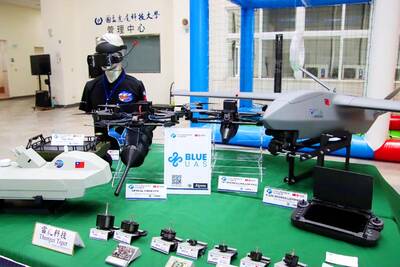
NON-RED SUPPLY: Boosting the nation’s drone industry is becoming increasingly urgent as China’s UAV dominance could become an issue in a crisis, an analyst said Taiwan’s drone exports to Europe grew 41.7-fold from 2024 to last year, with demand from Ukraine’s fight against Russian aggression the most likely driver of growth, a study showed. The Institute for Democracy, Society and Emerging Technology (DSET) in a statement on Wednesday said it found that many of Taiwan’s uncrewed aerial vehicle (UAV) sales were from Poland and the Czech Republic. These countries likely transferred the drones to Ukraine to aid it in its fight against the Russian invasion that started in 2022, it said. Despite the gains, Taiwan is not the dominant drone exporter to these markets, ranking second and fourth


 RSS
RSS