


The Democratic Progressive Party (DPP) will reinvent itself as a “moderate reformist” party to reassure and attract swing voters ahead of next year’s presidential election, DPP Chairperson Tsai Ing-wen (蔡英文) said yesterday.
Speaking to a group of Taiwanese businesspeople based in Southeast Asian countries, the DPP presidential candidate said the support of swing voters would be “crucial” in January’s election.
The swing vote is expected to be the main battleground between Tsai and the Chinese Nationalist Party (KMT) candidate, President Ma Ying-jeou (馬英九).
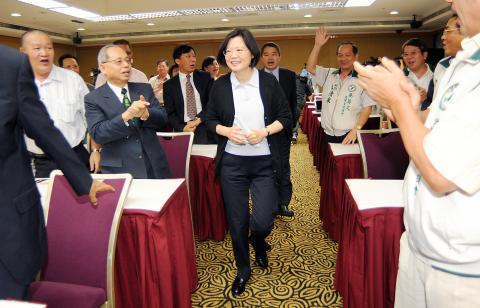
Photo: Lo Pei-der, Taipei Times
While the definition of swing voters in Taiwan is still up for debate, it is true that some voters stress social stability above all else, Tsai said, adding: “And the Chinese Nationalist Party has been taking advantage of this mindset to woo the so-called ‘swing voters’ and to evade reform in the past.”
The KMT has given the public the impression it wants to duplicate the era of the president Chiang Ching-kuo (蔣經國), when the country was run by an authoritative regime to achieve social stability, she said.
“The DPP will neither refuse to change for the sole purpose of stability, nor insist on reform and forget about stability,” she said.
The DPP will be moderately reformist because, as a party better at recognizing the global situation than its rival, it is able to identify the most urgently needed reforms, she said.
A good team of experienced former government officials from the DPP’s previous administrations is already in place to advance the party’s ideology, she said.
“That means we’re determined and are able to take care of the underprivileged, one of the DPP’s core values,” she added.
Outlining what would be the priorities of her administration, if elected, Tsai said two issues stand out — providing quality jobs and upgrading industrial infrastructure.
Instead of seeking temporary solutions, such as depending on China to solve any problems as the KMT does, the DPP has always insisted on finding long-term solutions that serve the best interest of the Taiwanese, she said.
The DPP is not opposed to economic exchange with China, she said, but the exchange she has in mind is one that is practiced within a normal framework and fits with international obligations in a multilateral system.
“The exchange should not be politicized either, which is the case at the moment,” she said.

Taiwanese paleontologists have discovered fossil evidence that pythons up to 4m long inhabited Taiwan during the Pleistocene epoch, reporting their findings in the international scientific journal Historical Biology. National Taiwan University (NTU) Institute of Ecology and Evolutionary Biology associate professor Tsai Cheng-hsiu (蔡政修) led the team that discovered the largest snake fossil ever found in Taiwan. The single trunk vertebra was discovered in Tainan at the Chiting Formation, dated to between 400,000 and 800,000 years ago in the Middle Pleistocene, the paper said. The area also produced Taiwan’s first avian fossil, as well as crocodile, mammoth, saber-toothed cat and rhinoceros fossils, it said. Discoveries

Taiwanese paleontologists have discovered fossil evidence that pythons up to 4m long inhabited Taiwan during the Pleistocene epoch, reporting their findings in the international scientific journal Historical Biology. National Taiwan University (NTU) Institute of Ecology and Evolutionary Biology associate professor Tsai Cheng-hsiu (蔡政修) led the team that discovered the largest snake fossil ever found in Taiwan. A single trunk vertebra was discovered in Tainan at the Chiting Formation, dated to between 800,000 to 400,000 years ago in the Middle Pleistocene, the paper said. The area also produced Taiwan’s first avian fossil, as well as crocodile, mammoth, sabre-toothed cat and rhinoceros fossils, it said. Discoveries

Whether Japan would help defend Taiwan in case of a cross-strait conflict would depend on the US and the extent to which Japan would be allowed to act under the US-Japan Security Treaty, former Japanese minister of defense Satoshi Morimoto said. As China has not given up on the idea of invading Taiwan by force, to what extent Japan could support US military action would hinge on Washington’s intention and its negotiation with Tokyo, Morimoto said in an interview with the Liberty Times (sister paper of the Taipei Times) yesterday. There has to be sufficient mutual recognition of how Japan could provide
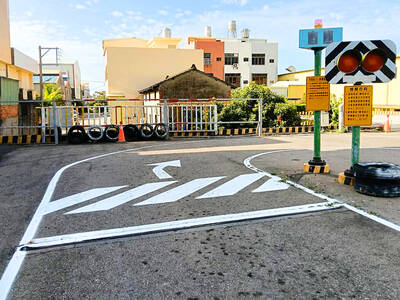
UPDATED TEST: The new rules aim to assess drivers’ awareness of risky behaviors and how they respond under certain circumstances, the Highway Bureau said Driver’s license applicants who fail to yield to pedestrians at intersections or to check blind spots, or omit pointing-and-calling procedures would fail the driving test, the Highway Bureau said yesterday. The change is set to be implemented at the end of the month, and is part of the bureau’s reform of the driving portion of the test, which has been criticized for failing to assess whether drivers can operate vehicles safely. Sedan drivers would be tested regarding yielding to pedestrians and turning their heads to check blind spots, while drivers of large vehicles would be tested on their familiarity with pointing-and-calling


 RSS
RSS