


With pressure mounting on the administration of US President Barack Obama to release the 66 F-16C/D aircraft requested by Taipei, Chinese officials have threatened that such a sale would cross a so-called “red line” that risked damaging relations between Beijing and Washington.
As defense experts and officials endeavor to explain Washington’s reluctance to release the fighter aircraft — touted as necessary to maintain a balance of air power in the Taiwan Strait — many have concluded that crossing Beijing’s red line would come at an unbearable cost to the US. However, beyond Beijing’s threat of once again suspending military exchanges with the US, the consequences of crossing the red line remain largely undefined.
When asked by the Taipei Times to help define what those costs might entail, a number of experts seemed to agree on the following conclusion: Not only would Beijing have limited retaliatory options, but the US could mitigate their impact with relative ease.
Furthermore, if the past 20 years of cross-strait negotiations are any indication, there is no correlation between major US arms sales to Taiwan and a chill in relations between Taipei and Beijing — in fact, major arms packages released in 1992, 2008 and last year were accompanied by diplomatic breakthroughs across the Strait.
“The only country that has talked about the red line is China,” said US-Taiwan Business Council president Rupert Hammond-Chambers, whose organization is closely involved in the arms sale process. “However, it has failed to identify what the implications of crossing the red line are.”
Some of the possible retaliatory measures advanced by China watchers include the sale of Chinese missile technology to “rogue” states such as Iran, Pakistan and North Korea, or a hardening Chinese policy in the South China Sea.
LIMITED OPTIONS
Following the announcement of a major arms package in January last year, senior People’s Liberation Army (PLA) officials also proposed, among other punishments, that Beijing sell large amounts of US Treasury bonds (which some Chinese media have described in a different context as a “nuclear option”).
However, such actions would not be beyond Washington’s ability to manage or to retaliate against, and there is doubt as to whether China would always follow through on its threats, the experts said.
“Beijing has been pushing a red line policy since the 1990s vis-a-vis former president Chen Shui-bian (陳水扁), the Dalai Lama and so on,” Willy Lam (林和立), a China specialist at the Chinese University of Hong Kong, told the Taipei Times. “[French President Nicolas] Sarkozy was ‘punished’ for seeing the Dalai Lama a few years ago, but the two nations have patched up since.”
Regarding the F-16s specifically, Lam said he did not see Beijing going beyond its usual saber rattling.
“I don’t think Beijing will do anything irrational, such as selling T bills, if the US were to sell the F-16s. When Washington announced the US$6.4 billion package in January 2010, Beijing vowed to penalize Boeing and other US arms manufacturers, but never carried out the threat,” he said.
For Hammond-Chambers, the most likely scenario following the release of the F-16s would be the suspension of military exchanges.
“The Chinese act in their own ‘core interest’ and are not typically swayed in the long term by short-term bilateral bumps,” he said. “Therefore, it is likely there will be no change to China’s overall policies toward other non-Taiwan policy areas and that their sole substantive action [in retaliation for the release of the F-16s] will be a further freeze of [military-to-military] contacts between the US and China.”
Rick Fisher, a senior fellow at the International Assessment and Strategy Center in Washington, said China would likely respond by intensifying many of the existing behaviors and trends that have long justified weapon sales to Taiwan.
“The immediate goal [for China] would be to portray the US as the ‘military aggressor,’” he said.
As for signaling its displeasure to Taiwan, Beijing would likely raise the level of Chinese public awareness of Taiwan-related war preparations, as well as increase media attention to new weapons, exercises and mobilization, Fisher said.
LONG-DISTANCE THREAT
However, Beijing’s strategy appears to center far more on threatening punishment to the distant enemy in Washington than the proximate one in Taipei.
“China has never taken punitive actions against Taiwan in the past for purchasing arms from the US,” said Bonnie Glaser, a senior fellow at the Center for Strategic and International Studies. “The Chinese consider it to be a US-China issue and a mistaken American policy.”
If past behavior is any guide, Beijing would probably not punish Taipei over an F-16 release, and could in fact react by intensifying cross-strait negotiations. Part of what motivates Beijing to do so is the recognition that arms sales are about far more than the delivery of weaponry — in fact, the weapons are not even the main issue.
Fu Mei (梅復興), director of the US-based Taiwan Security Analysis Center, said China’s real problem with the F-16C/D sale is that it represents continued US political support and de facto, if not almost de jure, recognition of Taipei as a legitimate and independent political entity.
“This is precisely the reason why Taipei wants the F-16C/D sale,” Mei said. “Besides the superficial justification that new F-16C/Ds are needed to replace aging equipment and maintain a minimal level of defense capability — which we’re not even sure [President Ma Ying-jeou’s (馬英九)] team actually believes in — the Ma administration is pursuing this mainly for two reasons: Ma wants to be able to produce credentials that show he is not weak on defense in the run-up to the presidential election … [and] in anticipation of having to deal with the issue of Beijing’s increasingly impatient pressure for political dialogue in his second term, Ma desperately needs to start hoarding his bargaining chips, and overt symbols of US support for Taipei are considered highly desirable.”
“That is why Beijing has been, principally through private channels, intimating to Washington that an F-16C/D sale would trip a red line,” Mei said, drawing attention to a warning by PLA Chief of General Staff Chen Bingde (陳炳德) during his visit to the US last month.
ONLY TARGET
As to why the new F-16s are the object of China’s red line, the answer is very simple, another defense expert said: It is the only defense procurement item of note on the table, not because Beijing fears they would dramatically alter the balance of power in the Taiwan Strait.
However, the fear that the sale of F-16s would derail cross-strait rapprochement is such that, on some occasions, officials from the Taiwanese side have called for the plan to be dropped.
In 2008, Ma’s future National Security Council secretary-general Su Chi (蘇起) reportedly asked the US side (all the way up to former US vice president Dick Cheney) not to go ahead with the F-16 sale, as cross-strait talks were being planned for later that year, thus sending mixed signals about the Ma administration’s commitment to the sale.
However, if Beijing’s threats fail and Washington proceeds with foreign military sales to Taiwan, contrary to what Su and others fear, all the evidence points to Beijing responding by creating the conditions for rapprochement with Taipei to negate the political significance of the sale.
PRECEDENT
During the past 20 years, three major packages for Taiwan were released by Washington. On all three occasions, relations between Taipei and Beijing, rather than suffering, improved markedly.
The first major package, notified to the US Congress on Sept. 14, 1992, involved the 150 F-16A/Bs that currently constitute the bulk of Taiwan’s fighter fleet, as well as its first Patriot missile firing units. Two months later, in November 1992, the Straits Exchange Foundation (SEF) and the Association for Relations Across the Taiwan Strait (ARATS) held a preparatory meeting in Hong Kong, from which the so-called “1992 consensus” is alleged to have emerged. In April the following year, then-SEF chairman Koo Chen-fu (辜振甫) met then-ARATS chairman Wang Daohan (汪道涵) in Singapore for groundbreaking talks.
On Nov. 4, 2008, ARATS Chairman Chen Yunlin (陳雲林) made his first visit to Taiwan, the first in a series of meetings launched after Ma’s inauguration. Almost exactly one month earlier, on Oct. 3, the US announced a US$3.1 billion sale of 330 PAC-3 missiles to Taiwan.
Then, on Jan. 29 last year, the US announced a US$6.4 billion arms package to Taiwan, just three days after the first round of Economic Cooperation Framework Agreement (ECFA) talks. Rather than retaliate against Taipei for the arms sale by scuttling negotiations on a trade pact portrayed as necessary for Taiwan, the following month Beijing confirmed the second round of talks would be held later that month. The ECFA was signed in June last year.
Taiwan, it seems, was able to weather Beijing’s anger over the arms sales, and experts say Washington could too.
“There are precious few voices in China who argue that Beijing should shrug its shoulders, take the high ground and say that it [arms sales] doesn’t matter because cross-strait relations are trending in the right direction,” Glaser said.
“But at the end of the day could the US and China weather the storm? Absolutely,” she added.
Since the 1970s, Beijing has drawn numerous red lines, as with the PAC-3s, a sale some Chinese officials said would mean “war.”
In the end, the US crossed the line and the relationship between the two, despite minor bumps, flourished. As with the F-16s, China dreaded the PAC-3 sale not so much because of the missile defense system’s military effectiveness, but rather that it necessitated linkage with US radar and satellites, which had political significance.
Beijing is too dependent on the stability of the international system and ultimately on the US to be able to retaliate in a manner that would prevent Washington honoring its commitments under the Taiwan Relations Act, a defense expert with years of involvement in arms sales to Taiwan told the Taipei Times on background.

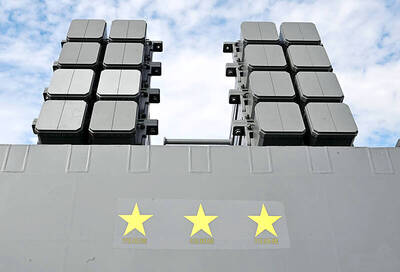
UPGRADE: The Kang Ding-class frigate is replacing its Chaparall missiles with Tien Chien II and Hua Yang VLS, which would provide it with long-range, 360° air defense Taiwan plans to produce 1,200 to 1,376 Hai Chien II missiles (海劍二, Sea Sword II) — also known as TC-2N — to serve as the standard air defense system of the navy’s surface combatant fleet, a source said yesterday. Last week, the Hai Chien II, the naval version of the Tien Kung II missile (天劍二, Sky Sword II), completed a live-fire test in waters off the National Chungshan Institute of Science and Technology’s Jiupeng facility (九鵬) in Pingtung County’s Manjhou Township (滿州). The MIM72 Chaparral and other dated air defense missiles that currently arm Taiwanese ships have inadequate range to combat Chinese

REASONS FOR TRAVEL: An assistant professor said that proposed amendments to penalize drivers if they used drugs overseas would not deter people from traveling People who operate a motor vehicle under the influence of marijuana would have their driver’s license revoked, even if they used the substance while overseas, the Ministry of Transportation and Communications said yesterday, citing proposed amendments to the Road Traffic Management and Penalty Act (道路交通管理處罰條例). The amendments would also authorize the government to revoke the licenses of people determined to have used Category 1 or Category 2 narcotics, even if they were not operating a vehicle while under the influence of drugs, as well as ban them from taking the license test for three years, the ministry said. People aged 18 or
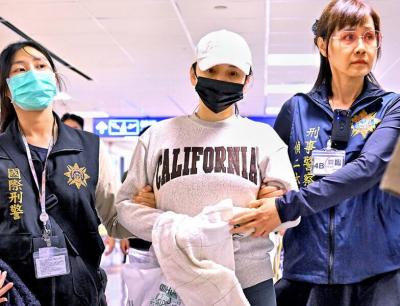
Johanne Liou (劉喬安), a Taiwanese woman who shot to unwanted fame during the Sunflower movement protests in 2014, returned to Taiwan last night after being deported from the US. She is to stand trial in Taiwan for charges involving embezzlement, fraud and drug crimes. The Criminal Investigation Bureau (CIB) said it took her into custody at Taiwan Taoyuan International Airport and would first question her before transferring her to the New Taipei District Prosecutors’ Office. She was arrested upon disembarking a flight from San Francisco that landed shortly before 7pm. Liou absconded to the US in 2019 after jumping bail
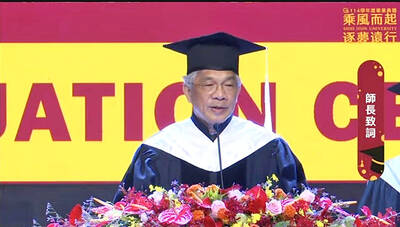
Shih Hsin University President Chen Ching-he (陳清河) yesterday issued a public apology for comments made in his commencement speech last week, stating that he has asked the school to suspend his duties and halt his wages for two months as a show of contrition. At the commencement ceremony on May 30, Chen said, “If you don’t manage your time well, or your own emotions, or your health, then I am telling every one of you — put a quick end to ‘you,’ because the world has no need for ‘you.’” The comments have sparked significant controversy online, and Chen through an open


 RSS
RSS