


Women are “ready” and “prepared” to take the nation’s presidency and put to rest traditional concepts about them, Democratic Progressive Party (DPP) presidential hopeful Tsai Ing-wen (蔡英文) said yesterday.
“Our time has come and we are ready,” Tsai told a discussion on female empowerment at the Garden of Hope Foundation in Taipei. “Next year will be an important test as to whether Taiwanese society can overcome traditional ideas about women and accept a female leader. There are people who wonder whether it is possible ... but I believe that the end result will be a good one.”
The remarks drew applause as Tsai, the nation’s first female presidential candidate representing a major political party, seeks more support among female voters — a demographic evenly split between her and President Ma Ying-jeou (馬英九), recent polls showed.

Photo: CNA
Responding to questions on whether women in politics faced greater difficulties, Tsai said that “surprisingly,” female candidates had been treated more favorably in the political arena, adding that more women should become involved.
“Many times we hear people say that as long as it is a female with a high level of education and good looks, she will be elected. In other words, society is starting to have a more favorable impression of female politicians,” she said.
Tsai has largely downplayed the gender issue before the upcoming campaign, which is expected to pick up in earnest in the next two months. Yesterday was one of the few occasions where she spoke on the subject.
Tsai also commented on a report by the Chinese-language Want Daily saying Beijing had been exerting pressure on the DPP and Tsai through the American Institute in Taiwan (AIT) to accept the so-called “1992 consensus.”
The controversial consensus refers to a supposed understanding reached during a meeting in Hong Kong in 1992 between Taiwanese and Chinese representatives, under which both sides claim to have acknowledged that there was “one China,” with each side having its own interpretation of what “one China” means.
The DPP insists that the “1992 consensus” does not exist.
In 2006, former Mainland Affairs Council chairman Su Chi (蘇起) admitted he made up the term in 2000 before the Chinese Nationalist Party (KMT) handed power over to the DPP.
The Want Daily quoted unnamed sources as saying that the matter was discussed between a Chinese Taiwan Affairs Office official and AIT Chairman Raymond Burghardt in New York last week.
Saying she wasn’t clear on the issue, Tsai, however, countered that “China should spend some time understanding the substance of Taiwan’s democracy,” adding that changes in administrations and policies were a “common routine” in democratic politics.
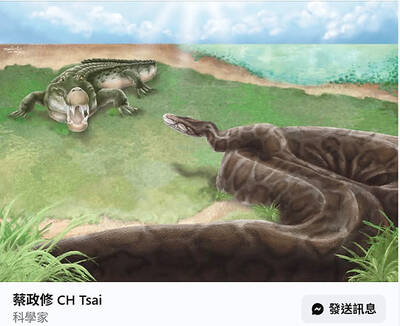
Taiwanese paleontologists have discovered fossil evidence that pythons up to 4m long inhabited Taiwan during the Pleistocene epoch, reporting their findings in the international scientific journal Historical Biology. National Taiwan University (NTU) Institute of Ecology and Evolutionary Biology associate professor Tsai Cheng-hsiu (蔡政修) led the team that discovered the largest snake fossil ever found in Taiwan. The single trunk vertebra was discovered in Tainan at the Chiting Formation, dated to between 400,000 and 800,000 years ago in the Middle Pleistocene, the paper said. The area also produced Taiwan’s first avian fossil, as well as crocodile, mammoth, saber-toothed cat and rhinoceros fossils, it said. Discoveries

Taiwanese paleontologists have discovered fossil evidence that pythons up to 4m long inhabited Taiwan during the Pleistocene epoch, reporting their findings in the international scientific journal Historical Biology. National Taiwan University (NTU) Institute of Ecology and Evolutionary Biology associate professor Tsai Cheng-hsiu (蔡政修) led the team that discovered the largest snake fossil ever found in Taiwan. A single trunk vertebra was discovered in Tainan at the Chiting Formation, dated to between 800,000 to 400,000 years ago in the Middle Pleistocene, the paper said. The area also produced Taiwan’s first avian fossil, as well as crocodile, mammoth, sabre-toothed cat and rhinoceros fossils, it said. Discoveries
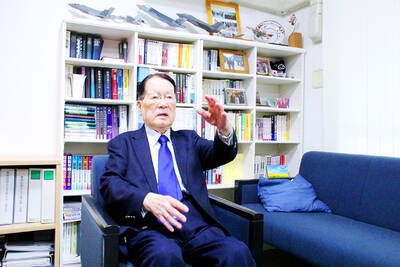
Whether Japan would help defend Taiwan in case of a cross-strait conflict would depend on the US and the extent to which Japan would be allowed to act under the US-Japan Security Treaty, former Japanese minister of defense Satoshi Morimoto said. As China has not given up on the idea of invading Taiwan by force, to what extent Japan could support US military action would hinge on Washington’s intention and its negotiation with Tokyo, Morimoto said in an interview with the Liberty Times (sister paper of the Taipei Times) yesterday. There has to be sufficient mutual recognition of how Japan could provide

UPDATED TEST: The new rules aim to assess drivers’ awareness of risky behaviors and how they respond under certain circumstances, the Highway Bureau said Driver’s license applicants who fail to yield to pedestrians at intersections or to check blind spots, or omit pointing-and-calling procedures would fail the driving test, the Highway Bureau said yesterday. The change is set to be implemented at the end of the month, and is part of the bureau’s reform of the driving portion of the test, which has been criticized for failing to assess whether drivers can operate vehicles safely. Sedan drivers would be tested regarding yielding to pedestrians and turning their heads to check blind spots, while drivers of large vehicles would be tested on their familiarity with pointing-and-calling


 RSS
RSS