


President Ma Ying-jeou (馬英九) yesterday defended Taiwan’s participation in the annual World Health Assembly (WHA), and said the government would seek to join more international organizations via the WHA model.
Amid challenges from the Democratic Progressive Party (DPP) about the government’s protest over the WHO addressing Taiwan as “a province of China” in an internal memo, Ma said the people should cherish the nation’s participation in the international health body and work together to strive for more achievements in the field of health.
Despite continuous difficulties participating in international organizations, Taiwan returned to the WHA in 2009 under the official title of “Chinese Taipei” and was able to participate in the assembly, rather than limited to technical meetings, Ma said.
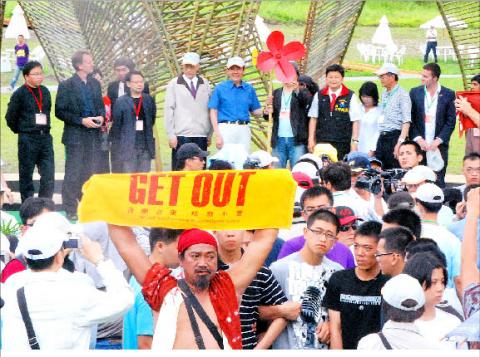
Photo: CNA
“Although Taiwan still faces many difficulties in taking part in international activities, it has gradually made a breakthrough,” Ma said.
“We will copy our experience of participating in the WHA and join more international organizations on the basis of that model. -Hopefully, Taiwanese will cherish the achievements we have made over the years and strive for more rights for the nation,” he said when meeting with medical staff at Mackay Memorial Hospital.
The revelation of the memo sparked challenges from the DPP over the nation’s sovereignty under the Ma administration. The DPP also demanded a boycott of the WHA meeting.
The Ma administration ignored such criticism and sent Department of Health Minister Chiu Wen-ta (邱文達) to attend the annual meeting last week.
Chiu, who returned to Taiwan on Friday, also attended the event yesterday.
In a letter dated Saturday last week to WHO Director-General Margaret Chan (陳馮富珍), which he signed off by addressing himself as “Minister of Department of Health, Chinese Taipei,” Chiu protested “improper procedures and erroneous terminology” used in the leaked WHO memo from last year. Yesterday Chiu said that his protest letter had made the nation’s stance clear during the WHA and urged the DPP to work with the government in defending Taiwanese sovereignty.
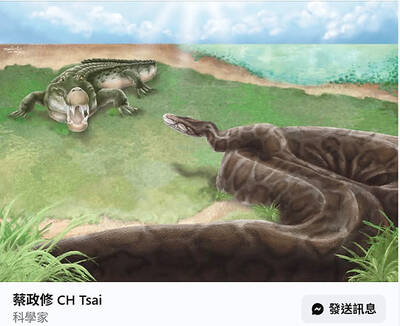
Taiwanese paleontologists have discovered fossil evidence that pythons up to 4m long inhabited Taiwan during the Pleistocene epoch, reporting their findings in the international scientific journal Historical Biology. National Taiwan University (NTU) Institute of Ecology and Evolutionary Biology associate professor Tsai Cheng-hsiu (蔡政修) led the team that discovered the largest snake fossil ever found in Taiwan. The single trunk vertebra was discovered in Tainan at the Chiting Formation, dated to between 400,000 and 800,000 years ago in the Middle Pleistocene, the paper said. The area also produced Taiwan’s first avian fossil, as well as crocodile, mammoth, saber-toothed cat and rhinoceros fossils, it said. Discoveries

Taiwanese paleontologists have discovered fossil evidence that pythons up to 4m long inhabited Taiwan during the Pleistocene epoch, reporting their findings in the international scientific journal Historical Biology. National Taiwan University (NTU) Institute of Ecology and Evolutionary Biology associate professor Tsai Cheng-hsiu (蔡政修) led the team that discovered the largest snake fossil ever found in Taiwan. A single trunk vertebra was discovered in Tainan at the Chiting Formation, dated to between 800,000 to 400,000 years ago in the Middle Pleistocene, the paper said. The area also produced Taiwan’s first avian fossil, as well as crocodile, mammoth, sabre-toothed cat and rhinoceros fossils, it said. Discoveries
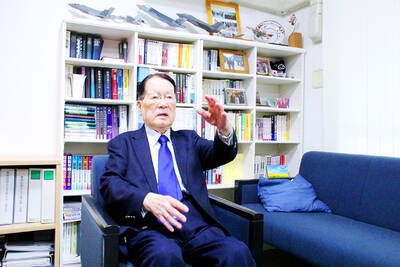
Whether Japan would help defend Taiwan in case of a cross-strait conflict would depend on the US and the extent to which Japan would be allowed to act under the US-Japan Security Treaty, former Japanese minister of defense Satoshi Morimoto said. As China has not given up on the idea of invading Taiwan by force, to what extent Japan could support US military action would hinge on Washington’s intention and its negotiation with Tokyo, Morimoto said in an interview with the Liberty Times (sister paper of the Taipei Times) yesterday. There has to be sufficient mutual recognition of how Japan could provide
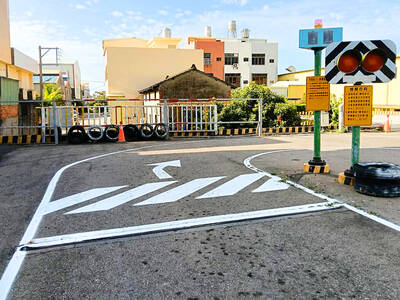
UPDATED TEST: The new rules aim to assess drivers’ awareness of risky behaviors and how they respond under certain circumstances, the Highway Bureau said Driver’s license applicants who fail to yield to pedestrians at intersections or to check blind spots, or omit pointing-and-calling procedures would fail the driving test, the Highway Bureau said yesterday. The change is set to be implemented at the end of the month, and is part of the bureau’s reform of the driving portion of the test, which has been criticized for failing to assess whether drivers can operate vehicles safely. Sedan drivers would be tested regarding yielding to pedestrians and turning their heads to check blind spots, while drivers of large vehicles would be tested on their familiarity with pointing-and-calling


 RSS
RSS