


Democratic Progressive Party (DPP) Chairperson Tsai Ing-wen (蔡英文) officially became the nation’s first female presidential candidate to represent a major party when a DPP committee confirmed her as the party’s candidate yesterday afternoon
Tsai released a statement saying she would reclaim the presidency for the party and steer Taiwan “in the right direction.”
The unanimous decision by a DPP committee follows Tsai’s narrow victory over former premier Su Tseng-chang (蘇貞昌) in the party’s official telephone polls held last week.
Sources who were at the closed-door committee meeting said Tsai was given a rousing ovation after the nomination was made official and no objections were raised.
The committee did not address the issue of Tsai’s running mate.
The confirmation makes Tsai the second official candidate for next year’s presidential election. She will face off against President Ma Ying-jeou (馬英九) of the Chinese Nationalist Party (KMT), who is seeking re-election.
“For Taiwan, the presidential election will be about rebuilding the nation’s values, overturning the route of [this] administration and finding the power of the next generation,” Tsai said in the statement. “To be able to become the DPP’s candidate is an honor and, even more, a responsibility.”
Media polls conducted last week show Tsai holding a slight lead over Ma, but well within the polls’ margins of error. The surveys showed that the public believes her weaknesses include cross-strait issues and economic policy — two areas that Ma is likely to emphasize in the campaign.
Tsai did not address those concerns yesterday, but sought to emphasize that the election wasn’t simply between the DPP and the KMT, or Ma and herself. It was about finding the will to once again lead the nation down the correct path, she said.
“It’s not just about winning. It’s about accumulating the power to change the future during the [election] process. After we regain control, [we will] steer Taiwan back in the right direction,” Tsai’s statement read.
Talking about on the upcoming campaign, she also asked Ma to contest an election based on the spirit of democracy and “reasonable values” — suggesting that such a move would rebuild Taiwanese confidence in the political system.
Tsai is facing a busy month as she shuffles her campaign office and also returns as DPP chairperson -after an extended leave-of-absence. Party officials said she is expected to return to her party post sometime next week.
Her position as both the DPP presidential nominee and leader of the party will likely boost her prospects after a Central Election Commission decision merged the legislative and presidential elections last month.
The combined election will take place on Jan. 14 — the first ever joint elections in Taiwan.
The DPP yesterday also announced its latest round of eight confirmed legislative nominees, which included political commentator Ho Po-wen (何博文) and two former local administrators.
Former Taitung County deputy commissioner Liu Chuan-hao (劉櫂豪) and former Tainan mayor Hsu Tain-tsair (許添財) will both run in their respective areas, DPP spokesperson Lin Yu-chang (林右昌) said.
Ho will run in New Taipei City’s (新北市) Danshui District (淡水), likely against KMT Legislator Wu Yu-sheng (吳育昇), who was involved in an extra-marital affair that dominated the headlines last year.
Sources in the party revealed that the DPP is seeking to recruit baseball star Chao Shih-chiang (趙士強), former general manager of Taiwan Major League, to run in Taipei City’s Da-an District (大安).
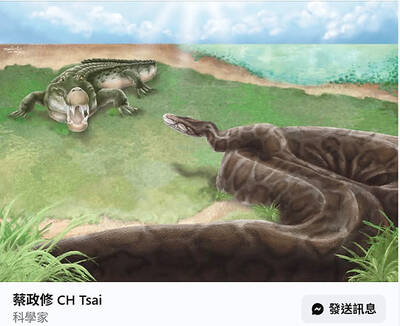
Taiwanese paleontologists have discovered fossil evidence that pythons up to 4m long inhabited Taiwan during the Pleistocene epoch, reporting their findings in the international scientific journal Historical Biology. National Taiwan University (NTU) Institute of Ecology and Evolutionary Biology associate professor Tsai Cheng-hsiu (蔡政修) led the team that discovered the largest snake fossil ever found in Taiwan. The single trunk vertebra was discovered in Tainan at the Chiting Formation, dated to between 400,000 and 800,000 years ago in the Middle Pleistocene, the paper said. The area also produced Taiwan’s first avian fossil, as well as crocodile, mammoth, saber-toothed cat and rhinoceros fossils, it said. Discoveries

Taiwanese paleontologists have discovered fossil evidence that pythons up to 4m long inhabited Taiwan during the Pleistocene epoch, reporting their findings in the international scientific journal Historical Biology. National Taiwan University (NTU) Institute of Ecology and Evolutionary Biology associate professor Tsai Cheng-hsiu (蔡政修) led the team that discovered the largest snake fossil ever found in Taiwan. A single trunk vertebra was discovered in Tainan at the Chiting Formation, dated to between 800,000 to 400,000 years ago in the Middle Pleistocene, the paper said. The area also produced Taiwan’s first avian fossil, as well as crocodile, mammoth, sabre-toothed cat and rhinoceros fossils, it said. Discoveries
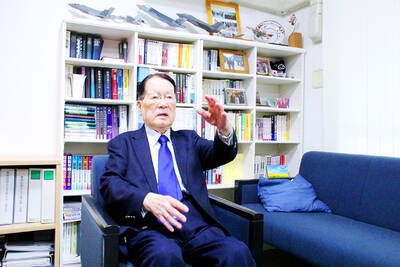
Whether Japan would help defend Taiwan in case of a cross-strait conflict would depend on the US and the extent to which Japan would be allowed to act under the US-Japan Security Treaty, former Japanese minister of defense Satoshi Morimoto said. As China has not given up on the idea of invading Taiwan by force, to what extent Japan could support US military action would hinge on Washington’s intention and its negotiation with Tokyo, Morimoto said in an interview with the Liberty Times (sister paper of the Taipei Times) yesterday. There has to be sufficient mutual recognition of how Japan could provide
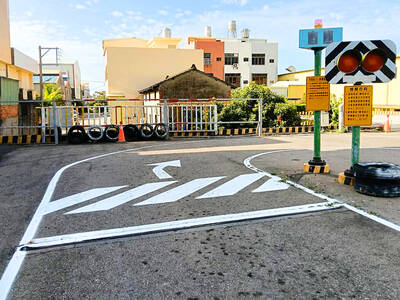
UPDATED TEST: The new rules aim to assess drivers’ awareness of risky behaviors and how they respond under certain circumstances, the Highway Bureau said Driver’s license applicants who fail to yield to pedestrians at intersections or to check blind spots, or omit pointing-and-calling procedures would fail the driving test, the Highway Bureau said yesterday. The change is set to be implemented at the end of the month, and is part of the bureau’s reform of the driving portion of the test, which has been criticized for failing to assess whether drivers can operate vehicles safely. Sedan drivers would be tested regarding yielding to pedestrians and turning their heads to check blind spots, while drivers of large vehicles would be tested on their familiarity with pointing-and-calling


 RSS
RSS