


Closed-door meetings between Democratic Progressive Party (DPP) presidential hopefuls are expected to be held before the end of the month to stave off a possibly damaging split during the primary, party sources said yesterday.
The focus is expected to stay on Tsai Ing-wen (蔡英文), who stepped down temporarily as party chairperson to focus on her campaign, and former premier Su Tseng-chang (蘇貞昌), and on whether a deal can be brokered between the two leading contenders.
Sources close to both campaigns said the closed-door negotiations would likely be modeled on the previous discussions on March 6 that saw participation by other key DPP politicians, including lawmakers and mayors.
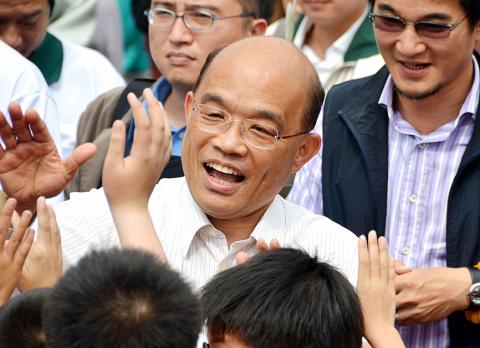
Photo: CNA
An invitation by either Tsai or Su for the other to join in on a vice presidential ticket would likely be on the table, although the offer is not expected to gain much traction.
Another option spearheaded by Su’s campaign that could be discussed involves a handshake agreement that the runner-up in any preliminary polls would back down and support the leading candidate, sources said.
Tsai campaign office spokesperson Hsu Chia-chin (徐佳青) declined to comment on the specific proposals, but expressed cautious optimism over the upcoming talks.
“We hope that we can keep these discussions going. Everybody should have a spirit of yielding a bit for the greater good,” Hsu said.
The meeting would likely be chaired by DPP acting chairperson Ker Chien-ming (柯建銘) or DPP Secretary-General Su Jia-chyuan (蘇嘉全).
Both camps said they hoped that further discussions would lead to concrete measures on the presidential campaign after the closed-door negotiations on March 6 left participants only with calls for party unity.
“Su is open to any kind of talks that are conducive to party unity,” said Lee Hou-ching (李厚慶), a spokesperson for the former premier.
Former vice president Annette Lu (呂秀蓮), a presidential hopeful, is also expected to attend the upcoming talks, having attended the March 6 negotiations.
In addition to the closed-door talks, the DPP is scheduled to hold an official negotiation session on April 6. If the talks fall through, the DPP will hold telephone polls from April 25 to April 29. A final decision on a candidate is expected on May 4.

Taiwanese paleontologists have discovered fossil evidence that pythons up to 4m long inhabited Taiwan during the Pleistocene epoch, reporting their findings in the international scientific journal Historical Biology. National Taiwan University (NTU) Institute of Ecology and Evolutionary Biology associate professor Tsai Cheng-hsiu (蔡政修) led the team that discovered the largest snake fossil ever found in Taiwan. The single trunk vertebra was discovered in Tainan at the Chiting Formation, dated to between 400,000 and 800,000 years ago in the Middle Pleistocene, the paper said. The area also produced Taiwan’s first avian fossil, as well as crocodile, mammoth, saber-toothed cat and rhinoceros fossils, it said. Discoveries

Taiwanese paleontologists have discovered fossil evidence that pythons up to 4m long inhabited Taiwan during the Pleistocene epoch, reporting their findings in the international scientific journal Historical Biology. National Taiwan University (NTU) Institute of Ecology and Evolutionary Biology associate professor Tsai Cheng-hsiu (蔡政修) led the team that discovered the largest snake fossil ever found in Taiwan. A single trunk vertebra was discovered in Tainan at the Chiting Formation, dated to between 800,000 to 400,000 years ago in the Middle Pleistocene, the paper said. The area also produced Taiwan’s first avian fossil, as well as crocodile, mammoth, sabre-toothed cat and rhinoceros fossils, it said. Discoveries
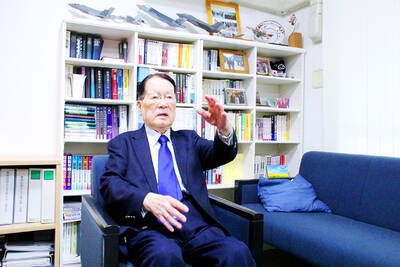
Whether Japan would help defend Taiwan in case of a cross-strait conflict would depend on the US and the extent to which Japan would be allowed to act under the US-Japan Security Treaty, former Japanese minister of defense Satoshi Morimoto said. As China has not given up on the idea of invading Taiwan by force, to what extent Japan could support US military action would hinge on Washington’s intention and its negotiation with Tokyo, Morimoto said in an interview with the Liberty Times (sister paper of the Taipei Times) yesterday. There has to be sufficient mutual recognition of how Japan could provide
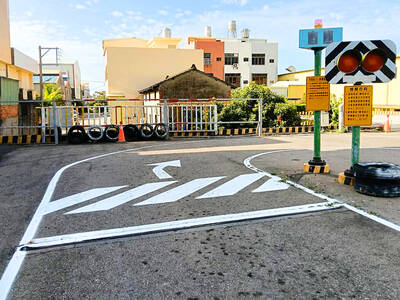
UPDATED TEST: The new rules aim to assess drivers’ awareness of risky behaviors and how they respond under certain circumstances, the Highway Bureau said Driver’s license applicants who fail to yield to pedestrians at intersections or to check blind spots, or omit pointing-and-calling procedures would fail the driving test, the Highway Bureau said yesterday. The change is set to be implemented at the end of the month, and is part of the bureau’s reform of the driving portion of the test, which has been criticized for failing to assess whether drivers can operate vehicles safely. Sedan drivers would be tested regarding yielding to pedestrians and turning their heads to check blind spots, while drivers of large vehicles would be tested on their familiarity with pointing-and-calling


 RSS
RSS