


A majority of Taiwanese are unhappy with President Ma Ying-jeou’s (馬英九) performance in office, with both his popularity and public trust levels dropping this month, a poll by the Chinese-language Global Views magazine showed yesterday.
The poll, conducted on last Monday and Tuesday, showed that 52 percent of respondents were unhappy with Ma’s overall performance, compared with 35 percent who said they were satisfied. This represented a 3 percent drop in satisfaction with Ma and a 0.7 percent increase in dissatisfaction with his performance.
Meanwhile, Ma’s trust level was 42.4 percent, a drop of 3 percent from last month.
More than 43 percent of respondents said they did not trust him, a rise of 3.1 percent.
Although the Chinese Nationalist Party (KMT), of which Ma is chairman, controls nearly 70 percent of the legislative seats, more than 58 percent of respondents said they were not satisfied with the overall performance of KMT legislators, compared with 21.9 percent who were satisfied.
This marked a rise of 3.9 percent in dissatisfaction, while satisfaction fell 7.9 percent. The 7.9 percent drop was the second highest since legislators began their four-year term in 2008 after an 8 percent drop in March 2009.
Respondents said the KMT should see its recent losses in the legislative by-elections in Greater Kaohsiung and Greater Tainan earlier this month as a warning.
The poll surveyed 1,018 adults nationwide with a margin of error of plus and minus 3.1 percent.
Meanwhile, former president Chen Shui-bian (陳水扁) said he doubted the Democratic Progressive Party’s (DPP) recent election victories would carry over to the presidential election next year.
Chen said in his latest newsletter, released by his office yesterday, that Tsai Ing-wen (蔡英文), who temporarily stepped down as party chairperson to focus on her presidential election campaign, saw the legislative by-elections in Greater Kaohsiung and Greater Tainan as a an important indicator of the legislative and presidential elections.
While there were undeniable signs that the KMT has been in decline — winning only three seats in the 13 legislative by-elections since September 2009 against the DPP’s nine — it remained to be seen whether the momentum could be sustained in the presidential election, Chen said.
As the KMT seemed keen on holding the legislative election in tandem with the presidential poll and implementing absentee voting, Chen said the DPP should not worry that this would make it easier for the KMT to buy votes or that this would put it at a disadvantage.
“In which elections did we not see vote buying? The DPP still has a chance to win, don’t be afraid,” he said. “Even if the legislative and presidential elections are held together, the DPP must win.”
While Tsai hoped her party would become the largest after the legislative election, Chen said he hoped that the DPP would be able to secure half of the legislative seats and win the presidential election.
People interested in making a presidential bid should do so, but if they are defeated, they should run for legislator, Chen said, without naming individuals.
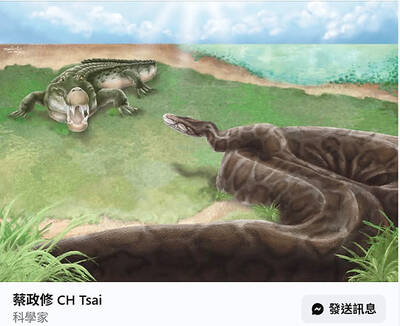
Taiwanese paleontologists have discovered fossil evidence that pythons up to 4m long inhabited Taiwan during the Pleistocene epoch, reporting their findings in the international scientific journal Historical Biology. National Taiwan University (NTU) Institute of Ecology and Evolutionary Biology associate professor Tsai Cheng-hsiu (蔡政修) led the team that discovered the largest snake fossil ever found in Taiwan. The single trunk vertebra was discovered in Tainan at the Chiting Formation, dated to between 400,000 and 800,000 years ago in the Middle Pleistocene, the paper said. The area also produced Taiwan’s first avian fossil, as well as crocodile, mammoth, saber-toothed cat and rhinoceros fossils, it said. Discoveries

Taiwanese paleontologists have discovered fossil evidence that pythons up to 4m long inhabited Taiwan during the Pleistocene epoch, reporting their findings in the international scientific journal Historical Biology. National Taiwan University (NTU) Institute of Ecology and Evolutionary Biology associate professor Tsai Cheng-hsiu (蔡政修) led the team that discovered the largest snake fossil ever found in Taiwan. A single trunk vertebra was discovered in Tainan at the Chiting Formation, dated to between 800,000 to 400,000 years ago in the Middle Pleistocene, the paper said. The area also produced Taiwan’s first avian fossil, as well as crocodile, mammoth, sabre-toothed cat and rhinoceros fossils, it said. Discoveries
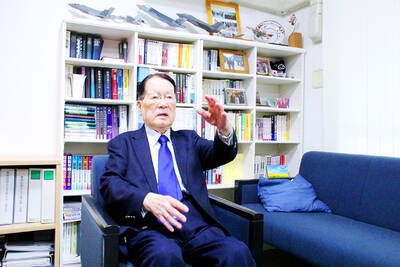
Whether Japan would help defend Taiwan in case of a cross-strait conflict would depend on the US and the extent to which Japan would be allowed to act under the US-Japan Security Treaty, former Japanese minister of defense Satoshi Morimoto said. As China has not given up on the idea of invading Taiwan by force, to what extent Japan could support US military action would hinge on Washington’s intention and its negotiation with Tokyo, Morimoto said in an interview with the Liberty Times (sister paper of the Taipei Times) yesterday. There has to be sufficient mutual recognition of how Japan could provide
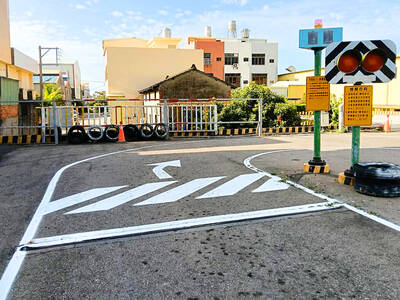
UPDATED TEST: The new rules aim to assess drivers’ awareness of risky behaviors and how they respond under certain circumstances, the Highway Bureau said Driver’s license applicants who fail to yield to pedestrians at intersections or to check blind spots, or omit pointing-and-calling procedures would fail the driving test, the Highway Bureau said yesterday. The change is set to be implemented at the end of the month, and is part of the bureau’s reform of the driving portion of the test, which has been criticized for failing to assess whether drivers can operate vehicles safely. Sedan drivers would be tested regarding yielding to pedestrians and turning their heads to check blind spots, while drivers of large vehicles would be tested on their familiarity with pointing-and-calling


 RSS
RSS