


Nearly 200 Tibetans and Taiwanese yesterday took to the streets in Taipei to voice their support for the independence and freedom of Tibet, while remembering those Tibetans who sacrificed their lives in an uprising against Chinese occupation of their country in 1959.
“Tibetans want to go home! The Dalai Lama wants to go home!” the crowd shouted as they marched. “Tibet belongs to Tibetans! Chinese Communist Party [CCP] get out of Tibet!”
Before the parade began, Tibetans performed a skit to show China’s repression of Tibetans.
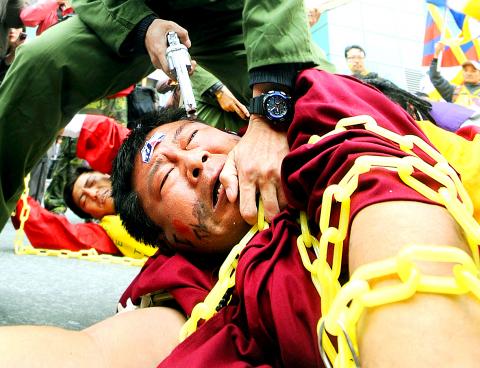
Photo: Fang Pin-chao, Taipei Times
As the crowd rallied near Zhongxiao Fuxing MRT Station, three Tibetans dressed in traditional outfits ran out of the crowd, shouting “Free Tibet” and “Independence for Tibet.”
Soon, four others dressed in Chinese military uniforms ran after them, took them down, covered their mouths, tied them up with chains and pointed pistols at their heads.
“The ‘skit’ that the Tibetans just performed is not really a ‘skit,’ because it’s something that has happened a lot during the past decades to Tibetans living within Tibet under Chinese occupation,” said Son Yu-lian (孫友聯), secretary-general of the Taiwan Labour Front, which was one of several civic groups taking part in the Free Tibet parade.
Speaking to the demonstrators, Taiwan Friends of Tibet (TFOT) president Chow Mei-li (周美里) said that Tibetan spiritual leader the Dalai Lama’s announcement earlier in the week that he would retire from exile government functions was a “slap at the CCP regime.”
“Traditionally, the Dalai Lama serves as both the spiritual and political leader of Tibet, and never retires,” Chow said. “But now, even the Dalai Lama has announced his retirement — we want to ask when is the CCP government going to retire?”
She added that the current Dalai Lama had pushed for democratic reforms in exile, leading to the elections of a legislative body and the government-in-exile through popular votes by Tibetans living in exile. In addition to the mostly adult demonstrators, there was also a high school student, Own Ching-ning (翁慶寧), who came from Taoyuan to join the parade.
“It’s just natural for us Taiwanese to join the Tibetans in their struggle for freedom, because we’re all facing the same threat — China,” Own said. “Although many people may think it’s the business of the grown-ups to support the free Tibet movement, I think people in high school are old enough to show care for the world.”
Jesse Duffield, a New Zealander who has been living in Taiwan for four years, said he has participated in many events related to the Tibetan cause, “because of my support for the Tibetans’ right to determine their own future as an independent nation.”
Besides showing their support for Tibet’s freedom, the demonstrators also observed a minute of silence and prayed for people in Japan who are suffering from the devastation brought by a massive earthquake and tsunami on Friday.

UPGRADE: The Kang Ding-class frigate is replacing its Chaparall missiles with Tien Chien II and Hua Yang VLS, which would provide it with long-range, 360° air defense Taiwan plans to produce 1,200 to 1,376 Hai Chien II missiles (海劍二, Sea Sword II) — also known as TC-2N — to serve as the standard air defense system of the navy’s surface combatant fleet, a source said yesterday. Last week, the Hai Chien II, the naval version of the Tien Kung II missile (天劍二, Sky Sword II), completed a live-fire test in waters off the National Chungshan Institute of Science and Technology’s Jiupeng facility (九鵬) in Pingtung County’s Manjhou Township (滿州). The MIM72 Chaparral and other dated air defense missiles that currently arm Taiwanese ships have inadequate range to combat Chinese

REASONS FOR TRAVEL: An assistant professor said that proposed amendments to penalize drivers if they used drugs overseas would not deter people from traveling People who operate a motor vehicle under the influence of marijuana would have their driver’s license revoked, even if they used the substance while overseas, the Ministry of Transportation and Communications said yesterday, citing proposed amendments to the Road Traffic Management and Penalty Act (道路交通管理處罰條例). The amendments would also authorize the government to revoke the licenses of people determined to have used Category 1 or Category 2 narcotics, even if they were not operating a vehicle while under the influence of drugs, as well as ban them from taking the license test for three years, the ministry said. People aged 18 or

HEAVY WEATHER: Typhoon Jangmi is due to crash straight into the Ryukyus as airlines look to shift flights to larger aircraft or cancel flights to Okinawa entirely Taiwan’s international air carriers announced flight adjustments over the weekend as Typhoon Jangmi is forecast to hit the Ryukyu Islands today and tomorrow. The Central Weather Administration (CWA) upgraded Jangmi from a tropical storm to a typhoon at 8am yesterday, with the eye located 580km south of Naha city. It was moving north at 19kph. Today, China Airlines’ CI-120, CI-121, CI-122 and CI-123 flights between Taoyuan and Naha, Okinawa, have been canceled as well as CI-132 and CI-133 between Kaohsiung and Naha. EVA Air’s BR-112, BR-113, BR-186 and BR-185 flights between Taoyuan and Naha are also canceled. Low-cost carrier Tigerair Taiwan canceled IT-230,
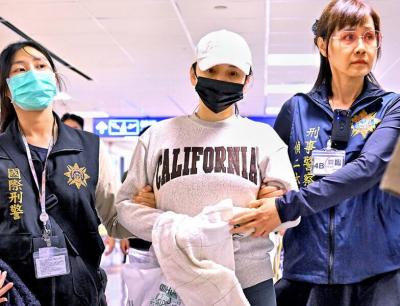
Johanne Liou (劉喬安), a Taiwanese woman who shot to unwanted fame during the Sunflower movement protests in 2014, returned to Taiwan last night after being deported from the US. She is to stand trial in Taiwan for charges involving embezzlement, fraud and drug crimes. The Criminal Investigation Bureau (CIB) said it took her into custody at Taiwan Taoyuan International Airport and would first question her before transferring her to the New Taipei District Prosecutors’ Office. She was arrested upon disembarking a flight from San Francisco that landed shortly before 7pm. Liou absconded to the US in 2019 after jumping bail


 RSS
RSS