


The Ministry of Transportation and Communications said yesterday it had mobilized more than 2,000 Netizens via Facebook to identify incorrectly translated or misspelled bilingual signs on the highways and freeways as well as in scenic areas around the nation.
The ministry said it had received a total of 140 submissions from -September last year to last month, with 72 of them being valid.
The ministry said that 81 cases were related to signs made by its own bureaus, whereas 59 cases involved signs produced by other government agencies. Ministry of Transportation and Communications Deputy Minister Yeh Kuang-shih (葉匡時) said that as the nation aims to become a tourist nation, it has been trying to correct some of the ill-translated signs.
“In the past, the ministry was more passive about this matter. We only started correcting signs either after media reported them or people complained about them,” he said.
Yeh said the event showed that the ministry has taken an active approach to addressing the issue.
“More than 2,000 Netizens spent four months finding only 72 valid cases,” he added. “This showed that problems with bilingual signs in this nation are not as serious as some people might think.”
Meanwhile, the ministry gave out Wiis or other electronic products to the Netizens as gifts for making an effort to identify the problematic translations.
Liu Hou-jun (劉厚君), and his wife topped the list of those identifying the most badly translated signs. Because they could not attend the award ceremony yesterday, Liu’s sister accepted the gifts on their behalf.
“They [the couple] would travel to small towns in Tainan and Kaohsiung over the weekend and pay special attention to the signs,” Liu’s sister said.
Among some of the interesting findings, the lemon aiyu jelly (檸檬愛玉) was translated into “The lemon loves the jade.” The steamed pork bun (肉包), on the other hand, was translated into “fresh meat package.” Uni-President drinks containing lactic acid bacteria were translated as “Good fungus very much.”

Kenting National Park service technician Yang Jien-fon (楊政峰) won a silver award in World Grand Prix Photography Awards Spring Season for his photograph of two male rat snakes intertwined in combat. Yang’s colleagues at Kenting National Park said he is a master of nature photography who has been held back by his job in civil service. The awards accept entries in all four seasons across six categories: architectural and urban photography, black-and-white and fine art photography, commercial and fashion photography, documentary and people photography, nature and experimental photography, and mobile photography. Awards are ranked according to scores and divided into platinum, gold and

More than half of the bamboo vipers captured in Tainan in the past few years were found in the city’s Sinhua District (新化), while other districts had smaller catches or none at all. Every year, Tainan captures about 6,000 snakes which have made their way into people’s homes. Of the six major venomous snakes in Taiwan, the cobra, the many-banded krait, the brown-spotted pit viper and the bamboo viper are the most frequently captured. The high concentration of bamboo vipers captured in Sinhua District is puzzling. Tainan Agriculture Bureau Forestry and Nature Conservation Division head Chu Chien-ming (朱健明) earlier this week said that the

NAMING SPAT: The foreign ministry called on Denmark to propose an acceptable solution to the erroneous nationality used for Taiwanese on residence permits Taiwan has revoked some privileges for Danish diplomatic staff over a Danish permit that lists “Taiwan” as “China,” Eric Huang (黃鈞耀), head of the Ministry of Foreign Affairs’ Department of European Affairs, told a news conference in Taipei yesterday. Reporters asked Huang whether the Danish government had responded to the ministry’s request that it correct the nationality on Danish residence permits of Taiwanese, which has been listed as “China” since 2024. Taiwan’s representative office in Denmark continues to communicate with the Danish government, and the ministry has revoked some privileges previously granted to Danish representatives in Taiwan and would continue to review
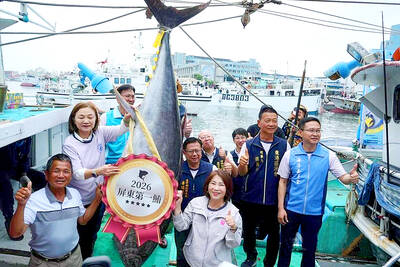
The first bluefin tuna of the season, brought to shore in Pingtung County and weighing 190kg, was yesterday auctioned for NT$10,600 (US$333.5) per kilogram, setting a record high for the local market. The auction was held at the fish market in Donggang Fishing Harbor, where the Siaoliouciou Island-registered fishing vessel Fu Yu Ching No. 2 delivered the “Pingtung First Tuna” it had caught for bidding. Bidding was intense, and the tuna was ultimately jointly purchased by a local restaurant and a local company for NT$10,600 per kilogram — NT$300 ,more than last year — for a total of NT$2.014 million. The 67-year-old skipper


 RSS
RSS