


The Tourism Bureau yesterday launched its new global campaign slogan — “Taiwan — The Heart of Asia” — as well as a new theme song, setting the tone for tourism campaign strategies in the years to come. The bureau had been using “Taiwan, Touch Your Heart” as its global campaign motto since 2000.
Aside from the slogan, the new campaign also features a heart containing some of the crucial elements of Taiwan, including food, culture, festive events and biodiversity.
All of the bureau’s campaign materials published in the future will feature the new campaign logos, the bureau said.
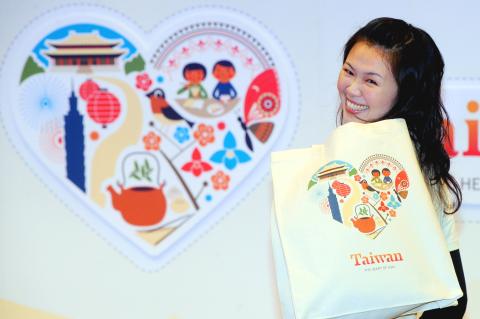
Photo: Lu Chun-wei, Taipei Times
Minister of Transportation and Communications Mao Chi-kuo (毛治國) said the nation reached a major milestone last year by having more than 5 million tourists visit the nation.
“Considering the exponential growth, I believe that the introduction of the new tourism campaign slogan could lead us toward the 10-million mark within three to five years,” he said.
“When you have only 2 million tourists, you are a peripheral market. But when you have 10 million, you become a core market,” he said, adding that the new logo not only shows the nation’s determination, but also its faith in reaching the goal of having 10 million tourists come to visit.
“The international tourists we are talking about here are not those crossing the borders and buying a bottle of water at a 7-Eleven store, like those in Hong Kong or Singapore,” he added. “We are talking about a solid number of people who come to travel in Taiwan.”
Tourism Bureau Director--General Janice Lai (賴瑟珍) said the bureau spent about two years developing the new logo.
“Over the past 10 years, many have been impressed by the old logo,” Lai said. “But we felt the need to find a new brand as we are repositioning ourselves in the market.”
Lai said the bureau first -gathered opinions from government representatives, academics and the tourism industry. It then entrusted a UK-based branding firm Winkreative with the task of executing the actual design work.
To create a sense of continuity, Lai said the new logo keeps the concept of a human heart, which should be where everything begins.
Winkreative chief executive Jerry Fielder said that some successful logos, such as “Incredible India,” were presented in a very graphic and simple manner, adding that the stories they tell are behind the logo, as opposed to having a logo of something that is intrinsically important.
Adding that since the logos from Fiji, Indonesia and Malaysia all look similar, he said the team was trying to make Taiwan different.
Fielder said he had visited -Taiwan about 10 times in the past year and having checked out tourist attractions such as Sun Moon Lake (日月潭) Taroko Gorge (太魯閣) and Alishan (阿里山), he had seen both good and bad and had experienced what he characterized as the “unbelievable warmness of the people.”
Characterizing Taiwan as the heart of Asia is not just in the geographical sense, but also has a spiritual dimension, he added.
“Everything my colleagues and I personally learned in traveling here is that this [Taiwan] is a real secret. This is a very different type of place from some of the other countries in the Far East. This place is all about the people ... The life and dynamic come from the people. You gotta experience them,” Fielder said. “In many ways, [we were] trying to make sure that it [the campaign] is a very human, straightforward and clear assimilation.”

Considering that most countries issue more than five denominations of banknotes, the central bank has decided to redesign all five denominations, the bank said as it prepares for the first major overhaul of the banknotes in more than 24 years. Central bank Governor Yang Chin-lung (楊金龍) is expected to report to the Legislative Yuan today on the bank’s operations and the redesign’s progress. The bank in a report sent to the legislature ahead of today’s meeting said it had commissioned a survey on the public’s preferences. Survey results showed that NT$100 and NT$1,000 banknotes are the most commonly used, while NT$200 and NT$2,000

The Centers for Disease Control (CDC) yesterday reported the first case of a new COVID-19 subvariant — BA.3.2 — in a 10-year-old Singaporean girl who had a fever upon arrival in Taiwan and tested positive for the disease. The girl left Taiwan on March 20 and the case did not have a direct impact on the local community, it said. The WHO added the BA.3.2 strain to its list of Variants Under Monitoring in December last year, but this was the first imported case of the COVID-19 variant in Taiwan, CDC Deputy Director-General Lin Ming-cheng (林明誠) said. The girl arrived in Taiwan on

South Korea is planning to revise its controversial electronic arrival card, a step Taiwanese officials said prompted them to hold off on planned retaliatory measures, a South Korean media report said yesterday. A Yonhap News Agency report said that the South Korean Ministry of Foreign Affairs is planning to remove the “previous departure place” and “next destination” fields from its e-arrival card system. The plan, reached after interagency consultations, is under review and aims to simplify entry procedures and align the electronic form with the paper version, a South Korean ministry official said. The fields — which appeared only on the electronic form

The Ministry of Foreign Affairs (MOFA) is suspending retaliation measures against South Korea that were set to take effect tomorrow, after Seoul said it is updating its e-arrival system, MOFA said today. The measures were to be a new round of retaliation after Taiwan on March 1 changed South Korea's designation on government-issued alien resident certificates held by South Korean nationals to "South Korea” from the "Republic of Korea," the country’s official name. The move came after months of protests to Seoul over its listing of Taiwan as "China (Taiwan)" in dropdown menus on its new online immigration entry system. MOFA last week


 RSS
RSS