


The announcement earlier this week by US Ambassador to China Jon Huntsman that he was resigning from his post to seek the Republican Party’s nomination for the presidential election next year could have substantial implications for Washington’s Taiwan policy.
A billionaire and former governor of Utah, Huntsman was a Mormon missionary in Taiwan from 1987 to 1988 and is said to be fluent in Mandarin and Hoklo (also known as Taiwanese).
While it is far too early to speculate on Huntsman’s chances of winning his party’s nomination, his political campaign could bring issues concerning Taiwan to the fore.
Political insiders said he would formally announce his candidacy late this summer.
Huntsman, 50, told the US Senate Foreign Relations Committee during his confirmation hearings in July 2009 that Taiwan, human rights and Tibet were major problem areas between the US and Beijing and that he expected “robust engagement” on these issues.
He said he felt “personally invested in the peaceful resolution of cross-strait differences, in a way that respects the wishes of the people on both Taiwan and the mainland.”
Huntsman said US policy “supports this objective and I have been encouraged by the recent relaxing of cross-strait tensions.”
Some sources say US President Barack Obama considers Huntsman a formidable opponent and potentially the most difficult-to-defeat candidate the Republicans could field.
US media said Obama appointed Huntsman as ambassador to China in the first place because he believed it would take him out of the presidential race next year, when Obama will be running for a second term.
The attractive and charismatic Huntsman also has a certain star quality that most of the other Republican hopefuls seem to lack.
However, winning the nomination will be an uphill battle because the Republican Party is heavily influenced by conservative Christians who are very wary of Mormons, who don’t like the fact that Huntsman has worked for Obama and who decry the ambassador’s moderate stance on key social issues such as immigration.
The White House confirmed on Tuesday that Huntsman would be returning to Washington in April and the New York Times said he was going to explore “a potential 2012 Republican presidential bid.”
Huntsman, a former ambassador to Singapore, has seven children, including an adopted daughter from China who was abandoned in a vegetable market in Yangzhou, Jiangsu Province.
His fortune comes from the family plastics business, Huntsman Corp.
A Wall Street Journal report said that in 1971, as an 11-year-old, Huntsman accompanied his father, a plastics tycoon and special assistant to then-US president Richard Nixon, to the White House and met then-national security adviser Henry Kissinger as he was heading to the airport on a secret mission to open diplomatic contact with China.
Huntsman recalls being allowed to carry Kissinger’s briefcase to a waiting car.
His campaign for the presidency is almost certain to make a major issue of China policy and arms sales to Taiwan, which he is believed to support.
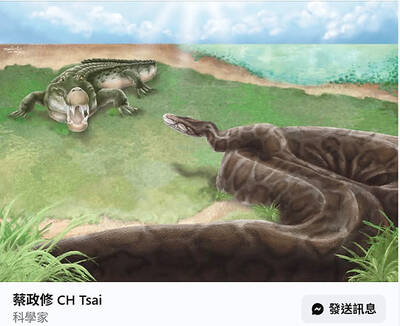
Taiwanese paleontologists have discovered fossil evidence that pythons up to 4m long inhabited Taiwan during the Pleistocene epoch, reporting their findings in the international scientific journal Historical Biology. National Taiwan University (NTU) Institute of Ecology and Evolutionary Biology associate professor Tsai Cheng-hsiu (蔡政修) led the team that discovered the largest snake fossil ever found in Taiwan. The single trunk vertebra was discovered in Tainan at the Chiting Formation, dated to between 400,000 and 800,000 years ago in the Middle Pleistocene, the paper said. The area also produced Taiwan’s first avian fossil, as well as crocodile, mammoth, saber-toothed cat and rhinoceros fossils, it said. Discoveries

Taiwanese paleontologists have discovered fossil evidence that pythons up to 4m long inhabited Taiwan during the Pleistocene epoch, reporting their findings in the international scientific journal Historical Biology. National Taiwan University (NTU) Institute of Ecology and Evolutionary Biology associate professor Tsai Cheng-hsiu (蔡政修) led the team that discovered the largest snake fossil ever found in Taiwan. A single trunk vertebra was discovered in Tainan at the Chiting Formation, dated to between 800,000 to 400,000 years ago in the Middle Pleistocene, the paper said. The area also produced Taiwan’s first avian fossil, as well as crocodile, mammoth, sabre-toothed cat and rhinoceros fossils, it said. Discoveries
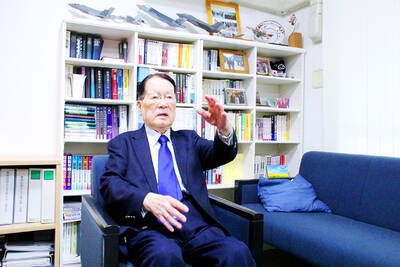
Whether Japan would help defend Taiwan in case of a cross-strait conflict would depend on the US and the extent to which Japan would be allowed to act under the US-Japan Security Treaty, former Japanese minister of defense Satoshi Morimoto said. As China has not given up on the idea of invading Taiwan by force, to what extent Japan could support US military action would hinge on Washington’s intention and its negotiation with Tokyo, Morimoto said in an interview with the Liberty Times (sister paper of the Taipei Times) yesterday. There has to be sufficient mutual recognition of how Japan could provide

UPDATED TEST: The new rules aim to assess drivers’ awareness of risky behaviors and how they respond under certain circumstances, the Highway Bureau said Driver’s license applicants who fail to yield to pedestrians at intersections or to check blind spots, or omit pointing-and-calling procedures would fail the driving test, the Highway Bureau said yesterday. The change is set to be implemented at the end of the month, and is part of the bureau’s reform of the driving portion of the test, which has been criticized for failing to assess whether drivers can operate vehicles safely. Sedan drivers would be tested regarding yielding to pedestrians and turning their heads to check blind spots, while drivers of large vehicles would be tested on their familiarity with pointing-and-calling


 RSS
RSS