


Australian newspapers yesterday revealed that James Sun, an Australian citizen, has been in jail in China for five years after being arrested by Chinese authorities on suspicion of spying for Taiwan.
After serving two years on death row, Sun is now serving a life sentence at Beijing Prison No. 2 in what the Sydney Morning Herald described as “harsh conditions.”
Sun’s wife, who contacted the media this week, said the Australian government had known of her husband’s detention since 2006, but had never made the case public. She was four months pregnant when her husband was convicted of spying for Taiwan, she says.
Reports say that in January 2006, Sun, who worked for an agency recruiting foreign students to Australia, went to China to visit his mother. He was apprehended by state security officials as he was heading out to dinner with friends from his days in the People’s Liberation Army Air Force.
Six days after Sun’s family reported him missing, officials at the Australian embassy in Beijing located Sun at a detention facility operated by the Chinese Ministry of State Security. Chinese authorities accused Sun of “seducing” Yang Delong, a former colleague who was still serving in the air force, into copying more than 1,000 classified documents and passing them on to Taiwanese intelligence, the Herald reported.
Sun’s conviction appears to have relied on his alleged confession and that of Yang. Officials from the Australian embassy were not allowed to attend the trial — which began after Sun had already been detained for 22 months — as it involved matters of state security. Sun also allegedly turned down his court-approved lawyer.
However, embassy officials were allowed to attend the verdict hearing in September 2007 and consular officials have been in constant contact with Sun in prison.
Sun’s wife denies her husband was a spy for Taiwan.
“He’s just a normal person. He’s never been to Taiwan and he doesn’t know anyone from Taiwan,” she told media.
Requests for comment on the case by the Taipei Times yesterday were turned down by the Presidential Office.
The Herald speculated that if Sun’s conviction was based on actual intelligence, this could show that Taiwanese intelligence was at some point recruiting agents from within the Australian Chinese community and that Chinese intelligence were in turn monitoring the Chinese community in Australia.
Though it has not been confirmed that Taiwan was recruiting agents in Australia during former president Chen Shui-bian’s (陳水扁) tenure — the period during which Sun would ostensibly have been approached — under president Ma Ying-jeou (馬英九) Taiwanese intelligence agencies have been ordered to draw down intelligence operations in China.
Sun’s wife, who has launched a letter campaign over her husband’s detention, now hopes the Australian government will pass enabling legislation on the repatriation of prisoners with China, which was signed between the two countries in 2007. Australian authorities say no time frame has been set for the enactment of the law.
The Australian Associated Press (AAP) quoted a spokesman for the Australian attorney general as saying the government was “working to implement the treaty as soon as possible.”
However, whether Beijing would agree to repatriate Sun after the legislation is implemented, and, if so, when this would occur, remains uncertain.
“Certain criteria must be fulfilled and consent from a number of parties is required,” the spokesman said.
Sun’s detention and the government’s inaction in implementing the treaty has sparked anger among Australian political parties, with Australian Greens leader Bob Brown pointing to the unfairness of the Chinese legal system.
“We should not stand by, cautiously and obsequiously, and accept lack of scrutiny of China’s unfair legal system where the government and courts are intertwined,” Brown was quoted by AAP as saying.
Mining executive Stern Hu (胡士泰), another Australian citizen, was sentenced to 10 years in a Chinese prison last year for accepting bribes and stealing commercial secrets in the Rio Tinto scandal.
In November 2008, China executed 59-year-old Wo Weihan (伍維漢), a scientist and businessman who was also accused of spying for Taiwan. Wo’s family, who had made numerous appeals for clemency, claimed Wo had been tortured into making a confession.
The scientist, who was arrested in early 2005, was convicted of passing Chinese military secrets to Taiwan, among other crimes.

FUKUOKA SITUATION: Japanese media reported that the pathogen is expected to be identified by the summer, while the CDC downplayed the idea that it was hMPV A “mysterious cold-like illness” reported in Japan’s Fukuoka Prefecture does not seem to be a new disease, but Japanese authorities have been asked about the situation, the Centers for Disease Control (CDC) said yesterday. The Fukuoka Prefectural Medical Association on Wednesday told a news conference that a “mystery cold” that has become a hot topic on social media is “highly likely to be caused by some kind of viral infection,” Japan’s KBC News reported. “Many people are experiencing symptoms starting with a sore throat, followed by a runny nose, phlegm and a severe cough,” KBC News reported, citing association officials. Health authorities are

Nvidia Corp CEO Jensen Huang (黃仁勳) arrived in Taiwan yesterday ahead of upcoming AI and technology events, saying he plans to meet with clients and Taiwan Semiconductor Manufacturing Co Chairman C.C. Wei (魏哲家) during his visit. After landing at Taipei Songshan Airport, Huang posed for photos with fans and handed out Yakult drinks to reporters and supporters waiting at the scene, saying he has “a lot to do” during the trip. Asked about reports that Nvidia’s planned headquarters site in Taipei’s Beitou Shilin Technology Park could break ground on May 27, Huang said that if the company holds an event, he would

Carrefour Taiwan is to begin using a new name from the start of July, but it cannot divulge the name until then, the chairman of the supermarket chain's parent company said today. President Chain Store Co chairman Lo Chih-hsien (羅智先) was asked by reporters after a shareholders' meeting to confirm whether the company has settled on a new name for the supermarket brand. In March, the government-registered name of two Carrefour Taiwan branches was quietly changed to "Le Chia Kang" (樂家康) in Chinese, raising speculation that has been selected as the name. Lo said that because of local regulations and contractual obligations, the
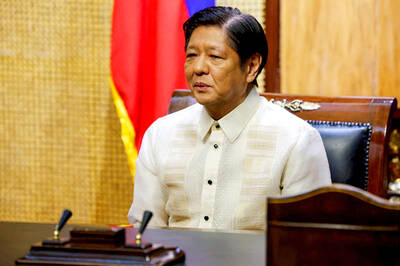
The Philippines would likely be involved in any conflict over Taiwan due to its proximity to the democracy claimed by China, President Ferdinand Marcos Jr said, reiterating a stance that risks angering Beijing. “In the Philippines, we do not have a choice because Taiwan is so close to the Philippines and we have almost 200,000 Filipino nationals living and working in Taiwan,” Marcos said in an interview with Japanese media in Manila on Monday. The Philippine leader’s comments come ahead of a state visit to Japan next week, where he is to meet with Japanese Prime Minister Sanae Takaichi to discuss security


 RSS
RSS