


Washington was anxiously awaiting the arrival of Chinese President Hu Jintao (胡錦濤) yesterday for a state visit that may be long on pomp and ceremony, but short on achievement and substance.
Top officials are adamant that the US will continue to sell arms to Taipei no matter what proposals Hu makes.
Even though Hu will be honored with a 21-gun salute and a black-tie White House dinner, US President Barack Obama and his closest aides remain unsure and suspicious of Chinese intentions and motivations.
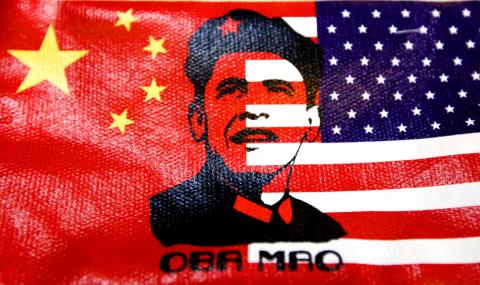
Photo: REUTERS
Within the administration, there is even doubt about just how much internal power Hu really has.
It is being widely reported in US media that Hu may be the weakest leader of the Chinese Communist Party era.
According to the New York Times, Obama’s advisers have concluded that Hu “is often at the mercy of a diffuse ruling party in which generals, ministers and big corporate interests have more clout, and less deference, than they did in the days of Mao [Zedong (毛澤東)] or Deng Xiaoping (鄧小平).”
“Years of waiting for China to play a more constructive role have given way to the realization that American and Chinese national interests may simply be too divergent for the two to create a meaningful partnership,” American Enterprise Institute academic Michael Auslin said.
Meanwhile, the Washington Post forecast: “The Obama administration plans to use the summit to refocus attention on China’s record on human rights and political freedoms after spending much of the past two years seeking to engage the Chinese leadership on a broad array of global issues, including climate change, helping stabilize the global economy and dealing with the nuclear ambitions of Iran and North Korea.”
The biggest announcement to come out of the visit could involve new contracts for Beijing to buy tens of billions of US dollars in US goods, including civilian aircraft.
During his last visit in 2006, a Falun Gong protester broke through a security cordon to heckle Hu and an interpreter announced the Chinese national anthem as that of the “Republic of China,” the official name of Taiwan.
The White House is determined that there will be no such snafus this time.
During that first visit, Hu also spoke at some length about Taiwan and there is considerable interest in whether he will do that again.
It has been widely reported that in his answers to written questions from the Wall Street Journal and the Washington Post — published this week — Hu did not mention Taiwan.
The Washington Post said on Monday that the consensus among China watchers was that the chances of Obama and Hu finding a resolution to such sensitive issues as the Chinese currency, North Korea or Taiwan were unlikely.
Hu is expected to press the US to ease its ban on technology exports and seek assurances that US markets will remain open to Chinese goods.
Bonnie Glaser, an academic with the Center for Strategic and International Studies, has told the Washington Post that the Obama administration would like some “concrete deliverables” to demonstrate that the president’s China policy is effective and producing results.
She said that at the end of the summit, a statement might be issued that “reaffirms both leaders’ commitment to promoting a positive, cooperative and comprehensive bilateral relationship and to working together on a vast agenda of issues.”
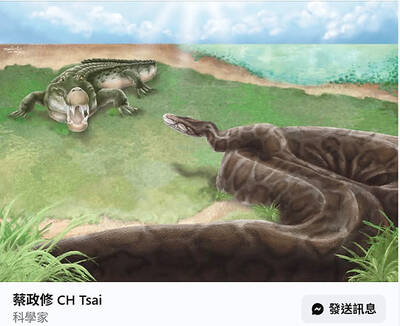
Taiwanese paleontologists have discovered fossil evidence that pythons up to 4m long inhabited Taiwan during the Pleistocene epoch, reporting their findings in the international scientific journal Historical Biology. National Taiwan University (NTU) Institute of Ecology and Evolutionary Biology associate professor Tsai Cheng-hsiu (蔡政修) led the team that discovered the largest snake fossil ever found in Taiwan. The single trunk vertebra was discovered in Tainan at the Chiting Formation, dated to between 400,000 and 800,000 years ago in the Middle Pleistocene, the paper said. The area also produced Taiwan’s first avian fossil, as well as crocodile, mammoth, saber-toothed cat and rhinoceros fossils, it said. Discoveries

Taiwanese paleontologists have discovered fossil evidence that pythons up to 4m long inhabited Taiwan during the Pleistocene epoch, reporting their findings in the international scientific journal Historical Biology. National Taiwan University (NTU) Institute of Ecology and Evolutionary Biology associate professor Tsai Cheng-hsiu (蔡政修) led the team that discovered the largest snake fossil ever found in Taiwan. A single trunk vertebra was discovered in Tainan at the Chiting Formation, dated to between 800,000 to 400,000 years ago in the Middle Pleistocene, the paper said. The area also produced Taiwan’s first avian fossil, as well as crocodile, mammoth, sabre-toothed cat and rhinoceros fossils, it said. Discoveries
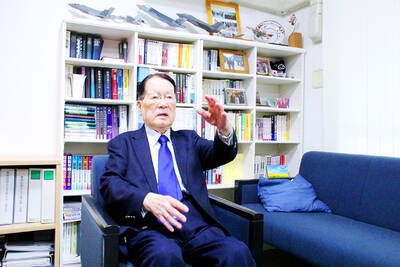
Whether Japan would help defend Taiwan in case of a cross-strait conflict would depend on the US and the extent to which Japan would be allowed to act under the US-Japan Security Treaty, former Japanese minister of defense Satoshi Morimoto said. As China has not given up on the idea of invading Taiwan by force, to what extent Japan could support US military action would hinge on Washington’s intention and its negotiation with Tokyo, Morimoto said in an interview with the Liberty Times (sister paper of the Taipei Times) yesterday. There has to be sufficient mutual recognition of how Japan could provide
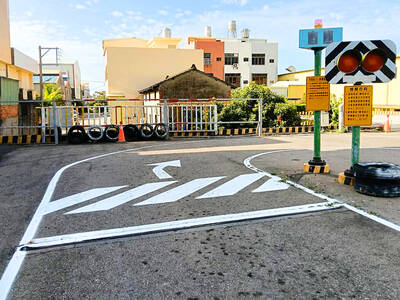
UPDATED TEST: The new rules aim to assess drivers’ awareness of risky behaviors and how they respond under certain circumstances, the Highway Bureau said Driver’s license applicants who fail to yield to pedestrians at intersections or to check blind spots, or omit pointing-and-calling procedures would fail the driving test, the Highway Bureau said yesterday. The change is set to be implemented at the end of the month, and is part of the bureau’s reform of the driving portion of the test, which has been criticized for failing to assess whether drivers can operate vehicles safely. Sedan drivers would be tested regarding yielding to pedestrians and turning their heads to check blind spots, while drivers of large vehicles would be tested on their familiarity with pointing-and-calling


 RSS
RSS