


Chinese President Hu Jintao’s (胡錦濤) state visit to the US next week could run into more problems after 17 Taiwanese-American organizations said they would hold demonstrations in front of the White House as Hu meets US President Barack Obama to protest repression in Tibet and East Turkestan and “threats and intimidation” against Taiwan.
At the same time, just up Pennsylvania Avenue on Capitol Hill, the House of Representatives Committee on Foreign Affairs will meet under its new chairwoman, Republican Ileana Ros-Lehtinen, for what promises to be extremely critical hearings on “China’s behavior and its impact on US interests.”
Added to that, the front pages of major US newspapers have been dominated by stories about the unexpected testing of China’s new J-20 stealth fighter this week amid speculation that the People’s Liberation Army (PLA) is acting independently of the civilian leadership.
All of this could add up to a very difficult and even embarrassing two-day visit to Washington for Hu.
While his itinerary is being kept under close wraps, it is understood that he will fly into Andrews Air Force Base near Washington on Tuesday and stay at Blair House, across the street from the White House.
He will attend a private dinner in the White House that night and the next day he will hold talks with Obama. Hu is next scheduled to attend a lunch at the State Department before returning to Blair House, where he will receive members of US Congress and the media before touring the new Chinese embassy complex. Another dinner will be held at the White House later that evening.
On Thursday, Hu will meet Chinese Americans before leaving for Chicago.
The Taiwanese-American group that plan to protest Hu’s visit sent a letter to Obama appealing for the White House to reaffirm the US’ support for “freedom, democracy and human rights in Taiwan.”
“We ask you to prod China to dismantle its 1,600 missiles targeted at Taiwan and renounce the threat or use of force against Taiwan. We also implore you to impress upon the Chinese delegation that it is essential to end Taiwan’s international political isolation,” the letter says.
Formosan Association for Public Affairs president Bob Yang (楊英育), the main organizer of the protests and initiator of the joint letter, said: “We want to emphasize that Taiwan was never part of the PRC [People’s Republic of China] and that the PRC has no basis whatsoever to claim sovereignty over Taiwan.”
Hu’s trip comes at a time when US-China relations are under great strain because of Beijing’s economic and military policies.
At a briefing on Wednesday, Chairman of the US Joint Chiefs of Staff Admiral Mike Mullen was asked by a Taiwanese journalist about China’s testing of the J-20 stealth fighter earlier this week when US Secretary of Defense Robert Gates was visiting Beijing.
“China is investing in very high-end, high-tech capabilities. And the question that is always out there is to try to understand exactly why,” Mullen said.
“The Chinese are not 10 feet tall. What I have not been able to crack is the why on some of these capabilities they are developing. Many of these capabilities seem to be focused very specifically on the United States,” he said.
It now seems certain that Hu will face some difficult questions while he is in Washington about the expansion of the Chinese military.
The Washington Post said the testing of the J-20 was “a blunt demonstration” of the People’s Liberation Army’s (PLA) willingness to challenge both the US and China’s president.
“It was a clear statement that although Hu might want Gates in China to burnish his legacy as a steward of solid ties with Washington before he steps down next year, the military has a different view,” the newspaper said.
“Making matters worse for Hu, when Gates queried him about the 15-minute flight, it appeared to him that the PLA had kept word of the test from China’s president and all other Chinese civilians at the meeting,” the Post said.
“The PLA has wrong-footed China’s civilians before, but has never so publicly embarrassed Hu,” the paper said.
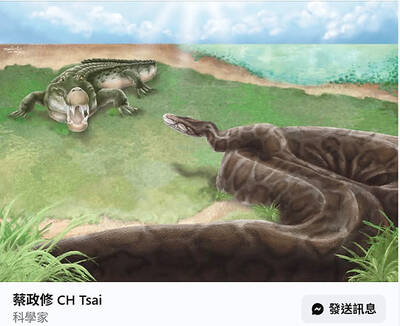
Taiwanese paleontologists have discovered fossil evidence that pythons up to 4m long inhabited Taiwan during the Pleistocene epoch, reporting their findings in the international scientific journal Historical Biology. National Taiwan University (NTU) Institute of Ecology and Evolutionary Biology associate professor Tsai Cheng-hsiu (蔡政修) led the team that discovered the largest snake fossil ever found in Taiwan. The single trunk vertebra was discovered in Tainan at the Chiting Formation, dated to between 400,000 and 800,000 years ago in the Middle Pleistocene, the paper said. The area also produced Taiwan’s first avian fossil, as well as crocodile, mammoth, saber-toothed cat and rhinoceros fossils, it said. Discoveries

Taiwanese paleontologists have discovered fossil evidence that pythons up to 4m long inhabited Taiwan during the Pleistocene epoch, reporting their findings in the international scientific journal Historical Biology. National Taiwan University (NTU) Institute of Ecology and Evolutionary Biology associate professor Tsai Cheng-hsiu (蔡政修) led the team that discovered the largest snake fossil ever found in Taiwan. A single trunk vertebra was discovered in Tainan at the Chiting Formation, dated to between 800,000 to 400,000 years ago in the Middle Pleistocene, the paper said. The area also produced Taiwan’s first avian fossil, as well as crocodile, mammoth, sabre-toothed cat and rhinoceros fossils, it said. Discoveries
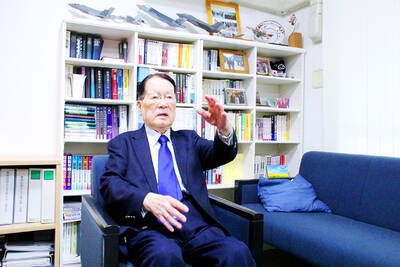
Whether Japan would help defend Taiwan in case of a cross-strait conflict would depend on the US and the extent to which Japan would be allowed to act under the US-Japan Security Treaty, former Japanese minister of defense Satoshi Morimoto said. As China has not given up on the idea of invading Taiwan by force, to what extent Japan could support US military action would hinge on Washington’s intention and its negotiation with Tokyo, Morimoto said in an interview with the Liberty Times (sister paper of the Taipei Times) yesterday. There has to be sufficient mutual recognition of how Japan could provide
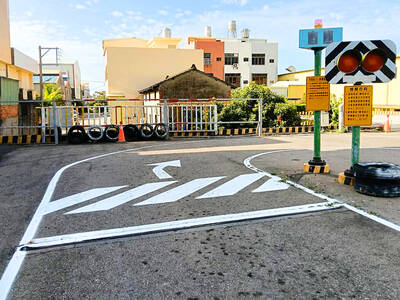
UPDATED TEST: The new rules aim to assess drivers’ awareness of risky behaviors and how they respond under certain circumstances, the Highway Bureau said Driver’s license applicants who fail to yield to pedestrians at intersections or to check blind spots, or omit pointing-and-calling procedures would fail the driving test, the Highway Bureau said yesterday. The change is set to be implemented at the end of the month, and is part of the bureau’s reform of the driving portion of the test, which has been criticized for failing to assess whether drivers can operate vehicles safely. Sedan drivers would be tested regarding yielding to pedestrians and turning their heads to check blind spots, while drivers of large vehicles would be tested on their familiarity with pointing-and-calling


 RSS
RSS