


A poll recently commissioned by the Mainland Affairs Council suggests that a majority of Taiwanese support an institutionalized negotiation mechanism to handle problems between the two sides of the Taiwan Strait.
The survey found that 72 percent of respondents said they supported Taipei and Beijing tackling cross-strait problems via institutionalized negotiations, compared with 15.1 percent of respondents that opposed the mechanism.
About 62 percent said they were happy with the agreement on cross-strait medical and health cooperation signed last month, saying it could advance the development of the pharmaceutical and biotechnology industries.
The poll also showed that about 44 percent of respondents said the speed of cross-strait liberalization was just right, while nearly 36 percent said it was going too fast and 12 percent said it was too slow.
When asked about cross-strait relations, nearly 58 percent said cross-strait tensions have eased since President Ma Ying-jeou (馬英九) took office in May 2008, compared with 26 percent who said tensions remained the same and 10.2 percent said the situation has become more tense.
Regarding the nation’s future, more than 87 percent still preferred to maintain the “status quo.” About 6 percent of respondents said they favored declaring independence as soon as possible and only 1.2 percent said they felt unification with China was the best course of action.
When asked about the Chinese government’s attitude toward the Taiwanese government, more than 51 percent said it was unfriendly, while 34 percent said it was friendly and 14.4 percent did not offer any opinion.
As for Beijing’s attitude toward the Taiwanese public, about 48 percent said it was unfriendly, compared with 39.3 percent who said it was friendly. About 12 percent of respondents said they did not know or expressed no opinion.
The poll, conducted by National Chengchi University’s Election Study Center, questioned 1,070 adults nationwide between Dec. 24 and Dec. 27. It has a margin of error of 3.1 percent.
In other developments, Mainland Affairs Council Minister Lai Shin-yuan (賴幸媛) is scheduled to visit Matsu on Friday and Saturday to inspect transportation links with China, know as the “mini three links,” prior to the Lunar New Year.
Emphasizing that the activity is “routine,” the council said in a statement that Lai will visit the defense command post on Matsu and meet with Lienchiang County Commissioner Yang Sui-sheng (楊綏生) on Friday. She will then visit Nangan Island (南竿島) — the largest island in the Matsu chain — on Friday afternoon to examine how the mini three links with China. On Saturday, Lai will visit Beigan Island (北竿島).
The mini three links, established in January 2001, opened the door for residents of Kinmen and Matsu to travel to Xiamen in Fujian Province without restrictions. Penghu was not included in the transportation links until October 2008.

Taiwanese paleontologists have discovered fossil evidence that pythons up to 4m long inhabited Taiwan during the Pleistocene epoch, reporting their findings in the international scientific journal Historical Biology. National Taiwan University (NTU) Institute of Ecology and Evolutionary Biology associate professor Tsai Cheng-hsiu (蔡政修) led the team that discovered the largest snake fossil ever found in Taiwan. The single trunk vertebra was discovered in Tainan at the Chiting Formation, dated to between 400,000 and 800,000 years ago in the Middle Pleistocene, the paper said. The area also produced Taiwan’s first avian fossil, as well as crocodile, mammoth, saber-toothed cat and rhinoceros fossils, it said. Discoveries

Taiwanese paleontologists have discovered fossil evidence that pythons up to 4m long inhabited Taiwan during the Pleistocene epoch, reporting their findings in the international scientific journal Historical Biology. National Taiwan University (NTU) Institute of Ecology and Evolutionary Biology associate professor Tsai Cheng-hsiu (蔡政修) led the team that discovered the largest snake fossil ever found in Taiwan. A single trunk vertebra was discovered in Tainan at the Chiting Formation, dated to between 800,000 to 400,000 years ago in the Middle Pleistocene, the paper said. The area also produced Taiwan’s first avian fossil, as well as crocodile, mammoth, sabre-toothed cat and rhinoceros fossils, it said. Discoveries

Whether Japan would help defend Taiwan in case of a cross-strait conflict would depend on the US and the extent to which Japan would be allowed to act under the US-Japan Security Treaty, former Japanese minister of defense Satoshi Morimoto said. As China has not given up on the idea of invading Taiwan by force, to what extent Japan could support US military action would hinge on Washington’s intention and its negotiation with Tokyo, Morimoto said in an interview with the Liberty Times (sister paper of the Taipei Times) yesterday. There has to be sufficient mutual recognition of how Japan could provide
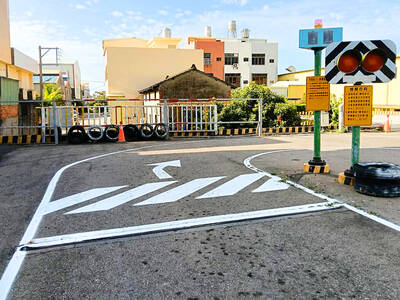
UPDATED TEST: The new rules aim to assess drivers’ awareness of risky behaviors and how they respond under certain circumstances, the Highway Bureau said Driver’s license applicants who fail to yield to pedestrians at intersections or to check blind spots, or omit pointing-and-calling procedures would fail the driving test, the Highway Bureau said yesterday. The change is set to be implemented at the end of the month, and is part of the bureau’s reform of the driving portion of the test, which has been criticized for failing to assess whether drivers can operate vehicles safely. Sedan drivers would be tested regarding yielding to pedestrians and turning their heads to check blind spots, while drivers of large vehicles would be tested on their familiarity with pointing-and-calling


 RSS
RSS