


The National Communications Commission (NCC) said yesterday it had initiated plans for the withdrawal before 2017 of the frequency spectrums assigned to second-generation (2G) mobile phone services.
Wang De-wei (王德威), a senior technical specialist at the NCC, said the 2G service licenses would expire either in 2012 or 2013.
While representatives from concerned government agencies have met to discuss how they should execute the withdrawal of frequency spectrums, they have not finalized the details, Wang said.
He added, however, that the commission had laid out some guiding principles.
“There are still users of 2G services, and if we do not let the telecoms carriers renew their licenses, the interests of 2G service users would be compromised,” Wang said.
Wang said the Regulations Governing Mobile Communication Service (行動通信業務管理規則) allow operators to apply for license renewal a year before the licenses expire.
However, the government has not decided how long operators can continue offering the service after renewing their license and before the government withdraws the frequency spectrums, Wang said.
“We must consider the most efficient way to use rare national resources and ensure fair competition among telecoms carriers,” he said. “The operators can continue offering 2G services [beyond 2012 or 2013] after renewing their license, but 2G technology will not help them if they want to offer more innovative services,” Wang said.
“The bottom line is that those holding 2G licenses should not carry on their services until 2017, when most third-generation [3G] licenses are set to expire,” he said.
Regarding the reassignment of frequency spectrums currently allocated for 2G services, Wang said they might be issued to telecoms carriers that offer services using more advanced technologies.
While it appears that the frequencies can be divided into five big blocks after they are withdrawn, Wang said this did not mean that the government would issue five new licenses for telecoms carriers.
NCC spokesperson Chen Jeng-chang (陳正倉) said the commission might consider issuing the licenses through a public auction, following the regulations listed in the Budget Act (預算法).
While the government is responsible for setting a deadline for when it will withdraw the frequencies, telecoms carriers must take charge of offering incentives to motivate their customers to switch from 2G to 3G service, Chen said.
NCC statistics showed that the nation has about 27 million registered users of mobile phone services, with 2G users numbering about 1 million.
In other developments, the commission said it may soon redefine the service areas for cable TV operators in a bid to end regional monopolies and encourage operators to provide digital cable TV services.
Chen said the Executive Yuan has set a target of raising the digital cable TV penetration rate from 5 percent to 50 percent.
To achieve this goal, the commission has started providing digital cable TV test services in certain areas, Chen said.
Analog signals for terrestrial television services will be shut down by 2012, and only digital terrestrial television services will be available, Chen said.
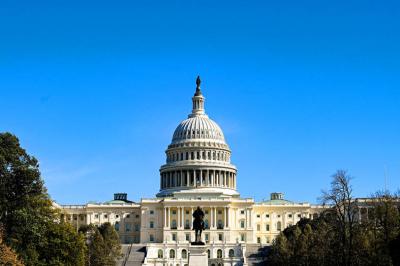
The US House of Representatives yesterday passed the PROTECT Taiwan Act, which stipulates that Washington would exclude China from participating in major global financial organizations if its actions directly threaten Taiwan’s security. The bill, proposed by Republican US Representative Frank Lucas, passed with 395 votes in favor and two against. It stipulates that if China’s actions pose any threat to Taiwan’s security, economic or social systems, the US would, “to the maximum extent practicable,” exclude China from international financial institutions, including the G20, the Bank for International Settlements and the Financial Stability Board. The bill makes it clear that China

Taiwan’s Li Yu-hsiang performs in the men’s singles figure skating short program at the Milano-Cortina Winter Olympics, in Milan, Italy, on Tuesday. Li finished 24th with a score of 72.41 to advance to Saturday’s free skate portion of the event. He is the first Taiwanese to qualify for the free skate of men’s singles figure skating at the Olympics since David Liu in 1992.
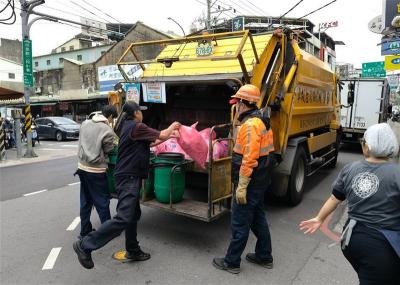
Garbage and recycling schedules are to vary from Saturday through Sunday next week over the Lunar New Year holiday period. The following collection information is from the governments of the six special municipalities. Taipei Regular service: Sunday to Monday next week. No service: Tuesday to Thursday next week. Extra service: Friday next week. Regular service resumes: Saturday next week. New Taipei City Extra service: Sunday. Adjusted collection time: Monday next week — garbage collection is to begin in the morning and end at 6pm. No service: Tuesday to Thursday next week. Regular service resumes: Friday next week. Note: Garbage can be dropped off at 70
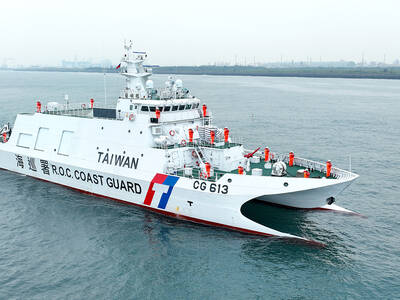
The Coast Guard Administration (CGA) yesterday held a ceremony marking the delivery of its 11th Anping-class offshore patrol vessel Lanyu (蘭嶼艦), saying it would boost Taiwan’s ability to respond to Beijing’s “gray zone” tactics. Ocean Affairs Council Deputy Minister Chang Chung-Lung (張忠龍) presided over the CGA event in the Port of Kaoshiung. Representatives of the National Security Council also attended the event. Designed for long-range and protracted patrol operations at sea, the Lanyu is a 65.4m-long and 14.8m-wide ship with a top speed of 44 knots (81.5kph) and a cruising range of 2,000 nautical miles (3704km). The vessel is equipped with a


 RSS
RSS