


To help the nation respond faster to undersea earthquakes and tsunamis, the Central Weather Bureau said it would soon deploy more advanced monitoring equipment.
Kuo Kai-wen (郭鎧紋), director of the bureau’s seismology center, said the Marine Cable Hosted Observatory (MACHO) was designed to improve the bureau’s ability to detect and monitor earthquakes and tsunamis off the east coast.
The system will be implemented in two stages. First, a 45km cable will be laid from a land station in Toucheng (頭城), Yilan County, out to sea next year. The project will be launched after the birthday of the sea goddess Mazu (媽祖), he said.
“A magnitude 7.1 earthquake between Hsinchu and Taichung hit at 6am on April 21, 1935. About 3,500 people died and 50,000 houses collapsed or semi-collapsed,” Kuo said. “It was close to Mazu’s birthday and some people survived because they were out worshipping the goddess.”
The second stage of the project will double the cable’s length, Kuo said.
The seismometer, or pressure gauge, in the MACHO system will help detect earthquakes and tsunamis, the information being transmitted via the cable to the bureau. The bureau will then analyze the information and produce reports for relief agencies, the media and the public.
The bureau estimates that the project, scheduled for completion by 2014, will cost about NT$800 million (US$25 million). Once installation is finished, Kuo said the nation could gain an extra 10 or 20 seconds to respond to strong earthquakes centered off the northeast coast. It could also provide an extra 10 to 20 minutes to prepare for a tsunami.
Aside from the MACHO system, the bureau also plans to expand the installation of borehole seismometers on land, Kuo said, adding that six more could be built this year. By last year, the bureau had completed nine such seismometers, Kuo said.
“The seismometers have lowered interference from the ground and reduced the risk of incorrect analysis,” he said.
The bureau has reduced the time from when an earthquake occurs to when the computer system reports the information from 102 seconds in 1999 to 30 seconds last year.
Meanwhile, the bureau said intermittent showers were expected throughout Taiwan starting yesterday as Typhoon Malou moves northward in the Sea of Japan.
The typhoon was expected to reach a location 530km north-northwest of Okinawa by 2am today and to change direction, moving north, forecasters said.
Malou is not expected to hit Taiwan directly, but the accompanying cloud system will bring intermittent rain across the country in the coming week, the bureau said.
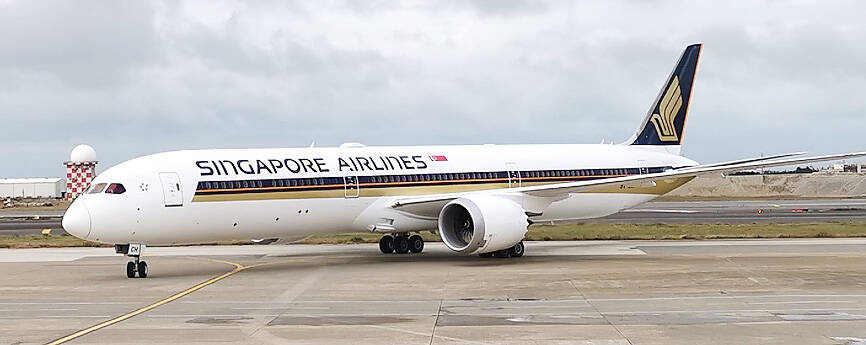
INCREASED CAPACITY: The flights on Mondays, Wednesdays, Fridays and Sundays would leave Singapore in the morning and Taipei in the afternoon Singapore Airlines is adding four supplementary flights to Taipei per week until May to meet increased tourist and business travel demand, the carrier said on Friday. The addition would raise the number of weekly flights it operates to Taipei to 18, Singapore Airlines Taiwan general manager Timothy Ouyang (歐陽漢源) said. The airline has recorded a steady rise in tourist and business travel to and from Taipei, and aims to provide more flexible travel arrangements for passengers, said Ouyang, who assumed the post in July last year. From now until Saturday next week, four additional flights would depart from Singapore on Monday, Wednesday, Friday
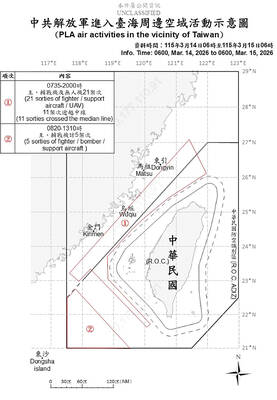
The Ministry of National Defense yesterday reported the return of large-scale Chinese air force activities after their unexplained absence for more than two weeks, which had prompted speculation regarding Beijing’s motives. China usually sends fighter jets, drones and other military aircraft around the nation on a daily basis. Interruptions to such routine are generally caused by bad weather. The Ministry of National Defense said it had detected 26 Chinese military aircraft in the Taiwan Strait over the previous 24 hours. It last reported that many aircraft on Feb. 25, when it spotted 30 aircraft, saying Beijing was carrying out another “joint combat

Taiwan successfully defended its women’s 540 kilogram title and won its first-ever men’s 640 kg title at the 2026 World Indoor Tug of War Championships in Taipei yesterday. In the women’s event, Taiwan’s eight-person squad reached the final following a round-robin preliminary round and semifinals featuring teams from Ukraine, Japan, Thailand, Vietnam, the Basque Country and South Korea. In the finals, they swept the Basque team 2-0, giving the team composed mainly of National Taiwan Normal University students and graduates its second championship in a row, and its fourth in five years. Team captain

Taiwan’s three major international carriers are increasing booking fees, with EVA Airways having already increased the charge to US$28 per flight segment from US$25, while China Airlines (CAL) and Starlux Airlines are set to follow suit. Booking fees are charged by airlines through a global distribution system (GDS) and passed on to passengers. Carriers that apply the fees include CAL, EVA, Starlux and Tigerair Taiwan. A GDS is a computerized network operated by a company that connects airlines with travel agents and ticketing platforms, allowing reservations to be made and processed in real time. Major players include Amadeus, Sabre and Travelport. EVA Air began


 RSS
RSS