


A cross-agency task force will be established to combat counterfeit drugs and medical products sold via underground radio stations, the Internet and night markets, the Executive Yuan and the Department of Health announced yesterday.
Premier Wu Dun-yih (吳敦義) told a briefing that he expects the taskforce to turn in a weekly report updating him on the progress of its efforts, starting next month.
The department said Taiwanese spend more than NT$30 billion (US$940 million) each year on dialysis or related treatments for renal failure caused mostly by counterfeit drugs purchased via underground radio stations, the Internet, street vendors, night markets, tour buses, sex-toy shops and some pharmacies.
“These unethical vendors make profits from selling fake drugs. Such behavior not only puts the public’s health at risk, it also further strains the national health insurance system,” Wu said.
Food and Drug Administration Director Kang Jaw-jou (康照洲) said vendors often take advantage of trusting buyers by exaggerating the efficacy of drugs and selling them at a low price.
The products range from hypertension drugs to skin rash ointments, the report said.
The task force will be made up of personnel from the National Police Administration, the Ministry of Justice, Coast Guard Administration, National Immigration Agency, the National Communications Committee and the health department.
Kang said the department set up its own mechanism to crack down on fake drug vendors, with less than ideal results.
Last year, only 102 cases were brought before courts and 283 manufacturers fined. The total fines collected totaled NT$110 million, he said, adding that in accordance with Wu’s request, the health department will push for an amendment to include harsher punishment for violators within three months.
The department held another public hearing yesterday about setting up special medical services zones catering solely to foreign patients. No consensus was reached during the four-hour meeting.
Health officials said the scheme could be profitable, but the Taiwan Healthcare Reform Foundation worried that the rights of low-income patients might suffer as doctors would prefer to see high-paying patients.
Deputy Minister of the Department of Health Chen Tzay-jinn (陳再晉) said last year foreign patients accounted for only 0.33 percent of patients treated, indicating that it would be possible to set up a special medical services zone without interfering with the access of local patients to healthcare.

Yangmingshan National Park authorities yesterday urged visitors to respect public spaces and obey the law after a couple was caught on a camera livestream having sex at the park’s Qingtiangang (擎天崗) earlier in the day. The Shilin Police Precinct in Taipei said it has identified a suspect and his vehicle registration number, and would summon him for questioning. The case would be handled in accordance with public indecency charges, it added. The couple entered the park at about 11pm on Thursday and began fooling around by 1am yesterday, the police said, adding that the two were unaware of the park’s all-day live

Fast food chain McDonald's is to raise prices by up to NT$5 on some products at its restaurants across Taiwan, starting on Wednesday next week, the company announced today. The prices of all extra value meals and sharing boxes are to increase by NT$5, while breakfast combos and creamy corn soup would go up by NT$3, the company said in a statement. The price of the main items of those meals, if ordered individually, would remain the same. Meanwhile, the price of a medium-sized lemon iced tea and hot cappuccino would rise by NT$3, extra dipping sauces for chicken nuggets would go up
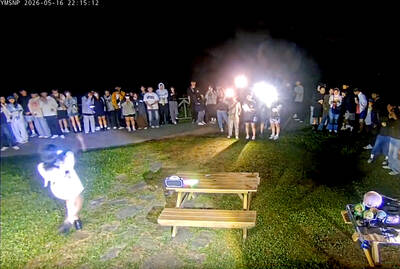
Yangmingshan National Park’s Qingtiangang (擎天崗) nature area has gone viral after a park livestream camera observed a couple in the throes of intimate congress, which was broadcast live on YouTube, drawing large late-night crowds and sparking a backlash over noise, bright lights and disruption to wildlife habitat. The area’s livestream footage appeared to show a couple engaging in sexual activity on a picnic table in the park on Friday last week, with the uncensored footage streamed publicly online. The footage quickly spread across social media, prompting a tide of visitors to travel to the site to “check in” and recreate the

Minister of Digital Affairs Lin Yi-ching (林宜敬) yesterday cited regulatory issues and national security concerns as an expert said that Taiwan is among the few Asian regions without Starlink. Lin made the remarks on Facebook after funP Innovation Group chief executive officer Nathan Chiu (邱繼弘) on Friday said Taiwan and four other countries in Asia — China, North Korea, Afghanistan and Syria — have no access to Starlink. Starlink has become available in 166 countries worldwide, including Ukraine, Malaysia, the Philippines and Vietnam, in the six years since it became commercial, he said. While China and North Korea block Starlink, Syria is not


 RSS
RSS