


Family members, entertainers and politicians across party lines yesterday bid a final farewell to Taiwanese singer-songwriter Hung Yi-feng (洪一峰), who died of pancreatic cancer in Taipei late last month at the age of 82.
Dubbed “the king of Formosan song,” Hung sprang into fame when a song he wrote, Butterfly Infatuated with Flower (蝶戀花), made its debut in 1946. Other well-known tunes such as Memories of an Old Love (舊情綿綿) and The One I’m Missing (思慕的人) remain very popular among KTV patrons.
Hung formed a singing and dancing troupe in 1957 and began a national tour that received much acclaim until the then-Chinese Nationalist Party (KMT) government began banning Taiwanese songs in 1959.
Hung moved to Japan to continue his music career. In 1962, Hung played the leading role in a musical that took its name from his song Memories of an Old Love. Its overwhelming success landed him another leading role in the movie When Will We Meet Again (何日再相逢) the following year and many more over the next five years.
His eldest son, Chris Hung (洪榮宏), was sent to Japan to study music when he was 10 years old. He later said that the Spartan-style training his father gave him from an early age dealt a significant blow to his self-esteem and to their relationship.
Chris Hung later developed a drinking problem and the tension between father and son escalated. It was not until Chris Hung converted to Christianity and introduced his father to the religion in 1991 that they found peace again.
Delivering the eulogy yesterday, Chris Hung, 47, thanked his father for teaching him to be a skilled singer and a better man.
“He was my best teacher and best friend,” he said at the memorial service held at the Bread of Life Christian Church in Shihlin (士林).
Hung Yi-feng was diagnosed with terminal pancreatic cancer and hospitalized in December. He fell into a coma following a bout of pneumonia and was transferred to a hospice ward last month.
President Ma Ying-jeou (馬英九), who delivered his speech in Hoklo (commonly known as Taiwanese), lamented the loss of Hung Yi-feng, calling him a well-rounded entertainer and national treasure.
“On behalf of the Republic of China government, I want to thank him for his contribution to bringing joy and solace to every family over the past 50 years,” he said. “I believe he will continue from above to protect this land and its people.”
Ma also presented Hung Yi-feng’s family with a certificate honoring his contribution to Taiwanese culture.
Chiu Kun-liang (邱坤良), a professor at National Taipei University of the Arts who grew up listening to Hung’s songs, had previously said that Hung Yi-feng “was unfortunate to have been born in Taiwan ... If he had lived in another country, he would have long been recognized as a national treasure.”
ADDITIONAL REPORTING BY CNA

NATIONAL SECURITY: Authorities are working to confirm the identities of the military personnel involved and investigating possible illegal conduct and regulatory violations Authorities are probing possible national security implications after Kinmen police and immigration officers on Sunday found a Chinese woman allegedly posing as a tourist while engaging in prostitution involving more than 10 military personnel. The woman, surnamed Chen (陳), has since been deported, authorities said, adding that investigators are still working to confirm the identities of those implicated, as the records only listed code names and aliases. The case stemmed from a report received by the Kinmen District Prosecutors’ Office on Friday last week from the Jinhu Precinct of the Kinmen County Police Bureau. On Sunday, police, along with the National Immigration

GLOBALGIVING: ‘ Caving to external pressure is not acceptable for an organization that has cultivated justice reform and human rights for 30 years,’ one NGO said A slew of non-government organizations (NGOs) have withdrawn from the GlobalGiving fundraising platform after it announced it would use “Chinese Taipei” instead of “Taiwan” from next month. The Taiwan Good Rice Association wrote on Facebook on Friday that it was informed on April 28 via a teleconference call of the change, which was made because the platform wanted to operate in China. Taiwan Good Rice is to terminate all cooperative relationships with GlobalGiving in response to the platform’s “unilateral and non-negotiable” decision to remove references to Taiwan, the NGO said. “Taiwan is in the official name of Taiwan Good Rice Association and the
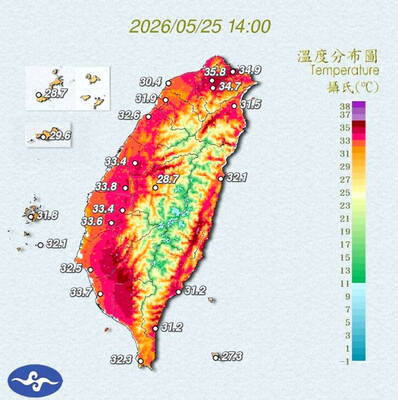
STAY COOL: The HPA recommended that people stay hydrated, use air-conditioning or fans while indoors, wear loose-fitting clothes and walk in the shade while outdoors Employers must implement measures such as installing cooling equipment, and providing drinking water and rest breaks for outdoor workers starting from Monday next week, the Taipei Department of Labor said on Sunday. Employers who fail to comply could face fines of NT$30,000 to NT$300,000 under the Occupational Safety and Health Act (職業安全衛生法), the department said. Businesses in Taipei employing fewer than 100 workers, as well as registered self-employed workers with labor insurance coverage, could receive on-site assessments and guidance from occupational safety consultants to help them apply for central government subsidies to implement or improve heat-protection measures, it said. Under the Ministry of

Chinese Nationalist Party (KMT) Chairwoman Cheng Li-wun (鄭麗文) yesterday briefed her party’s Central Standing Committee regarding her scheduled visit to the US between Monday next week and June 16, saying that her purpose would be to persuade the US that the Republic of China (ROC) Constitution was a “one China” constitution that would foster stable and peaceful cross-strait relations. The ROC Constitution is the most important defense for all Taiwanese citizens, as it upholds our democracy and has contributed to our robust economy, which aligns with international and US interests, she said. “We would not be troublemakers and drag the US under,”


 RSS
RSS