


Premier Wu Den-yih (吳敦義) yesterday expressed his hope that he would see a draft statute on promoting innovative industries (產業創新條例) clear the legislature as it reconvenes today.
Wu said both ruling and opposition parties were greatly concerned about the bill and that the executive branch has amended it to avoid accusations that it was tailor-made for the high-tech industry or certain big businesses.
The bill will be an extension of the Statute for Industrial Upgrading (促進產業升級條例) after it expired at the end of last year. The bill for industrial innovation aims to encourage business to invest in innovation, research and development.
After Hon Hai Group chairman Terry Gou (郭台銘) threatened to pull out of Taiwan if the legislature passes the bill, which would grant preferential tariff treatment to the world’s top 500 international businesses, Minister of Economic Affairs Shih Yen-shiang (施顏祥) said the Executive Yuan had decided to scrap the article because of its controversial nature.
Wu and Shih made the remarks while addressing a meeting chaired by President Ma Ying-jeou (馬英九), who doubles as Chinese Nationalist Party (KMT) chairman.
The meeting was called by the KMT for Cabinet officials and party lawmakers to discuss how to better cooperate with each other during the new legislative session.
Ma threw his backing behind a government plan to introduce absentee voting despite accusations by the Democratic Progressive Party that the KMT was planning the system to manipulate elections.
Minister of the Interior Jiang Yi-huah (江宜樺) said the government planned to implement the measure during the next presidential election in 2012, but did not rule out doing it earlier if legislation and supplementary measures are completed on time.
Jiang said his ministry would start with a transfer system to allow voters to cast their ballots in the constituencies where they work rather than where they are registered. Currently, voters can only turn in ballots at designated polling stations near their registered address, preventing many from voting.
Calling it a “human rights” issue, Ma said any democratic country must have absentee voting, although there was room for discussion regarding how extensive it would be.
“It concerns the protection of human rights guaranteed by the Constitution,” he said.
On the economic cooperation framework agreement (ECFA), Ma said he hoped the second round of official negotiations would take place as soon as possible so both sides would have a better idea about what the items of the “early harvest” measure will be.

The military has spotted two Chinese warships operating in waters near Penghu County in the Taiwan Strait and sent its own naval and air forces to monitor the vessels, the Ministry of National Defense (MND) said. Beijing sends warships and warplanes into the waters and skies around Taiwan on an almost daily basis, drawing condemnation from Taipei. While the ministry offers daily updates on the locations of Chinese military aircraft, it only rarely gives details of where Chinese warships are operating, generally only when it detects aircraft carriers, as happened last week. A Chinese destroyer and a frigate entered waters to the southwest

A magnitude 6.1 earthquake struck off the coast of Yilan County at 8:39pm tonight, the Central Weather Administration (CWA) said, with no immediate reports of damage or injuries. The epicenter was 38.7km east-northeast of Yilan County Hall at a focal depth of 98.3km, the CWA’s Seismological Center said. The quake’s maximum intensity, which gauges the actual physical effect of a seismic event, was a level 4 on Taiwan’s 7-tier intensity scale, the center said. That intensity level was recorded in Yilan County’s Nanao Township (南澳), Hsinchu County’s Guansi Township (關西), Nantou County’s Hehuanshan (合歡山) and Hualien County’s Yanliao (鹽寮). An intensity of 3 was

Japanese Prime Minister Sanae Takaichi’s comment last year on Tokyo’s potential reaction to a Taiwan-China conflict has forced Beijing to rewrite its invasion plans, a retired Japanese general said. Takaichi told the Diet on Nov. 7 last year that a Chinese naval blockade or military attack on Taiwan could constitute a “survival-threatening situation” for Japan, potentially allowing Tokyo to exercise its right to collective self-defense. Former Japan Ground Self-Defense Force general Kiyofumi Ogawa said in a recent speech that the remark has been interpreted as meaning Japan could intervene in the early stages of a Taiwan Strait conflict, undermining China’s previous assumptions
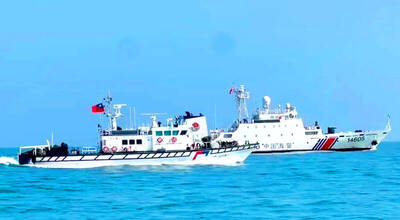
Instead of focusing solely on the threat of a full-scale military invasion, the US and its allies must prepare for a potential Chinese “quarantine” of Taiwan enforced through customs inspections, Stanford University Hoover fellow Eyck Freymann said in a Foreign Affairs article published on Wednesday. China could use various “gray zone” tactics in “reconfiguring the regional and ultimately the global economic order without a war,” said Freymann, who is also a nonresident research fellow at the US Naval War College. China might seize control of Taiwan’s links to the outside world by requiring all flights and ships entering or leaving Taiwan


 RSS
RSS