

The Council for Hakka Affairs (CHA) praised the legislature’s passage of the Hakka Basic Act (客家基本法) on Tuesday as a milestone in preserving Hakka culture, but activists were more reserved on what impact the Act would have.
The Hakka Basic Act, proposed by the council last year, aims to preserve Hakka culture and encourage the use of the Hakka language in public affairs. The Act requires counties and cities with a population that is more than 10 percent Hakka to create an agency to manage Hakka affairs. It also requires a Hakka language test in certain national exams and requires public servants in townships and cities where more than one-third of the population is Hakka to pass the Hakka proficiency test.
The Act also stipulates that at public places like schools, hospitals, train stations and courts, public announcements must be made in Hakka along with other languages and Hakka translation services must be available.
In addition, the Act asks the government to create a “Hakka Day.”
“We Hakka are not asking for privileges — all the clauses in the Hakka Basic Act are positive and non-exclusive measures aimed at granting equal rights [for Hakka] but not at the expense of other ethnic groups” CHA Minister Huang Yu-chen (黃玉振) said in a statement. “Hence it’s a law that will protect the ethnic and cultural diversity in this country.”
“It’s a milestone in Hakka affairs, and draws a long-lasting blue print for the development of the Hakka people,” he said.
Some Hakka activists and academics were reserved about what impact the Act would have.
“Of course the Hakka Basic Act will have a positive effect [on the protection of Hakka culture], but the question is: ‘How big will the impact be?’” said Chiang Ming-hsiu (江明修), dean of the College of Hakka Studies at National Central University.
He said that the former Democratic Progressive Party (DPP) government and the current Chinese Nationalist Party (KMT) government have done much to preserve Hakka culture, and that the Act still leaves most policy-making power in the hands of the government.
“So the main function of the law is to provide a legal basis on what the government is already doing,” Chiang said.
Lee Chiao (李喬), a long-time Hakka culture preservationist and writer, said that the intention behind the Hakka Basic Act is very good, “but the key will be how the law is turned into policies, how these policies are implemented and what exact measures the government has in mind.”
DPP Department of Hakka Affairs director Yiong Cong-ziin (楊長鎮) criticized the Act as a “blank cartridge.”
“The law appears to be very good at first sight, but take a closer look and you find it’s actually empty inside,” Yiong told the Taipei Times by telephone. “Eighty percent of the contents can be implemented through executive measures, and thus there’s no need to go through all the trouble of making a new law for those.”
He said that, for instance, having public announcements in Hakka at public places such as train stations is a policy that has been in practice since the DPP was in power.
“A Hakka Basic Act should deal with something more fundamental, not some policy measures that can be done even without a law,” Yiong said.

‘FRIENDSHIP FLEET’: A CGA official is scheduled to meet with the president of the Pacific nation, while one of the ships is to host a banquet and National Day event Two Coast Guard Administration (CGA) patrol vessels have docked at Malakal Harbor in Palau as part of an expedition exercise and diplomatic visit, during which a senior official is expected to meet with Palauan President Surangel Whipps Jr, the agency said yesterday. The two vessels, the 4,000-tonne-class Chiayi and the 1,000-tonne-class Penghu, set sail for Palau from Taiwan last week and arrived on Tuesday at Malakal Harbor, the CGA’s Fleet Branch said in a statement. The journey marks the second time the CGA has dispatched a “friendship fleet” to another country, after it sent its first-ever goodwill fleet, comprising the Hualien and

Two executives of drone supplier Jiin Ming Industry Co (錦明實業) have been detained and held incommunicado over the company's alleged use of prohibited China-made chips and camera lenses in drones supplied under recent military contracts, the Taoyuan District Prosecutors' Office said today. In a statement, prosecutors said they raided the offices of Jiin Ming — headquartered in Taoyuan — as well as those of its subsidiaries and its suppliers on Thursday last week. The raids followed a report that the company had breached its procurement contracts by putting the prohibited components into drones delivered to the military. During the raids, prosecutors summoned

South Korean boy band BigBang drew 120,000 fans to three concerts at Taipei Dome from Friday through yesterday, as the band thanked them for their support over their 20-year career. The Taipei Dome concerts were part of BigBang's "2026-2027 World Tour XX: Cosmos." Friday's concert was BigBang's first performance in Taiwan in 11 years. During the encore, group leader G-Dragon (GD) shouted "I love you" in Chinese and said he was especially happy to perform in Taiwan with bandmates Taeyang and Daesung. "Taipei, I'm very grateful to you all," GD said in Chinese, asking fans to wait for the band's return. Daesung thanked
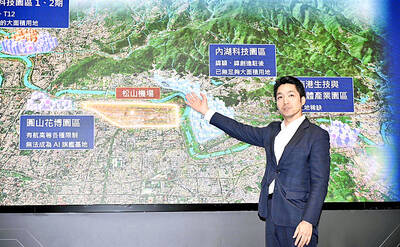
DETAILED PLAN NEEDED: Relocating the airport would affect not just travelers, but also undermine national defense and emergency medical services, a legislator said Taipei Mayor Chiang Wan-an (蔣萬安) yesterday proposed relocating Taipei International Airport (Songshan airport) and turning the site into an artificial intelligence (AI) park, drawing opposition from politicians across party lines. Chiang’s plan would turn the 300 hectares into an AI park featuring tech clusters, residential communities and green space. The industrial cluster would host 200 domestic enterprises, generate NT$12 trillion (US$376.47 billion) in output, and accommodate 65,000 jobs and 35,000 residents, he said. Cabinet spokeswoman Michelle Lee (李慧芝) said the Executive Yuan was surprised by the announcement, as the Taipei City Government did not discuss the proposal with the central government before making


 RSS
RSS