


Proposed legislation to overturn parts of a protocol on beef imports from the US will not affect Washington’s sale of an arms package to Taiwan, Premier Wu Den-yih (吳敦義) said yesterday.
“I don’t think this will happen,” Wu said when approached for comment on the ongoing US beef dispute.
On Tuesday, Chinese Nationalist Pary (KMT) and Democratic Progressive Party (DPP) legislators reached consensus on passing an amendment to the Act Governing Food Sanitation (食品衛生管理法) next week that will ban imports of beef offal and ground beef from areas where cases of mad cow disease have been documented in the past 10 years, which would include the US.
Officials in Washington subsequently issued a statement expressing dismay and warned that the move could amount to an abrogation of a protocol signed in October that would relax restrictions on US beef imports.
Wu said the US would formally respond after the legislative amendment is passed on Tuesday.
“The Executive Yuan will closely monitor its response,” he said.
Last month, Foreign Policy magazine said US President Barack Obama was “getting ready” to announce an arms sales package to Taiwan that would include Black Hawk helicopters and Patriot missile batteries. A report by the Chinese-language China Times yesterday quoted an anonymous source from the Ministry of Foreign Affairs as saying that the US was inclined to stall arms sales to Taiwan in response the legislature’s move.
The US’ Taiwan Relations Act makes it unlikely that Washington would shelve arms sales to Taiwan, Wu said.
“The US is also a democratic country. It must surely be familiar with decisions made by its administrative branch not being endorsed by Congress. It should understand that Taiwan’s administrative branch and legislature each have their own duties and should respect the decision made by Taiwan’s legislature,” he added.
At a separate setting yesterday, Minister of Foreign Affairs Timothy Yang (楊進添) said the uproar over US beef imports would not prevent President Ma Ying-jeou (馬英九) making transit stopovers in the US on his next foreign trip.
Yang said the possibility of Ma making transit stops in the US and the beef dilemma were “two separate issues” and that Taiwan-US ties remained firm.
It has been widely speculated that Ma will travel to Honduras this month to attend the inauguration of president-elect Porfirio Lobo Sosa on Jan. 27. However, some political analysts have speculated that, unlike his last two trips to Latin America, the US might not be so willing to allow Ma to make transit stops because Taiwan is veering toward maintaining a partial ban on US beef.
Yang, declining to say what Ma’s travel plans were, said if the president were to make a stopover in the US, he would use various methods, including telephone calls, to explain the government’s position on the beef issue to the nation’s “American friends.”
Although the recent bipartisan consensus on maintaining the partial ban on US beef products did have a negative impact on bilateral trade relations, “it should be just temporary,” he said.
Ma called a meeting on Wednesday last week after the Legislative Yuan declined to endorse the protocol relaxing import restrictions.
During the meeting, Ma instructed that an Executive Yuan delegation be sent to Washington to mitigate the fallout. However, the government on Thursday made an about-face and said the delegation would be mainly comprised of lawmakers and representatives from consumer groups, with Wu saying the delegation would conduct a fact-finding mission, rather than explaining Taiwan’s stance.
DPP Legislator Wang Sing-nan (王幸男) said yestersday that the root of the problem was not pressure from the US, because the US exerted the same pressure while the DPP was in power, but rather the government’s unilateral decision to sign a protocol with the US without first obtaining the public’s consent.
He said the government’s shoddy leadership was the reason for any tension between Taiwan and the US.
“Sending a lobbying delegation would only bring further shame to the country,” he added.
ADDITIONAL REPORTING BY CNA

UPGRADE: The Kang Ding-class frigate is replacing its Chaparall missiles with Tien Chien II and Hua Yang VLS, which would provide it with long-range, 360° air defense Taiwan plans to produce 1,200 to 1,376 Hai Chien II missiles (海劍二, Sea Sword II) — also known as TC-2N — to serve as the standard air defense system of the navy’s surface combatant fleet, a source said yesterday. Last week, the Hai Chien II, the naval version of the Tien Kung II missile (天劍二, Sky Sword II), completed a live-fire test in waters off the National Chungshan Institute of Science and Technology’s Jiupeng facility (九鵬) in Pingtung County’s Manjhou Township (滿州). The MIM72 Chaparral and other dated air defense missiles that currently arm Taiwanese ships have inadequate range to combat Chinese

REASONS FOR TRAVEL: An assistant professor said that proposed amendments to penalize drivers if they used drugs overseas would not deter people from traveling People who operate a motor vehicle under the influence of marijuana would have their driver’s license revoked, even if they used the substance while overseas, the Ministry of Transportation and Communications said yesterday, citing proposed amendments to the Road Traffic Management and Penalty Act (道路交通管理處罰條例). The amendments would also authorize the government to revoke the licenses of people determined to have used Category 1 or Category 2 narcotics, even if they were not operating a vehicle while under the influence of drugs, as well as ban them from taking the license test for three years, the ministry said. People aged 18 or

HEAVY WEATHER: Typhoon Jangmi is due to crash straight into the Ryukyus as airlines look to shift flights to larger aircraft or cancel flights to Okinawa entirely Taiwan’s international air carriers announced flight adjustments over the weekend as Typhoon Jangmi is forecast to hit the Ryukyu Islands today and tomorrow. The Central Weather Administration (CWA) upgraded Jangmi from a tropical storm to a typhoon at 8am yesterday, with the eye located 580km south of Naha city. It was moving north at 19kph. Today, China Airlines’ CI-120, CI-121, CI-122 and CI-123 flights between Taoyuan and Naha, Okinawa, have been canceled as well as CI-132 and CI-133 between Kaohsiung and Naha. EVA Air’s BR-112, BR-113, BR-186 and BR-185 flights between Taoyuan and Naha are also canceled. Low-cost carrier Tigerair Taiwan canceled IT-230,
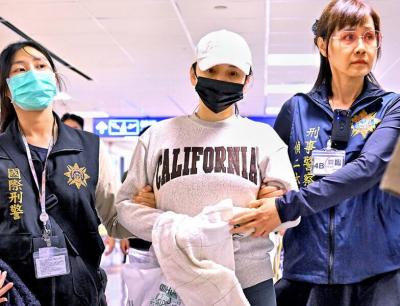
Johanne Liou (劉喬安), a Taiwanese woman who shot to unwanted fame during the Sunflower movement protests in 2014, returned to Taiwan last night after being deported from the US. She is to stand trial in Taiwan for charges involving embezzlement, fraud and drug crimes. The Criminal Investigation Bureau (CIB) said it took her into custody at Taiwan Taoyuan International Airport and would first question her before transferring her to the New Taipei District Prosecutors’ Office. She was arrested upon disembarking a flight from San Francisco that landed shortly before 7pm. Liou absconded to the US in 2019 after jumping bail


 RSS
RSS