


President Ma Ying-jeou (馬英九) was heckled in Taipei's Wanhua District (萬華) yesterday when he attended a ceremony marking the 270th anniversary of the establishment of Longshan Temple (龍山寺).
About 30 protesters shouted “Ma Ying-gao, step down” (gao means “dog” in Taiwanese) outside the temple. The temple was closed yesterday morning because of Ma's visit. While the president left at around 11am, the temple was not open to the public until 1:30pm.
Ma visited the temple to attend the ceremony marking the 270th anniversary of the temple's construction and the completion of the renovation of the temple's Tung Pao Hall (通寶殿) and its bell and drum towers.
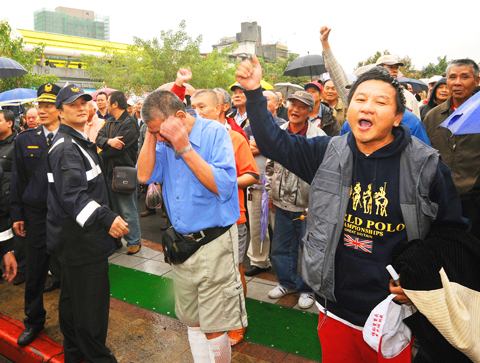
PHOTO: FANG PIN-CHAO, TAIPEI TIMES
Built in 1738, Longshan Temple was designated as a second-class national historic heritage site in 1985. An earthquake on Sept. 21, 1999, destroyed some of the stone pillars of the Tung Pao Hall, while some of the hall's wooden structure had rotted over time.
The “921 Earthquake” and the earthquake on March 31, 2002, also dealt a blow to the temple's bell and drum towers.
The temple was placed under tight security yesterday, with law enforcement officers forming a human chain to block the entrances.
An old married couple from Taoyuan said the temple manager told them that they had posted the announcement that the temple would be closed about a month ago, but they had no way of knowing because they lived in Taoyuan.
The temple manager told them the information was also available online, but they said they did not know how to use a computer.
Ma, who spent his childhood in Wanhua District, said Longshan Temple has been the center of religious worship since he was little. The temple has become one of the city's world-renowned landmarks, which include Taipei 101, the National Palace Museum and Chiang Kai-shek Memorial Hall, he said.
During his tenure as Taipei mayor, Ma said the city decided to open a Mass Rapid Transit System station at Longshan Temple, hoping to blend the old and new.
The city hoped the temple would continue to bless the region and ensure its prosperity, he said.

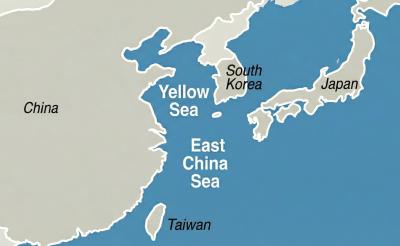
China has reserved offshore airspace in the Yellow Sea and East China Sea from March 27 to May 6, issuing alerts usually used to warn of military exercises, although no such exercises have been announced, the Wall Street Journal (WSJ) reported yesterday. Reserving such a large area for 40 days without explanation is an “unusual step,” as military exercises normally only last a few days, the paper said. These alerts, known as Notice to Air Missions (Notams), “are intended to inform pilots and aviation authorities of temporary airspace hazards or restrictions,” the article said. The airspace reserved in the alert is
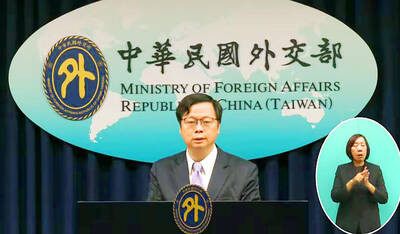
NAMING SPAT: The foreign ministry called on Denmark to propose an acceptable solution to the erroneous nationality used for Taiwanese on residence permits Taiwan has revoked some privileges for Danish diplomatic staff over a Danish permit that lists “Taiwan” as “China,” Eric Huang (黃鈞耀), head of the Ministry of Foreign Affairs’ Department of European Affairs, told a news conference in Taipei yesterday. Reporters asked Huang whether the Danish government had responded to the ministry’s request that it correct the nationality on Danish residence permits of Taiwanese, which has been listed as “China” since 2024. Taiwan’s representative office in Denmark continues to communicate with the Danish government, and the ministry has revoked some privileges previously granted to Danish representatives in Taiwan and would continue to review
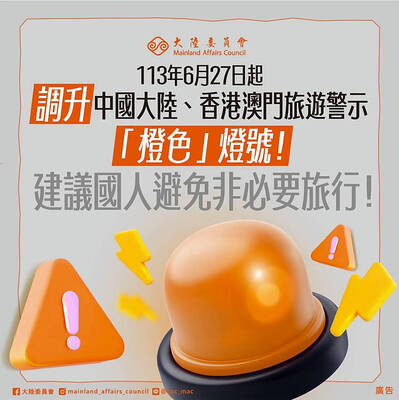
More than 6,000 Taiwanese students have participated in exchange programs in China over the past two years, despite the Mainland Affairs Council’s (MAC) “orange light” travel advisory, government records showed. The MAC’s publicly available registry showed that Taiwanese college and university students who went on exchange programs across the Strait numbered 3,592 and 2,966 people respectively. The National Immigration Agency data revealed that 2,296 and 2,551 Chinese students visited Taiwan for study in the same two years. A review of the Web sites of publicly-run universities and colleges showed that Taiwanese higher education institutions continued to recruit students for Chinese educational programs without

China has reserved offshore airspace over the Yellow Sea and East China Sea from March 27 to May 6, issuing alerts that are usually used to warn of military exercises, although no such exercises have been announced, the Wall Street Journal (WSJ) reported on Sunday. Reserving such a large area for 40 days without explanation is an “unusual step,” as military exercises normally only last a few days, the paper said. The alerts, known as notice to air missions (NOTAMs), “are intended to inform pilots and aviation authorities of temporary airspace hazards or restrictions,” the article said. The airspace reserved in the alert


 RSS
RSS