


Taiwan intends to build its first undersea seismic station, designed to improve the country’s early warning system and save valuable seconds when earthquakes strike, officials said yesterday.
The station, which is scheduled to come into service in 2011, would help reduce the margin of error when monitoring undersea quakes and improve on the nation’s existing system of land-based seismic stations.
The new facility would provide a roughly 10 second warning ahead of earthquakes and a 10 minute alert ahead of the impact of a tsunami, said Kuo Kai-wen (郭鎧紋), director of the Central Weather Bureau’s Seismological Center.
“The few seconds extra will give people precious time to seek shelter and flee coastal areas in the case of killer quakes,” he said.
NEC of Japan won the NT$423 million (US$13 million) contract to build the station, which will be situated some 45km off the northeastern coast, an area frequently hit by earthquakes, he said.
Taiwan’s three-phase earthquake early warning system has slashed the time of quake detection from up to three minutes in 1992 to around 35 seconds today.
Taiwan lies near the junction of two tectonic plates, is regularly shaken by earthquakes. A 7.6-magnitude quake killed about 2,400 people on Sept. 21, 1999.
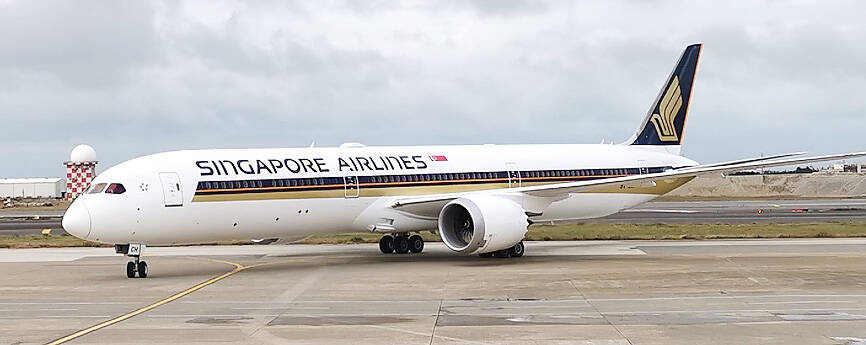
INCREASED CAPACITY: The flights on Mondays, Wednesdays, Fridays and Sundays would leave Singapore in the morning and Taipei in the afternoon Singapore Airlines is adding four supplementary flights to Taipei per week until May to meet increased tourist and business travel demand, the carrier said on Friday. The addition would raise the number of weekly flights it operates to Taipei to 18, Singapore Airlines Taiwan general manager Timothy Ouyang (歐陽漢源) said. The airline has recorded a steady rise in tourist and business travel to and from Taipei, and aims to provide more flexible travel arrangements for passengers, said Ouyang, who assumed the post in July last year. From now until Saturday next week, four additional flights would depart from Singapore on Monday, Wednesday, Friday
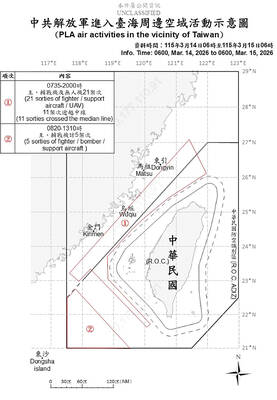
The Ministry of National Defense yesterday reported the return of large-scale Chinese air force activities after their unexplained absence for more than two weeks, which had prompted speculation regarding Beijing’s motives. China usually sends fighter jets, drones and other military aircraft around the nation on a daily basis. Interruptions to such routine are generally caused by bad weather. The Ministry of National Defense said it had detected 26 Chinese military aircraft in the Taiwan Strait over the previous 24 hours. It last reported that many aircraft on Feb. 25, when it spotted 30 aircraft, saying Beijing was carrying out another “joint combat

Taiwan successfully defended its women’s 540 kilogram title and won its first-ever men’s 640 kg title at the 2026 World Indoor Tug of War Championships in Taipei yesterday. In the women’s event, Taiwan’s eight-person squad reached the final following a round-robin preliminary round and semifinals featuring teams from Ukraine, Japan, Thailand, Vietnam, the Basque Country and South Korea. In the finals, they swept the Basque team 2-0, giving the team composed mainly of National Taiwan Normal University students and graduates its second championship in a row, and its fourth in five years. Team captain

Taiwan’s three major international carriers are increasing booking fees, with EVA Airways having already increased the charge to US$28 per flight segment from US$25, while China Airlines (CAL) and Starlux Airlines are set to follow suit. Booking fees are charged by airlines through a global distribution system (GDS) and passed on to passengers. Carriers that apply the fees include CAL, EVA, Starlux and Tigerair Taiwan. A GDS is a computerized network operated by a company that connects airlines with travel agents and ticketing platforms, allowing reservations to be made and processed in real time. Major players include Amadeus, Sabre and Travelport. EVA Air began


 RSS
RSS