


When Lulu Tseng took up karate more than a decade ago, she could not have imagined her hobby would one day save her and her family from the second-deadliest earthquake in the nation’s history.
That was exactly what happened, however, in the early morning of Sept. 21, 1999, when a 7.6-magnitude tremor jolted Taiwan, killing more than 2,400.
Tseng’s family of eight narrowly escaped because she used a precise karate kick to open a jammed iron door, just seconds before their home collapsed, like thousands of other houses at the epicenter in Nantou County.
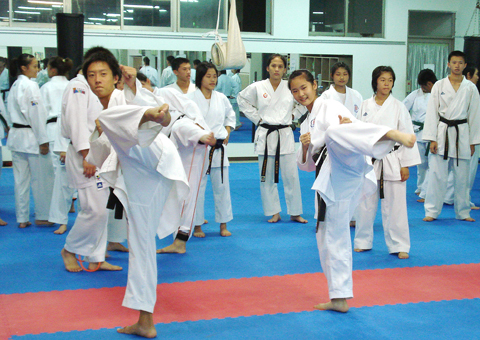
PHOTO: AMBER WANG, AFP
“I don’t know how I got the strength to kick open that door, but we would have all been crushed to death otherwise,” said Tseng, now 26.
If karate saved Tseng physically on that frightful night, it was to save her once more, this time psychologically — as the sport did for many other youngsters in the hilly part of the country.
The quake was only the beginning of the hardship in Nantou, where nearly 900 people were killed and 40,000 houses ruined, leaving the survivors struggling to cope with the catastrophe emotionally and financially.
“The quake triggered serious economic problems which drove some parents into depression or even to suicide, while youngsters turned to violence or drugs to cope with the pressure,” karate coach Huang Tai-chi said.
Huang and his wife, Liao Te-lan, also a coach and a native of Nantou, started a karate program, believing the martial art, with its emphasis on ethics, persistence and endurance, would help youngsters through the post-quake stress.
“These kids were traumatized, frightened and helpless as their homes and schools were gone. They needed a goal in life, an outlet to channel their energy and emotions, and to learn not to give up despite the setbacks,” Liao said.
The couple had their moments of doubt too, as they were soon forced to decide between abandoning the new karate program or closing their own karate school in Taichung.
“Our relatives thought we were crazy to leave Taichung where we were making good money and move here, but once we got to know the children and their plight, we could not leave them behind,” she said.
Tseng was among 30 pupils, mostly from dysfunctional or impoverished families, who joined the first year of the program and most found karate helped them get back on their feet after the disaster.
“I really wanted to quit school at that time to support my family since my mother was making NT$500 a day doing temp work,” Tseng said. “Instead of dwelling on the tragic and miserable things that had happened, however, I found a purpose in life through regular karate practice and learned to focus on positive things.”
Chang Kai-hao, a 21-year-old college student, said karate helped him regain confidence after the shock he experienced watching the shattered bodies of quake victims lying sprawled on the ground.
“I was feeling very sad for a long time whenever I thought of the people killed and I often had nightmares about earthquakes,” Chang said. “Practicing karate and later winning medals made me happier and gave me courage.”
About 400 teenagers have joined the program over the 10 years that have passed, transforming the ruined community into a karate center.
Some have gone on to represent Taiwan at international competitions and won top honors. Tseng has also found her life’s calling in karate and become a professional coach after graduating from college.
“I want to continue practicing karate for as long as I can and also help more students in Nantou learn karate, and the spirit it represents,” Tseng said.

Starlux Airlines, Taiwan’s newest international carrier, has announced it would apply to join the Oneworld global airline alliance before the end of next year. In an investor conference on Monday, Starlux Airlines chief executive officer Glenn Chai (翟健華) said joining the alliance would help it access Taiwan. Chai said that if accepted, Starlux would work with other airlines in the alliance on flight schedules, passenger transits and frequent flyer programs. The Oneworld alliance has 13 members, including American Airlines, British Airways, Cathay Pacific and Qantas, and serves more than 900 destinations in 170 territories. Joining Oneworld would also help boost

A new tropical storm formed late yesterday near Guam and is to approach closest to Taiwan on Thursday, the Central Weather Administration (CWA) said. Tropical Storm Pulasan became the 14th named storm of the year at 9:25pm yesterday, the agency said. As of 8am today, it was near Guam traveling northwest at 21kph, it said. The storm’s structure is relatively loose and conditions for strengthening are limited, WeatherRisk analyst Wu Sheng-yu (吳聖宇) said on Facebook. Its path is likely to be similar to Typhoon Bebinca, which passed north of Taiwan over Japan’s Ryukyu Islands and made landfall in Shanghai this morning, he said. However, it

Taiwan's Gold Apollo Co (金阿波羅通信) said today that the pagers used in detonations in Lebanon the day before were not made by it, but by a company called BAC which has a license to use its brand. At least nine people were killed and nearly 3,000 wounded when pagers used by Hezbollah members detonated simultaneously across Lebanon yesterday. Images of destroyed pagers analyzed by Reuters showed a format and stickers on the back that were consistent with pagers made by Gold Apollo. A senior Lebanese security source told Reuters that Hezbollah had ordered 5,000 pagers from Taiwan-based Gold Apollo. "The product was not

COLD FACTS: ‘Snow skin’ mooncakes, made with a glutinous rice skin and kept at a low temperature, have relatively few calories compared with other mooncakes Traditional mooncakes are a typical treat for many Taiwanese in the lead-up to the Mid-Autumn Festival, but a Taipei-based dietitian has urged people not to eat more than one per day and not to have them every day due to their high fat and calorie content. As mooncakes contain a lot of oil and sugar, they can have negative health effects on older people and those with diabetes, said Lai Yu-han (賴俞含), a dietitian at Taipei Hospital of the Ministry of Health and Welfare. “The maximum you can have is one mooncake a day, and do not eat them every day,” Lai


 RSS
RSS