


The Democratic Progressive Party (DPP) will do whatever it takes to create a more comprehensive referendum law, DPP Chairperson Tsai Ing-wen (蔡英文) said yesterday.
She said the government’s decision on Thursday to veto the party’s petition to launch a referendum on a cross-strait trade pact was “disappointing” and “unacceptable.”
The DPP will appeal the decision and demand a constitutional interpretation if necessary, she said at a press conference in Taipei.
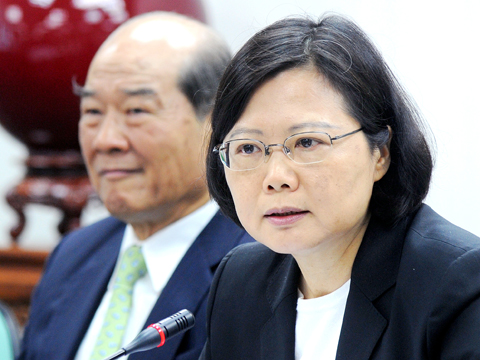
PHOTO: LU CHUN-WEI, TAIPEI TIMES
On Thursday, the Executive Yuan’s Referendum Review Committee rejected the DPP’s petition for a referendum on the economic cooperation framework agreement (ECFA) that the government plans to ink with Beijing.
The DPP had hoped to have the nation’s voters answer the question: “Do you agree that the government should put the ECFA that Taiwan signs with China to a referendum?”
Of the 19 members of the 21-member committee who attended Thursday’s review, only four voted in favor of the DPP’s proposal, while two abstained and the rest voted to reject it on the grounds that it is based on a hypothetical situation that does not meet the criteria of the Referendum Act (公投法).
Tsai rejected this line of thinking, saying that holding a referendum on a trade pact that poses potential threats to local industries one year after it goes into effect would be “too little, too late.”
“We can safely conclude that the members of the review committee are either ultra-conservative or hold biased political opinions,” Tsai said, adding that the purpose behind the DPP’s proposal was to highlight the shortcomings of the current Referendum Act.
The crux of the DPP petition, she said, was to urge the government to voluntarily hold referendums on major issues, such as an ECFA, that affect the livelihood of every person in Taiwan.
The ECFA is more than an economic trade deal, and touches upon Taiwan’s status as a sovereign nation, she said.
Also attending the press conference, Taiwan Solidarity Union Chairman Huang Kun-huei (黃昆輝) said he suspected the committee was pressured to object to the DPP’s petition to offset the wrath of Beijing about the Dalai Lama’s upcoming visit.
Huang said that if Penghu County can be allowed to hold a referendum on building casinos on the island, it made no sense for the government to block a referendum on an agreement that could affect the lives of all Taiwanese people.
ADDITIONAL REPORTING BY CNA

FUKUOKA SITUATION: Japanese media reported that the pathogen is expected to be identified by the summer, while the CDC downplayed the idea that it was hMPV A “mysterious cold-like illness” reported in Japan’s Fukuoka Prefecture does not seem to be a new disease, but Japanese authorities have been asked about the situation, the Centers for Disease Control (CDC) said yesterday. The Fukuoka Prefectural Medical Association on Wednesday told a news conference that a “mystery cold” that has become a hot topic on social media is “highly likely to be caused by some kind of viral infection,” Japan’s KBC News reported. “Many people are experiencing symptoms starting with a sore throat, followed by a runny nose, phlegm and a severe cough,” KBC News reported, citing association officials. Health authorities are

Nvidia Corp CEO Jensen Huang (黃仁勳) arrived in Taiwan yesterday ahead of upcoming AI and technology events, saying he plans to meet with clients and Taiwan Semiconductor Manufacturing Co Chairman C.C. Wei (魏哲家) during his visit. After landing at Taipei Songshan Airport, Huang posed for photos with fans and handed out Yakult drinks to reporters and supporters waiting at the scene, saying he has “a lot to do” during the trip. Asked about reports that Nvidia’s planned headquarters site in Taipei’s Beitou Shilin Technology Park could break ground on May 27, Huang said that if the company holds an event, he would

Carrefour Taiwan is to begin using a new name from the start of July, but it cannot divulge the name until then, the chairman of the supermarket chain's parent company said today. President Chain Store Co chairman Lo Chih-hsien (羅智先) was asked by reporters after a shareholders' meeting to confirm whether the company has settled on a new name for the supermarket brand. In March, the government-registered name of two Carrefour Taiwan branches was quietly changed to "Le Chia Kang" (樂家康) in Chinese, raising speculation that has been selected as the name. Lo said that because of local regulations and contractual obligations, the
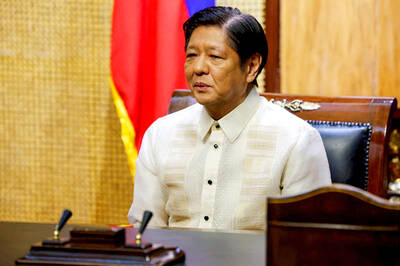
The Philippines would likely be involved in any conflict over Taiwan due to its proximity to the democracy claimed by China, President Ferdinand Marcos Jr said, reiterating a stance that risks angering Beijing. “In the Philippines, we do not have a choice because Taiwan is so close to the Philippines and we have almost 200,000 Filipino nationals living and working in Taiwan,” Marcos said in an interview with Japanese media in Manila on Monday. The Philippine leader’s comments come ahead of a state visit to Japan next week, where he is to meet with Japanese Prime Minister Sanae Takaichi to discuss security


 RSS
RSS