

Late US senator Edward Kennedy, who died on Tuesday at the age of 77, was remembered on Wednesday as a loyal friend to Taiwan.
Throughout his long and colorful career as a politician, Kennedy championed liberal domestic policies that promoted civil rights and dramatically improved life for the poor, while along the way he became especially interested in Taiwan.
Gerrit van der Wees, editor of the Taiwan Communique at the Formosan Association for Public Affairs, said that in the early and mid-1980s, Kennedy played an important role in Taiwan’s transition to democracy — he initiated many hearings and held press conferences to highlight martial law was still in place in Taiwan and had been in force since 1949, and the country’s lack of democracy.
Kennedy worked closely with the late senator Claiborne Pell, and congressmen Jim Leach and Stephen Solarz.
“Together, they were affectionately referred to as the “Gang of Four” in support of democracy and human rights in Taiwan,” van des Wees said. “The efforts of senator Kennedy and his colleagues in the US Congress strengthened the democratic opposition on the island, which coalesced and led to the formation of the Democratic Progressive Party in September 1986, and the end of martial law on July 14, 1987. The Taiwanese-American community and the people in Taiwan fondly remember senator Kennedy as one who stood with them in one of the most difficult periods in the island’s history. We will miss him.”
In a 1982 Senate speech, Kennedy said: “In Taiwan today, a broad range of basic liberties are denied. Serious restrictions are placed on press and political freedoms. Strikes are outlawed. Political and religious leaders have been subjected to arbitrary arrest and imprisonment. Military tribunals are used for civil cases and a range of other abuses persist.”
“Some members of the legislature in Taiwan have had the courage to question these restrictions and have called upon the government to set them aside, but despite these protests, there has been insufficient progress in restoring human rights for the people of Taiwan,” Kennedy said. “For several years, I have persisted in private efforts to alleviate this burden of repression. I therefore call on the leadership of Taiwan to take immediate action to release the political and religious prisoners and to improve the human rights situation on the island.”
“The United States is proud of its long and close relationship with those who live on Taiwan and I am proud of my own role in the Senate as the principal sponsor of the Taiwan Security Resolution in 1979 — now part of the law of our land — which was specifically designed to reassure the people of Taiwan about our concern for their security and prosperity and for peace in the area,” he said. “Now, as then, our friendship with Taiwan is based on a continued interest in their wellbeing and on a common belief in freedom, and in fundamental human rights.”
Also See: Senator Kennedy to be buried tomorrow
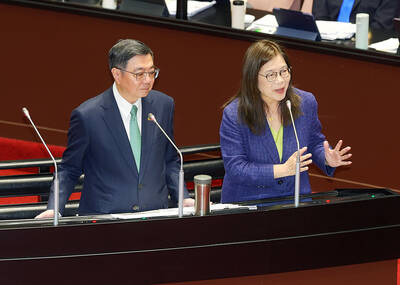
The donation of offshore patrol vessel Kinmen to the Philippines includes provisions that protect Taiwanese fishers and facilitate security cooperation across the First Island Chain, officials said yesterday. The comment was made during the Cabinet’s comprehensive administrative report at the legislature after Chinese Nationalist Party (KMT) Legislator Hsu Yu-chen (許宇甄) expressed concerns about the decision to give a ship to a country whose coast guard had in 2013 fired on a Taiwanese trawler and killed its captain without provocation. The Cabinet should lay out the safeguards that have been established to prevent the Philippine government from using the Kinmen to harass, expel
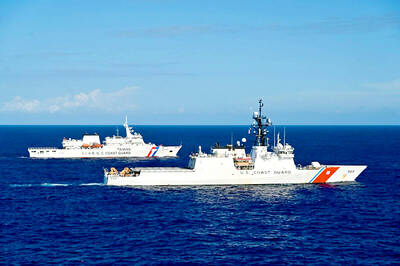
GROWING TIES: The CGA is planning a goodwill mission to the Philippines, in what would be the first time since 1975 a Taiwanese paramilitary vessel has visited the country The Coast Guard Administration (CGA) plans to significantly expand its participation in international security cooperative frameworks and its operational capabilities, a budget proposal for next year showed. The budget indicates a transformation of the CGA from a maritime law enforcement arm into a national defense and intelligence gathering entity capable of tackling larger regional security matters. The proposal showed that personnel from the coast guard’s Intelligence Division and Special Action Support Center are to participate in high-level national security talks with the US. As the CGA has dealt with China’s rising “gray zone” threats around Taiwan, it has become a valuable asset to
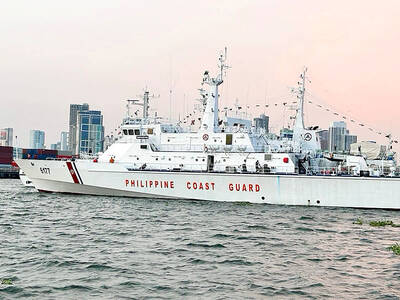
A patrol vessel donated by the Coast Guard Administration (CGA) to the Philippines was commissioned into the Philippine Coast Guard (PCG) on Friday, a Philippine non-governmental organization said. The CGA on Sept. 16 confirmed media reports that Taiwan had donated a retired 500-tonne patrol vessel to the Philippines. The Manila-based We Protect Our Seas (WPS) foundation, which served as an intermediary in the transfer, said that the vessel was formerly the CGA’s 500-tonne petrol vessel Kinmen (CG123). The WPS, in a statement issued on Friday, said the vessel, renamed as the BRP Sarangani, had been commissioned into the PCG the
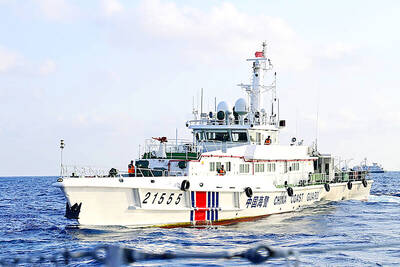
‘GRAY ZONE’ TACTICS: Beijing sent two China Coast Guard vessels to escort a ‘supposedly private research ship,’ a Philippine Coast Guard spokesman said The Coast Guard Administration (CGA) yesterday confirmed that it had recently deployed three patrol vessels to waters in Taiwan’s overlapping exclusive economic zone with the Philippines to monitor three Chinese vessels. CGA Deputy Director-General Hsieh Ching-chin (謝慶欽) said the agency regularly monitors Chinese vessels around Taiwan, and that the deployment south of Oluanpi (鵝鑾鼻), Taiwan proper’s southernmost point, was carried out in accordance with standard procedures. He added that the waters fall within the overlapping exclusive economic zones of Taiwan and the Philippines, which extend 200 nautical miles (370km) from their coastlines. Hsieh made the comments when asked about a


 RSS
RSS