

All seven mosquito coils made by the Crocodile Coil brand tested by the Environmental Protection Administration (EPA) contained dioxin levels more than 100 times the industrial norm, the EPA said at a press conference yesterday.
As the products pose a possible health risk, people should avoid buying Crocodile Coil products until the matter is resolved, the EPA said.
In addition to recalling all its products, Crocodile Coil said it would offer refunds to customers, EPA Deputy Minister Chang Tzi-chin (張子敬) said.
The EPA’s investigation of dioxin levels in all the mosquito coils on the market came after the administration’s unexpected finding during a random inspection on July 25 that two Crocodile Coil brand products — Vietnam-made Crocodile Dye-free Coil (product No. 0661) and Crocodile Light (product No. 0670) — contained 423 and 348 picograms of international toxic equivalent per gram (pg I-TEQ/g) of dioxin respectively.
Dioxins are listed by the WHO as carcinogens. If exposed to burning coils in closed environments for two or three months, a person’s risk of developing cancer could increase 3.7-fold, said director-general of the Department of Environmental Sanitation and Toxic Substances Yuan Shao-ying (袁紹英).
After receiving the test results last month, the EPA demanded that Crocodile Coil withdraw the two products and two other Vietnam-made coils from the market and said it would test all mosquito coils sold in Taiwan.
“After testing 20 products, we found that seven contained dioxin levels ranging from 163 to 624 pg I-TEQ/g, while the levels in the other 13 were 0 to 4 pg I-TEQ/g. All seven contaminated products were from the Crocodile Coil brand,” Chang said.
Although the contamination is believed to have originated from wood powders Crocodile Coil purchased from a Vietnamese firm — which it then distributed to its plants in Vietnam, Indonesia, China and Malaysia — Chang said the EPA had nevertheless demanded that Crocodile Coil launch an investigation to determine the source.
People who have been using the coils should not be overly worried, however, Yuan said.
“If a person has used the coils according to the instructions on the package ... the chances of inhaling excess dioxins are low,” Yuan said.

The donation of offshore patrol vessel Kinmen to the Philippines includes provisions that protect Taiwanese fishers and facilitate security cooperation across the First Island Chain, officials said yesterday. The comment was made during the Cabinet’s comprehensive administrative report at the legislature after Chinese Nationalist Party (KMT) Legislator Hsu Yu-chen (許宇甄) expressed concerns about the decision to give a ship to a country whose coast guard had in 2013 fired on a Taiwanese trawler and killed its captain without provocation. The Cabinet should lay out the safeguards that have been established to prevent the Philippine government from using the Kinmen to harass, expel
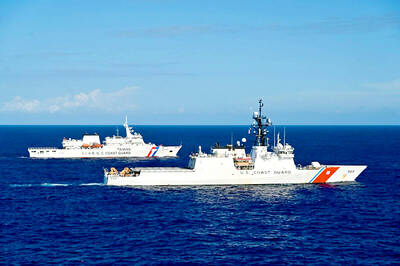
GROWING TIES: The CGA is planning a goodwill mission to the Philippines, in what would be the first time since 1975 a Taiwanese paramilitary vessel has visited the country The Coast Guard Administration (CGA) plans to significantly expand its participation in international security cooperative frameworks and its operational capabilities, a budget proposal for next year showed. The budget indicates a transformation of the CGA from a maritime law enforcement arm into a national defense and intelligence gathering entity capable of tackling larger regional security matters. The proposal showed that personnel from the coast guard’s Intelligence Division and Special Action Support Center are to participate in high-level national security talks with the US. As the CGA has dealt with China’s rising “gray zone” threats around Taiwan, it has become a valuable asset to
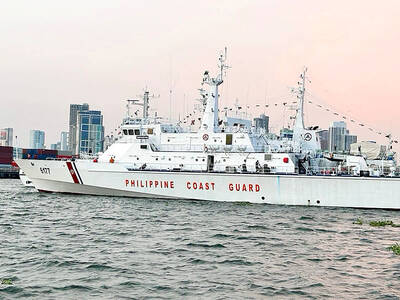
A patrol vessel donated by the Coast Guard Administration (CGA) to the Philippines was commissioned into the Philippine Coast Guard (PCG) on Friday, a Philippine non-governmental organization said. The CGA on Sept. 16 confirmed media reports that Taiwan had donated a retired 500-tonne patrol vessel to the Philippines. The Manila-based We Protect Our Seas (WPS) foundation, which served as an intermediary in the transfer, said that the vessel was formerly the CGA’s 500-tonne petrol vessel Kinmen (CG123). The WPS, in a statement issued on Friday, said the vessel, renamed as the BRP Sarangani, had been commissioned into the PCG the
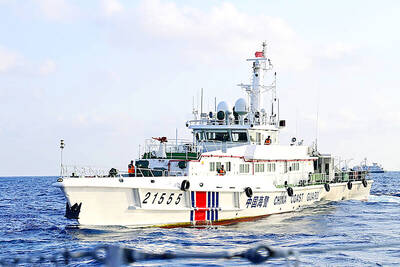
‘GRAY ZONE’ TACTICS: Beijing sent two China Coast Guard vessels to escort a ‘supposedly private research ship,’ a Philippine Coast Guard spokesman said The Coast Guard Administration (CGA) yesterday confirmed that it had recently deployed three patrol vessels to waters in Taiwan’s overlapping exclusive economic zone with the Philippines to monitor three Chinese vessels. CGA Deputy Director-General Hsieh Ching-chin (謝慶欽) said the agency regularly monitors Chinese vessels around Taiwan, and that the deployment south of Oluanpi (鵝鑾鼻), Taiwan proper’s southernmost point, was carried out in accordance with standard procedures. He added that the waters fall within the overlapping exclusive economic zones of Taiwan and the Philippines, which extend 200 nautical miles (370km) from their coastlines. Hsieh made the comments when asked about a


 RSS
RSS