


A group of young bikers from National Taiwan Normal University this month embarked upon a journey mentioned in the travel journal of a Qing Dynasty official and managed to complete their trip in 20 days.
Yu Yonghe (郁永河) was ordered by the Qing government to explore sulphur mines in Taiwan in 1697. He took a boat from Xiamen and arrived in Luermen (鹿耳門) in Tainan via Kinmen and Penghu. Yu then traveled up the west coast to Tamsui (淡水) and Beitou (北投).
Yu recorded his experiences in his journal, which was later published as the Bihai Travel Journal (裨海紀遊), one of the oldest travel guides for Taiwan.
Milly Lin (林于喬) was the captain of the biking team. She said she came across Yu’s journal when she was a student teacher.
“I taught history and was very interested in the history of Taiwan’s Aborigines,” she said in an interview with Taipei Times. “While I knew a lot about the Aborigines living in the mountains, I knew very little about the Pingpu tribes living on the plains. I later found that the journal actually said quite a lot about the Pingpu tribes.”
When the National Youth Commission said earlier this year it would subsidize young travelers who came up with creative ways to tour the country this summer, Lin pitched her idea and it was accepted.
The group first flew to Kinmen and biked around the island. Then they flew to Kaohsiung and took a ferry to Penghu because there are no flights between Kinmen and Penghu. After a bike tour there, they took a ferry to Kaohsiung and rode to Luermen, seeking the locations mentioned in Yu’s journal.
Lin also used articles by author Chiang Hsun (蔣勳) and former Control Yuan member Ma Yi-kung (馬以工), who made the same trip 30 years ago, to help her sketch out a more concrete travel route.
“We wanted to stick to provincial highways as much as possible, but unfortunately a lot of names mentioned in the journal were pretty far from the provincial highways and we ended up spending a lot of time on the county roads,” she said.
The five-member team began their adventure on July 5 and finished the trip last Friday, although Yu’s journey took several months in 1697.
“I can’t imagine how Yu and Qing officials were able to do this all on ox carriages,” Lin said.
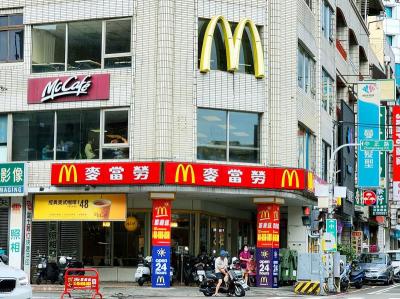
Fast food chain McDonald's is to raise prices by up to NT$5 on some products at its restaurants across Taiwan, starting on Wednesday next week, the company announced today. The prices of all extra value meals and sharing boxes are to increase by NT$5, while breakfast combos and creamy corn soup would go up by NT$3, the company said in a statement. The price of the main items of those meals, if ordered individually, would remain the same. Meanwhile, the price of a medium-sized lemon iced tea and hot cappuccino would rise by NT$3, extra dipping sauces for chicken nuggets would go up

Nvidia Corp CEO Jensen Huang (黃仁勳) arrived in Taiwan yesterday ahead of upcoming AI and technology events, saying he plans to meet with clients and Taiwan Semiconductor Manufacturing Co Chairman C.C. Wei (魏哲家) during his visit. After landing at Taipei Songshan Airport, Huang posed for photos with fans and handed out Yakult drinks to reporters and supporters waiting at the scene, saying he has “a lot to do” during the trip. Asked about reports that Nvidia’s planned headquarters site in Taipei’s Beitou Shilin Technology Park could break ground on May 27, Huang said that if the company holds an event, he would

FUKUOKA SITUATION: Japanese media reported that the pathogen is expected to be identified by the summer, while the CDC downplayed the idea that it was hMPV A “mysterious cold-like illness” reported in Japan’s Fukuoka Prefecture does not seem to be a new disease, but Japanese authorities have been asked about the situation, the Centers for Disease Control (CDC) said yesterday. The Fukuoka Prefectural Medical Association on Wednesday told a news conference that a “mystery cold” that has become a hot topic on social media is “highly likely to be caused by some kind of viral infection,” Japan’s KBC News reported. “Many people are experiencing symptoms starting with a sore throat, followed by a runny nose, phlegm and a severe cough,” KBC News reported, citing association officials. Health authorities are

Carrefour Taiwan is to begin using a new name from the start of July, but it cannot divulge the name until then, the chairman of the supermarket chain's parent company said today. President Chain Store Co chairman Lo Chih-hsien (羅智先) was asked by reporters after a shareholders' meeting to confirm whether the company has settled on a new name for the supermarket brand. In March, the government-registered name of two Carrefour Taiwan branches was quietly changed to "Le Chia Kang" (樂家康) in Chinese, raising speculation that has been selected as the name. Lo said that because of local regulations and contractual obligations, the


 RSS
RSS