

“If doctors can treat patients pro-bono, of course architects can build houses for free,” said architect Chien Chih-ming (簡志明), who believes that architects should pay attention to disadvantaged areas in the country. “Let’s go build houses for Aboriginal children in the mountains of Nantou County.”
At Chien’s urging, a group of young people with backgrounds in architectural design collected their tools earlier this month and went to the mountains to rebuild classrooms in the community school at a Bunun Aboriginal village with locals. Although the task wasn’t easy and funding it was a problem, the group of young architects said they would continue as long as Aboriginal communities needed it.
Chien came up with the idea of building houses for Aboriginal communities pro bono when a colleague at an elementary school in Hsinyi Township (信義), Nantou County, told him that classrooms at the community school in the village were damaged by a typhoon and that the villagers could not afford to reconstruct them.

PHOTO: CHEN HSIN-JEN, TAIPEI TIMES
After hearing of the school’s problems, Chien gathered 30 students from National Taipei University of Technology, National Chengkung University and National Chiaotung University to start a reconstruction project in the village.
They used computer graphics to design and analyze the structure of traditional bamboo houses and discussed details with local villagers and elementary students.
They also fused together modern architectural technology with traditional Bunun building styles.
The reconstruction project is scheduled to be completed next Monday, with an inauguration ceremony to be held the following day. Chien said that classrooms at the community school would be used for teaching Bunun children traditional handicrafts such as cloth-weaving, bamboo-weaving and wood-carving.
Following Bunun tradition, the classrooms are built with bamboo and covered with a transparent material.
Because Chien found that local elementary students were talented at drawing, he asked the children to paint decorations on the classrooms’ exteriors.
The volunteer architects get up every morning at 6am to work at the construction site, then meet at night to review what went right and what went wrong during the day, as well as learn bamboo-weaving from experienced Bunun elders.
The college students said they were not bothered by sleeping on the ground and eating boxed meals, although they were constantly harassed by mosquitoes at night.
“I’m not interested in making money, I like more challenging jobs,” Chien said. “If doctors can save people with their knowledge in medicine, why can’t we do the same with architecture?”
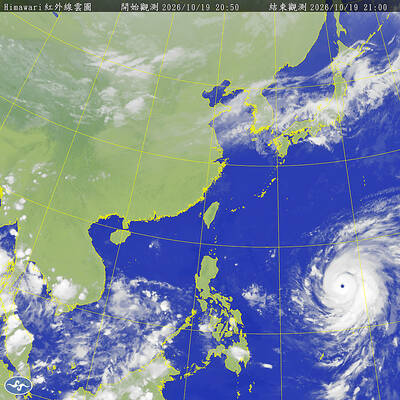
Typhoon Champi is forecast to turn northward earlier than previously expected, sparing Taiwan a direct hit but still bringing heavy rain to the north of the country on Friday and Saturday, the Central Weather Administration (CWA) said yesterday. Typhoon Champi had strengthened and increased in size over the past 12 hours, and as of yesterday afternoon, was packing sustained winds of 198kph near its center, CWA forecaster Cheng Chieh-jen (鄭傑仁) said. However, due to the weakening of a Pacific high-pressure system the storm is now expected to turn northward earlier than initially forecast, likely around Japan’s Ishigaki Island, Cheng said. As Champi brushes
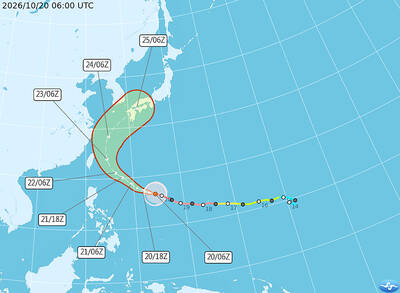
A sea warning for Typhoon Champi might be issued tonight, while the storm’s trajectory would determine whether a land warning is to be issued tomorrow night, the Central Weather Administration (CWA) said yesterday. As of 2pm yesterday, Champi was about 1,536km east-southeast of Taiwan proper’s southernmost point, Oluanpi (鵝鑾鼻), packing maximum sustained winds of 198kph, CWA forecaster Tseng Chao-cheng (曾昭誠) said. The storm was moving west-northwest at 23kph and was expected to strengthen over the next 24 hours before weakening slightly as it approaches cooler waters east of Taiwan, Tseng said. Champi is expected to turn north tomorrow, with the angle of the
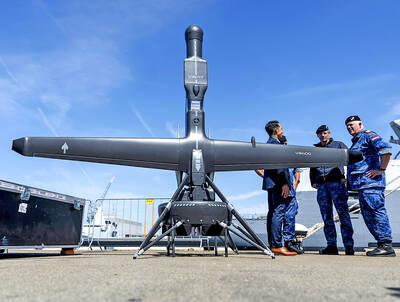
DEFENSE PROCUREMENT: Taiwan could become the largest operator of V-BAT drones outside the US if the contract is finalized, the Ministry of National Defense said The navy and the coast guard reportedly plan to acquire 292 units of MQ-35A V-BAT vertical takeoff and landing (VTOL) surveillance drones. If the contract is awarded and finalized, it would make Taiwan one of the largest buyers of the uncrewed aerial vehicle (UAV) developed by the US-based defense technology company Shield AI. The Coast Guard Administration budgeted NT$1.2 billion (US$37.1 million) to buy 12 drones, which have been delivered, Shield AI said in a report on Oct 13. The navy is planning to spend NT$36 billion under a four-year program code-named Project Yuan Hsiao (遠鴞) to acquire 280 V-BAT drones,
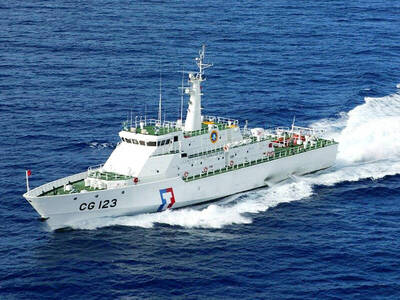
A patrol vessel donated by the Coast Guard Administration (CGA) to the Philippines would not be used in waters near Taiwan or areas where Taiwanese fishing vessels operate, Premier Cho Jung-tai (卓榮泰) said yesterday. The vessel, formerly the CGA's 500-tonne-class Kinmen (金門), was commissioned into the Philippine Coast Guard on Oct. 2. Speaking at the Legislative Yuan, Cho said the Philippines had pledged during the donation process that the vessel would be used only for designated missions and would not operate in waters related to Taiwan. The vessel could even provide assistance to Taiwan if needed, he added. Responding to questions from Chinese


 RSS