

President Ma Ying-jeou (馬英九) said yesterday that law enforcement agencies should be more tolerant of his critics — including five students who heckled him in Tainan on Sunday — saying that democracy is not only about appearance, but also substance.
Ma said the five students protesting the government’s policy to open up to Chinese university students and cross-strait investment were taken away by police. Law enforcement agencies should exercise more caution to ensure that differing opinions can be freely expressed, he said.
Although Taiwan has seen two transfers of power, there is much room for improvement in terms of tolerance, Ma said.
Taiwan is an immigrant society made up of diverse ethnic groups, he said, and tolerance is a core value bequeathed by our forefathers.
“Tolerance is key to the survival of a multi-ethnic society,” he said.
Ma made the remarks at a conference on the 90th anniversary of the May Fourth Movement at Academia Sinica in Taipei.
The movement was launched in China in 1919, with intellectuals and students protesting traditional feudal culture, and was spurred by the allocation of German concessions in China to Japan as part of the Treaty of Versailles. The movement is considered the beginning of China’s modernization.
Ma quoted Hu Shih (胡適), a key figure in the May Fourth Movement, as saying “democracy is a lifestyle of reason and tolerance.”
The essayist believed democracy could create a society that values freedom and tolerates dissenting opinions, Ma said.
Quoting the famous comment often attributed to Voltaire, Ma said: “I disapprove of what you say, but I will defend to the death your right to say it.”
“The more civilized a society, the more tolerant [it is] of different opinions,” he said. “Not only should the ruling party be tolerant of criticism against it, but the opposition should be open, too, to different opinions.”
A society with only two voices is not a civilized, democratic society, he said.
Taiwan has undergone two transfers of power and remains steady on the path of democracy, Ma said. Even during the authoritarian era, the country had a constitutional system, he said.
The spirit of the May Fourth Movement was put into practice in Taiwan’s democratization and the public cherishes the results.
Taiwan’s democracy has significance for the greater Chinese community as well, he said.
Meanwhile, Minister of Education Cheng Jei-cheng (鄭瑞城) told Democratic Progressive Party (DPP) Legislator Kuan Bi-ling (管碧玲) yesterday at a question-and-answer session of the legislature’s Education and Culture Committee, that “students enjoy the right to express their opinions and their freedom of speech should be protected.”
Speaking on condition of anonymity, one of the five students who heckled Ma said the police would not let the group leave until they had offered a full account of their protest.
“We were just voicing our opinion in front of [Ma]. I’m positive that he saw us and turned a blind eye,” the student said.
In related developments, DPP Department of Youth Development director Chao Tien-lin (趙天麟) said the five students had been beaten by persons wearing black as they protested.
Police did not arrest the attackers, but instead arrested the students, Chao said, accusing Ma and the government of bullying the students and possibly encouraging gangsters to attack them.
Chao said the party had requested the government investigate the incident and charge the assailants.
ADDITIONAL REPORTING BY FLORA WANG AND RICH CHANG
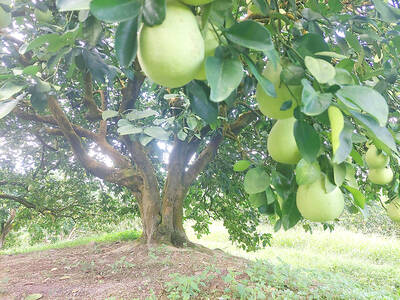
A Hualien pomelo farmer refused to sell to China after the country announced it would permit more Taiwanese pomelo imports, prompting widespread support from Taiwanese consumers, who rallied to buy his fruit. China’s Taiwan Affairs Office last month said that China’s General Administration of Customs registered an additional 79 Taiwanese pomelo orchards and packing facilities in Hualien County, allowing more Taiwanese producers to export pomelos to China. “I am a Hualien fruit farmer and I refuse to sell to China,” Liu Tzu-hao (劉子豪) from Ruisui Township (瑞穗) said in an online post. Liu is a well-known farmer in the community and has served
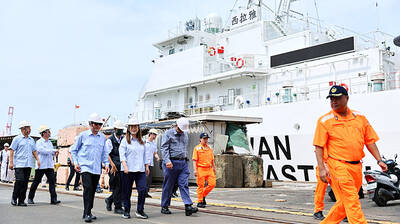
Ocean Affairs Council (OAC) Minister Kuan Bi-ling (管碧玲) on Wednesday said decommissioned coast guard vessels were given to the Philippines to enhance regional rescue capacity and would not affect Taiwanese fishers’ rights and benefits. Kuan made the remarks after confirmation on Tuesday that a 500-tonne Coast Guard Administration (CGA) patrol and rescue vessel would be given to the Philippine Coast Guard. The donation ceremony was reportedly done in Manila, but whether the vessel — previously numbered “CG123” and named Kinmen (金門) — has been handed over has yet to be confirmed. China’s Taiwan Affairs Office (TAO) on Wednesday criticized the donation for “taking
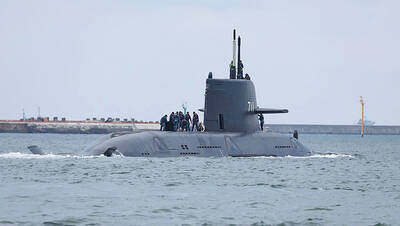
UPDATE: The submarine would need to undergo combined systems testing and crew training for navy personnel before it is ready for mission, an expert said Taiwan’s first domestically built submarine, the Hai Kun (Narwhal, 海鯤), could be delivered to the navy as early as next month, military expert and Taiwan Association for Security and Development chairman Chi Tung-yun (紀東昀) said yesterday. The submarine was yesterday morning observed departing for its 21st sea trial and its 15th submerged test. The vessel missed the initial delivery deadline of November last year due to “testing delays,” its primary contractor, shipbuilder CSBC Corp, Taiwan, said in June. The contractor also cited “political pressure from China” in procuring critical equipment. All testing operations are in the final stages, with the
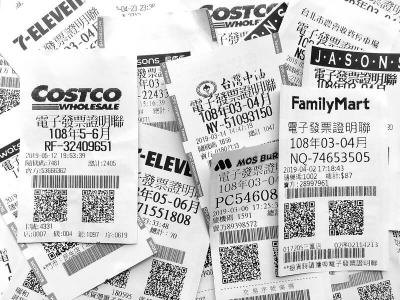
Six NT$10 million (US$315,527) special prizes and seven NT$2 million grand prizes in Taiwan's May-June uniform invoice lottery remained unclaimed as of today, including one NT$10 million winner who spent only NT$10 on an Uber Eats delivery order, the Ministry of Finance said. The ministry said the 13 winners need to claim their prizes by Nov. 5. The eight-digit serial number that won the NT$10 million special prize for May-June was 38548029, with 18 winning receipts in total. The NT$2 million grand prize number was 10138845, of which there were 22 winning receipts, the ministry said. In addition to the receipt issued for an


 RSS
RSS