


Ninety-three-year-old Wang King-ho (王金河) looks like an ordinary grandfather, but there is more to him than meets the eye — a painful story set in the coastal area of southern Taiwan.
Back in the late 1950s, a mystery illness dubbed by locals as “Blackfoot disease” afflicted several townships in Tainan and Chiayi counties including Hsuehchia (學甲), Beiman (北門), Budai (布袋) and Yijhu (義竹), where residents mainly depended on deep wells for drinking water.
“The wells they drilled became deeper and deeper because water from shallow wells tasted too salty as a result of the local salt industry,” said Shin Ya-ping (施雅屏), a staffer from the Southwest Coast National Scenic Area Administration.
But people in the townships did not know the water they drank everyday contained arsenic, which led to the chronic poisoning of local residents, Shin said.
As its name suggests, Blackfoot disease started with the tips of a patient’s limbs — usually their feet — turning black. What often followed the change of color was death of tissue (necrosis) and extreme pain as patients’ blood vessels were unable to deliver nutrients to tissues at the peripheries of their limbs.
Patients usually had to endure multiple amputations as necroses recurred on remaining parts of their limbs.
In addition to physical pain, patients were often shunned as the disease was considered a punishment from the gods.
The condition existed for years before Wang, then a 44-year-old doctor who had studied medicine in Tokyo, came onto the scene.
At the invitation of Lilian Dickson, a US missionary and founder of the Mustard Seed Mission, Wang established the nation’s first and only free clinic for patients with Blackfoot disease in 1960.
“I treated 2,000 to 3,000 patients suffering from [Blackfoot disease] during my 35 years of practice, with the youngest being a five-year-old child,” Wang said in an interview with the Taipei Times in front of his old clinic in Beimen Township.
Wang and Hsieh Wei (謝緯) — a doctor from Puli Township (埔里) in Nantou County — performed amputations inside the small clinic, while Dickson and the mission raised funds to support their work.
“I still remember that one of the patients was a very beautiful bride-to-be,” said Wang Hsiu-yun (王琇雲), a nurse who joined Wang King-ho’s practice in her teens.
“When she was diagnosed with the illness, she kept crying and didn’t want to have her foot amputated,” Wang Hsiu-yun said.
Some patients could not be saved so Wang and his two nurses also made coffins and helped bury them.
“My mother warned me that I could end up being single for the rest of my life because no man would dare to marry me since I helped Dr Wang carry the coffins,” Wang Hsiu-yun said.
Over the years, the clinic also sheltered patients who were rejected by their own families. At one point, the number of patients the small structure housed reached about 80 people.
To encourage patients who had become disillusioned as a result of the physical and psychological pain, Wang King-ho launched a handicraft training class at the back of the clinic in the hope that they could at least acquire some skills.
Wang and his wife Mao Pi-mei (毛碧梅) ran the class for 17 years before the Taiwan provincial government took over in 1978.
Though the provincial government also established an official Blackfoot disease prevention center in Beiman in 1977, Wang did not end his practice until 1996 — 50 years after he first started practicing medicine.
Although Wang saw many deaths and much suffering during his three decades of treating the disease, he said he never felt discouraged.
“I did not become a doctor in order to make more money. That’s why I did not lose my spirit after having treated so many patients,” Wang said.
Wang’s old clinic — a modest Japanese-style one-story wooden structure — was designated as the Taiwan Blackfoot Disease Socio-Medical Service Memorial House at the end of September 2007 to commemorate Wang’s selfless dedication and the history of a disease unique to Taiwan.
The house faithfully recreates Wang’s operating room as it was 30 years ago and has a set of patients’ amputated feet preserved in formaldehyde.
“The memorial house now serves as a witness of Taiwan’s 30-years of Blackfoot disease. It can also help pass on Dr Wang’s spirit,” said Wang Hsiu-yun, who returned to Beiman as a volunteer at the house after learning of the opening of the memorial.
“Dr Wang often delivers speeches to medical students,” she said. “He usually tells them that even though it is great for them to be able to make a lot of money [by becoming a doctor], sometimes doing volunteer work can bring happiness that they cannot buy.”

The US House of Representatives yesterday passed the PROTECT Taiwan Act, which stipulates that Washington would exclude China from participating in major global financial organizations if its actions directly threaten Taiwan’s security. The bill, proposed by Republican US Representative Frank Lucas, passed with 395 votes in favor and two against. It stipulates that if China’s actions pose any threat to Taiwan’s security, economic or social systems, the US would, “to the maximum extent practicable,” exclude China from international financial institutions, including the G20, the Bank for International Settlements and the Financial Stability Board. The bill makes it clear that China

Taiwan’s Li Yu-hsiang performs in the men’s singles figure skating short program at the Milano-Cortina Winter Olympics, in Milan, Italy, on Tuesday. Li finished 24th with a score of 72.41 to advance to Saturday’s free skate portion of the event. He is the first Taiwanese to qualify for the free skate of men’s singles figure skating at the Olympics since David Liu in 1992.
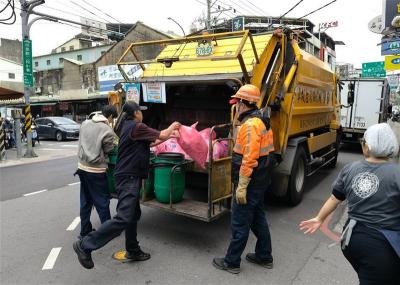
Garbage and recycling schedules are to vary from Saturday through Sunday next week over the Lunar New Year holiday period. The following collection information is from the governments of the six special municipalities. Taipei Regular service: Sunday to Monday next week. No service: Tuesday to Thursday next week. Extra service: Friday next week. Regular service resumes: Saturday next week. New Taipei City Extra service: Sunday. Adjusted collection time: Monday next week — garbage collection is to begin in the morning and end at 6pm. No service: Tuesday to Thursday next week. Regular service resumes: Friday next week. Note: Garbage can be dropped off at 70

The Coast Guard Administration (CGA) yesterday held a ceremony marking the delivery of its 11th Anping-class offshore patrol vessel Lanyu (蘭嶼艦), saying it would boost Taiwan’s ability to respond to Beijing’s “gray zone” tactics. Ocean Affairs Council Deputy Minister Chang Chung-Lung (張忠龍) presided over the CGA event in the Port of Kaoshiung. Representatives of the National Security Council also attended the event. Designed for long-range and protracted patrol operations at sea, the Lanyu is a 65.4m-long and 14.8m-wide ship with a top speed of 44 knots (81.5kph) and a cruising range of 2,000 nautical miles (3704km). The vessel is equipped with a


 RSS
RSS