

They danced, they sang, they prepared a feast for their guests. It could have been any other weiya (尾牙, year-end party held before the Lunar New Year), but this party was a demonstration and the hosts were worried about their future despite the festival atmosphere.
After a long struggle with the Taipei County Government to spare their homes from demolition last year, residents of the Sanying Aboriginal Community (三鶯部落) organized the protest weiya to show appreciation to their supporters and solidarity among themselves.
“I’m very excited to see so many friends here today. I know all of you have work today, but you still take the time to come out and support us when you hear about the troubles we’re in,” Sanying’s Community chief Kacaw told more than 100 supporters and residents before introducing members of the Sanying Self-Help Association.
“I want you to know that your help and support mean a lot to us, and we want to say thank you,” Kacaw said as the self-help group’s members bowed to the audience.
The Sanying Community is located in Yingge Township (鶯歌), Taipei County on the bank of the Dahan River (大漢溪).
Most of the residents are Amis Aborigines who came to Taipei to work as laborers and built their own simple houses there because they could not afford the city’s real estate prices.
However, as their houses were illegal and located in what the Water Conservation Act (水利法) has classified as a flood zone, the county has torn down their houses several times in the past decades. Although they have rebuilt their homes each time, they still have to live with the fear that their homes could be razed again.
The situation seemed to have taken a turn for the better when Taipei County Commissioner Chou Hsi-wei (周錫瑋) made a surprise visit to the community recently, promising that the county government would not touch their homes until a suitable location had been found for their relocation.
The promise gave the residents some relief, but they said they could not fully believe it until they saw what developed.
“I think we still have a long way to go, but we’re not yet sure what we’ll do next — we’ll probably get our electricity restored first,” Sangying spokeswoman Hung Feng-chin (洪鳳琴) told the Taipei Times.
The electricity was cut during one of the demolitions last year.
In front of Hung were tables with items donated by supporters for fundraising, including a Cape No. 7 (海角七號) movie poster autographed by director Wei Te-sheng (魏德勝), a calendar bearing the autograph of director Hou Hsiao-hsien (侯孝賢) and a pack of rice autographed by farmers’ rights activist Yang Ru-men (楊儒門).
Residents of the Sijhou Aboriginal Community (溪洲部落) — a community in Sindian City (新店), Taipei County, that faces the same fate as Sanying — performed several songs they wrote themselves.
While the county government has left it alone for a year since the last time it threatened to flatten the community in 2007, Sijhou residents were also uncertain about their future.
“The county government said it would find another piece of land for us, but we want to stay where we are,” Sijhou Self-Help Association chairwoman Osay Saoma said. “They haven’t bothered us for sometime already, but we don’t know when they’ll come again.”

The donation of offshore patrol vessel Kinmen to the Philippines includes provisions that protect Taiwanese fishers and facilitate security cooperation across the First Island Chain, officials said yesterday. The comment was made during the Cabinet’s comprehensive administrative report at the legislature after Chinese Nationalist Party (KMT) Legislator Hsu Yu-chen (許宇甄) expressed concerns about the decision to give a ship to a country whose coast guard had in 2013 fired on a Taiwanese trawler and killed its captain without provocation. The Cabinet should lay out the safeguards that have been established to prevent the Philippine government from using the Kinmen to harass, expel
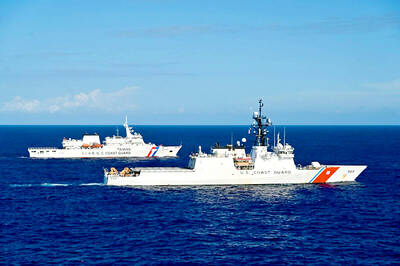
GROWING TIES: The CGA is planning a goodwill mission to the Philippines, in what would be the first time since 1975 a Taiwanese paramilitary vessel has visited the country The Coast Guard Administration (CGA) plans to significantly expand its participation in international security cooperative frameworks and its operational capabilities, a budget proposal for next year showed. The budget indicates a transformation of the CGA from a maritime law enforcement arm into a national defense and intelligence gathering entity capable of tackling larger regional security matters. The proposal showed that personnel from the coast guard’s Intelligence Division and Special Action Support Center are to participate in high-level national security talks with the US. As the CGA has dealt with China’s rising “gray zone” threats around Taiwan, it has become a valuable asset to
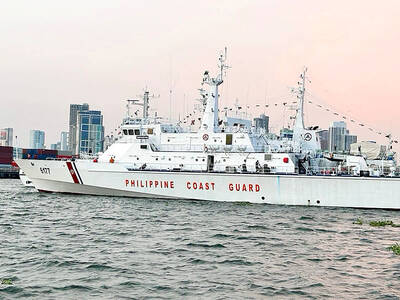
A patrol vessel donated by the Coast Guard Administration (CGA) to the Philippines was commissioned into the Philippine Coast Guard (PCG) on Friday, a Philippine non-governmental organization said. The CGA on Sept. 16 confirmed media reports that Taiwan had donated a retired 500-tonne patrol vessel to the Philippines. The Manila-based We Protect Our Seas (WPS) foundation, which served as an intermediary in the transfer, said that the vessel was formerly the CGA’s 500-tonne petrol vessel Kinmen (CG123). The WPS, in a statement issued on Friday, said the vessel, renamed as the BRP Sarangani, had been commissioned into the PCG the
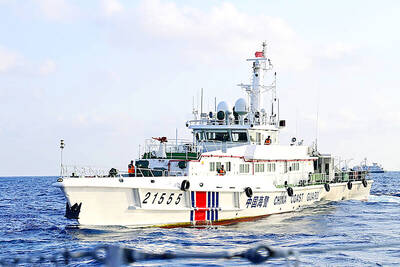
‘GRAY ZONE’ TACTICS: Beijing sent two China Coast Guard vessels to escort a ‘supposedly private research ship,’ a Philippine Coast Guard spokesman said The Coast Guard Administration (CGA) yesterday confirmed that it had recently deployed three patrol vessels to waters in Taiwan’s overlapping exclusive economic zone with the Philippines to monitor three Chinese vessels. CGA Deputy Director-General Hsieh Ching-chin (謝慶欽) said the agency regularly monitors Chinese vessels around Taiwan, and that the deployment south of Oluanpi (鵝鑾鼻), Taiwan proper’s southernmost point, was carried out in accordance with standard procedures. He added that the waters fall within the overlapping exclusive economic zones of Taiwan and the Philippines, which extend 200 nautical miles (370km) from their coastlines. Hsieh made the comments when asked about a


 RSS
RSS