


The Ministry of Justice has asked the Taipei District Court and Taipei Bar Association to investigate whether former president Chen Shui-bian’s (陳水扁) lawyer has violated the lawyer code of ethics by conveying his client’s messages to the outside world during Chen’s detention.
Claiming Cheng Wen-long’s (鄭文龍) statements have been political in nature and defamatory to the judiciary, the Ministry of Justice said on Monday night that it had sent a letter to the Taipei District Court and the Taipei Bar Association, asking if Cheng had violated the lawyer code of ethics.
The court said it would not begin an investigation until it received the letter. The bar association said a task force would be formed to conduct a probe after it receives the official notice.
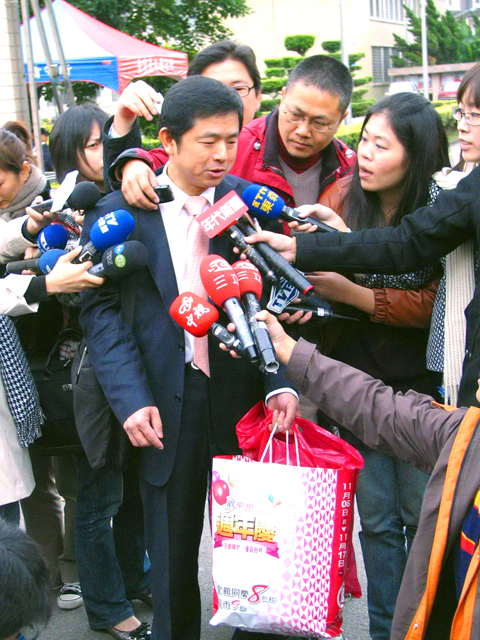
PHOTO: SUN YOU-LIEN, TAIPEI TIMES
Chen’s office issued a statement yesterday condemning the ministry, saying its actions would deprive him of his right to litigation guaranteed by the Constitution.
Cheng has been updating the media about Chen’s condition since he was detained without charge on Nov. 12 and began a fast on Nov. 13 to protest “political persecution.”
Cheng also issued a 10-point statement on behalf of Chen denouncing the “death of the judiciary.”
Attorney Richard Lee (李勝琛) said yesterday that Cheng has not violated legal ethics because he has not divulged anything related to Chen’s legal case.
“The ministry might think that Chen, who is being held incommunicado, should not enjoy freedom of speech,” he said. “It is worth discussing whether it is necessary to be so hard on a former president who suspects his case is politically motivated.”
Chen is suspected of money laundering, accepting bribes, forgery and embezzling NT$15 million (US$450,000) during his presidency.
He has accused the Chinese Nationalist Party (KMT) administration of waging a “political vendetta” against him to curry favor with China.
The latest message Cheng passed on to the media was a poem Chen wrote to his wife, Wu Shu-jen (吳淑珍) and Cheng transcribed during his visit to Chen on Monday.
In the poem, Chen described his political thoughts and his feelings for his wife, including regrets over his failure to listen to her.
Chen has said before that Wu tried to talk him out pursuing a political career.
Wu was indicted in November 2006 on corruption and forgery charges in connection with the use of Chen’s presidential “state affairs fund.” Chen was declared a defendant in the case shortly after he left office on May 20, when his presidential immunity expired.
Meanwhile, Chinese Nationalist Party (KMT) Legislator Tsao Erh-chang (曹爾忠) suggested yesterday that President Ma Ying-jeou (馬英九) consider granting an amnesty to Chen and sending him into exile if Chen admits guilt.
Tsao said Ma should consider pardoning and exiling Chen and his family if and only if the court finds Chen guilty, and Chen pleads guilty and returns the money he allegedly embezzled to the treasury.
Tsao said his proposal was aimed at maintaining social harmony.
“Society has paid a high price for [concentrating on the alleged corruption of] the former first family,” Tsao said.
When approached for comment, KMT caucus secretary-general Chang Sho-wen (張碩文) said the caucus would not discuss the idea until the court convicts Chen.
However, several KMT legislators spoke out yesterday against an amnesty.
KMT Legislator Wu Yu-sheng (吳育昇) said it was unlikely Tsao’s preconditions would be met.
Wu said both pan-blue and pan-green supporters should focus on the judicial investigation into Chen.
KMT Legislator Wu Ching-chih (吳清池) said it was too early for the public to discuss an amnesty.
KMT Legislator Chiu Yi (邱毅) said: “Whoever proposed this idea must be out of his mind.”
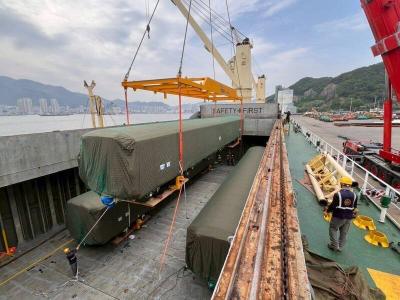
The first of 10 new high-capacity trains purchased from South Korea’s Hyundai Rotem arrived at the Port of Taipei yesterday to meet the demands of an expanding metro network, Taipei Rapid Transit Corp (TRTC) said yesterday. The train completed a three-day, 1,200km voyage from the Port of Masan in South Korea, the company said. Costing NT$590 million (US$18.79 million) each, the new six-carriage trains feature a redesigned interior based on "human-centric" transportation concepts, TRTC said. The design utilizes continuous longitudinal seating to widen the aisles and optimize passenger flow, while also upgrading passenger information displays and driving control systems for a more comfortable

Instead of focusing solely on the threat of a full-scale military invasion, the US and its allies must prepare for a potential Chinese “quarantine” of Taiwan enforced through customs inspections, Stanford University Hoover fellow Eyck Freymann said in a Foreign Affairs article published on Wednesday. China could use various “gray zone” tactics in “reconfiguring the regional and ultimately the global economic order without a war,” said Freymann, who is also a nonresident research fellow at the US Naval War College. China might seize control of Taiwan’s links to the outside world by requiring all flights and ships entering or leaving Taiwan
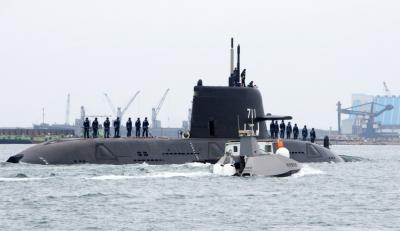
Taiwan's first indigenous defense submarine, the SS-711 Hai Kun (海鯤, or Narwhal), departed for its 13th sea trial at 7am today, marking its seventh submerged test, with delivery to the navy scheduled for July. The outing also marked its first sea deployment since President William Lai (賴清德) boarded the submarine for an inspection on March 19, drawing a crowd of military enthusiasts who gathered to show support. The submarine this morning departed port accompanied by CSBC Corp’s Endeavor Manta (奮進魔鬼魚號) uncrewed surface vessel and a navy M109 assault boat. Amid public interest in key milestones such as torpedo-launching operations and overnight submerged trials,
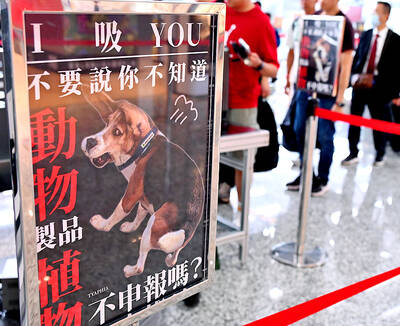
Quarantine awareness posters at Taiwan Taoyuan International Airport have gone viral for their use of wordplay. Issued by the airport branch of the Animal and Plant Health Inspection Agency, the posters feature sniffer dogs making a range of facial expressions, paired with advisory messages built around homophones. “We update the messages for holidays and campaign needs, periodically refreshing materials to attract people’s attention,” quarantine officials said. “The aim is to use the dogs’ appeal to draw focus to quarantine regulations.” A Japanese traveler visiting Taiwan has posted a photo on X of a poster showing a quarantine dog with a


 RSS
RSS