


The Department of Health (DOH) yesterday said that some finished products such as mooncakes and coffee beverages made with imported toxic milk powder have already been sold and consumed.
All future dairy products imported from China, however, will be tested for the presence of melamine, officials said.
The DOH said the powder had not been made into any infant products in Taiwan, but that it had been sold to bakeries, farmers and biochemical companies in many parts of Taiwan to be put into products such as mooncakes, bread, canned coffee beverages, papaya milk beverages, calcium tablets and fertilizer.
The DOH has been able to locate and seal between 50 percent and 60 percent of the contaminated products, authorities said.
“On average, baked goods contain between 1 percent and 3 percent [of the toxic milk powder] and coffee beverages contain 1.5 percent at the most,” said Hsiao Tung-ming (蕭東銘), acting director of the Bureau of Food Safety.
“According to standards set by the European Food Safety Authority, 0.5mg of melamine is the tolerable daily intake for every kilogram of body weight per day,” said Lin Ja-liang (林杰樑), director of clinical toxicology at Chang Gung Memorial Hospital.
This means that a person who weighs 60kg would have to consume more than 200g of pure melamine, or “tens of kilograms of the contaminated milk powder” to die from an overdose.
Lin said the reason for kidney stones in infants in China was because “their kidneys are not fully developed yet and they don’t know how to tell their parents where they hurt,” adding that in Taiwan, because the toxic milk powder is only one of the many ingredients in food and beverage products, “chances [of overdose] are close to zero.”
For those who are still worried about having consumed the harmful substance, Lin’s advice is to detoxify by drinking lots of water.
The safest way is to drink enough water to produce 2000cc of urine, which would lead one to urinate about seven times a day.
“[Doing this] will rid the body of about 90 percent of all kidney stones under 0.5cm,” Lin said.
Lin also said that because the contaminated products “are already in our bodies,” authorities should react faster in the future to protect consumers.
“We will work with the Ministry of Economic Affairs to ensure that all dairy products imported from China have been tested for melamine before they enter our borders,” Hsiao said.
“If China kept the information to themselves, it would have been very difficult for us [to detect that products have been contaminated],” Hsiao said, adding that governmental agencies will work to set up preventative measures.
Control Yuan member Cheng Jen-hung (程仁宏) said yesterday that he would file an application at the Control Yuan today to initiate an investigation to determine if the Department of Health, the Ministry of Economic Affairs and the Council of Agriculture had neglected their duties in case.
In addition to Taipei City, the DOH said that they found the toxic milk powder had been sold in at least nine counties and cities, including Taichung City, Taipei County, Taoyuan County, Yunlin County, Chiayi County, Hualien County and Kaohsiung County.
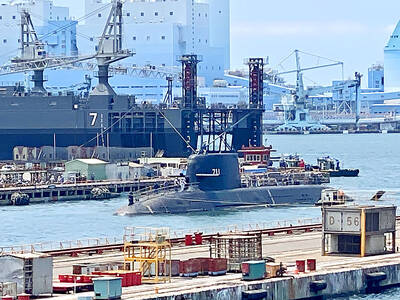
AGING: While Japan has 22 submarines, Taiwan only operates four, two of which were commissioned by the US in 1945 and 1946, and transferred to Taiwan in 1973 Taiwan would need at least 12 submarines to reach modern fleet capabilities, CSBC Corp, Taiwan chairman Chen Cheng-hung (陳政宏) said in an interview broadcast on Friday, citing a US assessment. CSBC is testing the nation’s first indigenous defense submarine, the Hai Kun (海鯤, Narwhal), which is scheduled to be delivered to the navy next month or in July. The Hai Kun has completed torpedo-firing tests and is scheduled to undergo overnight sea trials, Chen said on an SET TV military affairs program. Taiwan would require at least 12 submarines to establish a modern submarine force after assessing the nation’s operational environment and defense

A white king snake that frightened passengers and caused a stir on a Taipei MRT train on Friday evening has been claimed by its owner, who would be fined, Taipei Rapid Transit Corp (TRTC) said yesterday. A person on Threads posted that he thought he was lucky to find an empty row of seats on Friday after boarding a train on the Bannan (Blue) Line, only to spot a white snake with black stripes after sitting down. Startled, he jumped up, he wrote, describing the encounter as “terrifying.” “Taipei’s rat control plan: Release snakes on the metro,” one person wrote in reply, referring
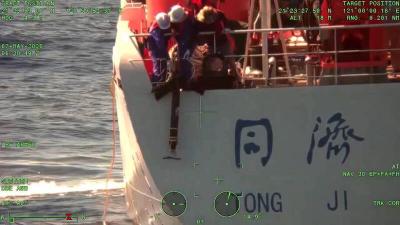
The coast guard today said that it had disrupted "illegal" operations by a Chinese research ship in waters close to the nation and driven it away, part of what Taipei sees a provocative pattern of China's stepped up maritime activities. The coast guard said that it on Thursday last week detected the Chinese ship Tongji (同濟號), which was commissioned only last year, 29 nautical miles (54km) southeast of the southern tip of Taiwan, although just outside restricted waters. The ship was observed lowering ropes into the water, suspected to be the deployment of scientific instruments for "illegal" survey operations, and the coast
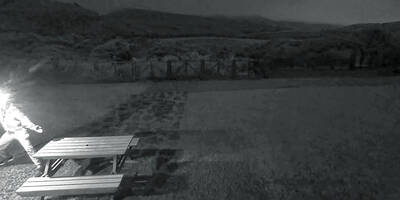
Yangmingshan National Park authorities yesterday urged visitors to respect public spaces and obey the law after a couple was caught on a camera livestream having sex at the park’s Qingtiangang (擎天崗) earlier in the day. The Shilin Police Precinct in Taipei said it has identified a suspect and his vehicle registration number, and would summon him for questioning. The case would be handled in accordance with public indecency charges, it added. The couple entered the park at about 11pm on Thursday and began fooling around by 1am yesterday, the police said, adding that the two were unaware of the park’s all-day live


 RSS
RSS