


The Executive Yuan has identified 65 priority bills that will be presented to the legislature for deliberation, including an amendment that would subject public servants to criminal prosecution for failing to disclose the full extent of their assets, Executive Yuan Secretary-General Hsueh Hsiang-chuan (薛香川) said yesterday.
The Legislative Yuan will convene its second session next Friday and is expected to go into recess early next year.
The bills will be referred to the legislature in separate stages, Hsueh said.
Hsueh told a press conference that the selection of the 65 bills was in line with the major policies the government hoped to implement during the legislative session.
Deputy Minister of Justice Huang Shih-ming (黃世銘), also present at the press conference, said the ministry proposed an amendment to the Statute for the Punishment of Corruption (貪污治罪條例) and an amendment to the Money Laundering Control Act (洗錢防制法) to ensure clean politics.
The amendment to the Statute for the Punishment of Corruption proposes a three-year prison sentence for cases in which large amounts of money or other assets are found registered in the name of public servants, their spouses or their underage children and the official in question refuses or fails to clearly explain the origins.
A public servant could be charged with violating the Statute for the Punishment of Corruption if his or her total assets were found to exceed what the official had declared in accordance with the Public Functionary Assets Disclosure Law (公職人員財產申報法).
The amendment does not define such a case as corruption, as it is in Britain, Hong Kong and Singapore, where undeclared assets are considered possible evidence of corruption or bribery, Huang said.
“The stipulated sentence for corruption is between five and seven years, which puts it on the level of a felony charge. Being convicted of corruption is bad for a public servant’s reputation, so after considering the matter we imposed an obligation on public servants to explain the sources of their assets, as required by the Civil Servants Work Act [公務人員服務法], to ensure integrity,” Huang said.
Huang said that the amendment, if approved by the legislature, would not apply to the case of alleged money-laundering involving former president Chen Shui-bian (陳水扁) and his family so as to conform to the ex post facto principle.
The ministry said property from unknown sources could be seized or confiscated, while the public servants could be asked to make repayments or pay compensation.
Minister Without Portfolio Kao Su-po (高思博) said the amendments would give prosecutors more effective tools to investigate corruption.
The new regulations will effectively combat corruption because public servants would not be able profit from corruption and would have to pay a high price for the crime, Ko said.
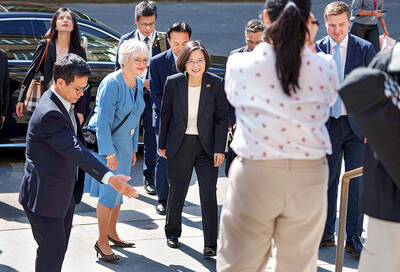
Former president Tsai Ing-wen (蔡英文) on Monday called for greater cooperation between Taiwan, Lithuania and the EU to counter threats to information security, including attacks on undersea cables and other critical infrastructure. In a speech at Vilnius University in the Lithuanian capital, Tsai highlighted recent incidents in which vital undersea cables — essential for cross-border data transmission — were severed in the Taiwan Strait and the Baltic Sea over the past year. Taiwanese authorities suspect Chinese sabotage in the incidents near Taiwan’s waters, while EU leaders have said Russia is the likely culprit behind similar breaches in the Baltic. “Taiwan and our European
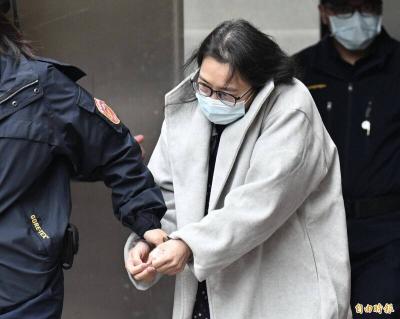
The Taipei District Court sentenced babysitters Liu Tsai-hsuan (劉彩萱) and Liu Jou-lin (劉若琳) to life and 18 years in prison respectively today for causing the death of a one-year-old boy in December 2023. The Taipei District Prosecutors’ Office said that Liu Tsai-hsuan was entrusted with the care of a one-year-old boy, nicknamed Kai Kai (剴剴), in August 2023 by the Child Welfare League Foundation. From Sept. 1 to Dec. 23 that year, she and her sister Liu Jou-lin allegedly committed acts of abuse against the boy, who was rushed to the hospital with severe injuries on Dec. 24, 2023, but did not
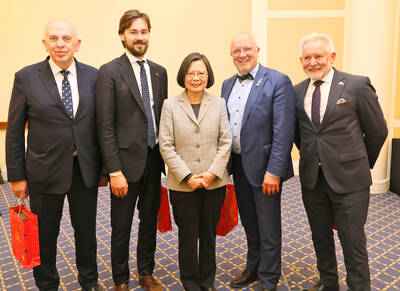
LIKE-MINDED COUNTRIES: Despite the threats from outside, Taiwan and Lithuania thrived and developed their economies, former president Tsai Ing-wen said Former president Tsai Ing-wen (蔡英文) on Saturday thanked Lithuania for its support of Taiwan, saying that both countries are united as partners in defending democracy. Speaking at a reception organized by the Lithuania-Taiwan Parliamentary Friendship Group welcoming her on her first visit to the Baltic state, Tsai said that while she was president from 2016 to last year, many Lithuanian “friends” visited Taiwan. “And I told myself I have to be here. I am very happy that I am here, a wonderful country and wonderful people,” Tsai said. Taiwan and Lithuania are in similar situations as both are neighbors to authoritarian countries, she
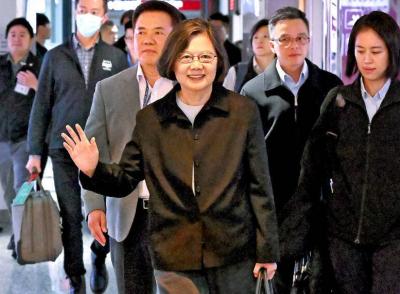
Former president Tsai Ing-wen (蔡英文) is to visit the UK during her ongoing European trip, which originally included only Lithuania and Denmark, her office said today. Tsai departed Taiwan for Europe on Friday night, with planned stops in Lithuania and Denmark, marking her second visit to the continent since her two-term presidency ended in May last year. Her office issued a statement today saying that Tsai would also visit the UK "for a few days," during which she is to meet with UK politicians and Taiwanese professionals, and visit academic and research institutions. Following Tsai's stop in Denmark, she is to visit the


 RSS
RSS