


While Islam may be an unfamiliar religion to most people in Taiwan, the first groups of Muslim settlers arrived in the country more than 300 years ago — and their descendants are still here.
Taisi Township (台西) in Yunlin County looks like any other township on Taiwan’s west coast.
Fish farms are scattered between uncultivated fields, while elderly villagers busily harvest oysters from farms along the coastline and river mouths.
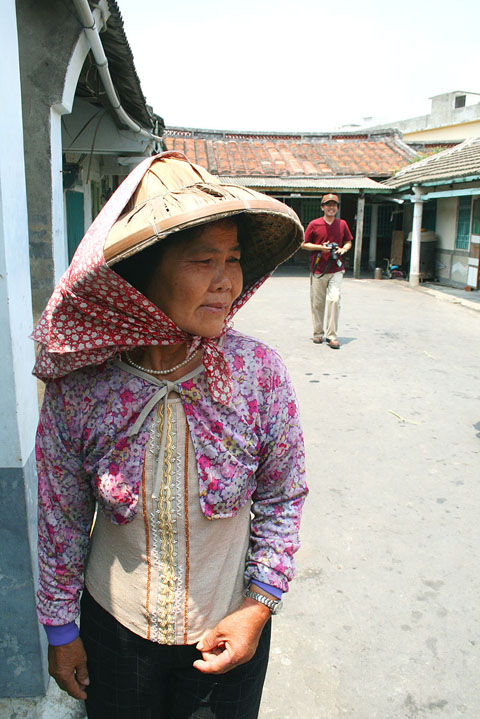
PHOTO: LOA IOK-SIN, TAIPEI TIMES
However, there’s something unique about Taisi — a majority of Taisi’s residents are descendants of Central Asian nobleman Sayyid Shamsuddin Omar.
“Seventy percent of the people in Taisi’s six villages bear the family name Ting (丁), which is derived from the last syllable of ‘Shamduddin,” said Ting Ching-chiang (丁清江), a retired Taisi schoolteacher who devotes himself to studying his family’s history.
Shamsuddin was born to a noble family in Central Asia and moved to China during the Yuan Dynasty when China was part of Genghis Khan’s empire, Ting said.
Aside from their connection to central Asian nobility, the Tings are also linked to the Prophet Mohammed.
“Sayyid is an honorable title given to descendants of the Prophet Mohammed, hence Sayyid Shamsuddin must be connected to Mohammed,” said Ishag Ma (馬孝棋), deputy secretary-general of the Chinese Muslim Association.
As Shamsuddin was favored by the Mongolian court and served in many official positions, his descendants feared retaliation from the Chinese when they overthrew Mongolian rule in the 14th century, and decided to disguise themselves as Han Chinese.
“They took ‘Ting’ as their family name and a group of Shamsuddin’s descendants moved to rural areas of Quanzhou in Fujian Province,” Ting said.
The “Muslim Tings” — as they call themselves — followed other Hoklo settlers from Fujian in migrating to Taiwan.
Already trying to hide their identity in Fujian, the Muslim Tings in Taiwan had completely given up their religion and traces of Islam are nowhere to be found in Taisi.
“But a lot of us — though not everyone — still know that our ancestors were Muslims,” Ting said.
Asked if anyone belonging to the Muslim Ting family in Taisi would consider converting to Islam, Ting said it was “not likely” as Islam is a very foreign religion for them, and most have adopted local Taoist, Buddhist or Christian beliefs.
A similar thing happened to another branch of the Muslim Ting family in Lugang Township (鹿港), Changhua County, a busy historic harbor town only a 40-minute drive from Taisi.
“We know that our ancestors were Muslims because it’s written in the family book,” said Ting Chen-hsiang (丁禎祥), a retired local school principal and director of the Lugang Ting Family Mansion Museum.
Nearly 200 years ago, Ting Chen-hsiang’s family migrated from one of the villages in China’s Fujian Province that still has a large Muslim population bearing the surname “Ting,” he said.
“When in Rome, do as the Romans do. My ancestors had stopped practicing Islam upon arriving in Taiwan because of public pressure,” Ting Chen-hsiang said, standing in the courtyard of his family mansion.
However, Ting Chen-hsiang’s ancestors still left some hints.
“The sanheyuan (三合院) is an architectural style for family houses in Taiwan, but our family house is built as a siheyuan (四合院) — this is how our ancestors secretly tried to preserve our heritage,” Ting Chen-shiang said.
Sanheyuan refers to a U-shaped house with a courtyard in the middle.
A siheyuan, on the other hand, is a square-shaped house with a courtyard in the middle.
“My ancestors constructed a siheyuan instead of a sanheyuan because a siheyuan resembles the Chinese character hui (回) when seen from above,” he said.
“Hui” is a minority Islamic people living in northwestern China and hence Islam is commonly referred to as huijiao (回教) or “religion of the Hui people.”
If the building style is a secret hint that Ting Chen-hsiang’s ancestors left behind for the Muslim Tings in Lugang, the ancestors of another Muslim family in the town — the Kuos (郭) — left them a more obvious hint.
“It has been passed down by word of mouth and recorded in certain historic documents that there used to be a mosque in the Beitou (北頭) area of Lugang,” said Chen Shih-hsien (陳仕賢), a local Lugang historian. “According to studies, the former site of the Kuo family ancestral temple should’ve been the mosque a few hundred years ago.”
The new Kuo family temple has been turned into a Taoist facility, the Pao’an Temple (保安宮).
The two-story building looks no different from other Taoist temples, with sculptures of deities on the main table.
Although it's been turned into a Taoist temple, the Kuos in Beitou still hold their ancestral worships at the temple, with an interesting twist.
"We do eat pork, but there's a practice that's been passed down through generations that pork cannot be presented as a sacrifice at ancestral worships," local borough chief Kuo Hsien-chin (郭獻欽) said.
Chen said that the Kuos do not eat pork during funerals of family members either.
"It would've been interesting to come to Lugang 300 years ago to see a mosque standing just a few hundred meters away from a temple worshipping [the goddess of the sea] Matsu [媽祖]," Ma said.
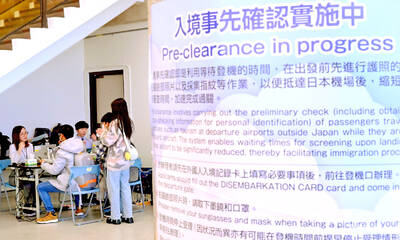
A preclearance service to facilitate entry for people traveling to select airports in Japan would be available from Thursday next week to Feb. 25 at Taiwan Taoyuan International Airport, Taoyuan International Airport Corp (TIAC) said on Tuesday. The service was first made available to Taiwanese travelers throughout the winter vacation of 2024 and during the Lunar New Year holiday. In addition to flights to the Japanese cities of Hakodate, Asahikawa, Akita, Sendai, Niigata, Okayama, Takamatsu, Kumamoto and Kagoshima, the service would be available to travelers to Kobe and Oita. The service can be accessed by passengers of 15 flight routes operated by
MORE FALL: An investigation into one of Xi’s key cronies, part of a broader ‘anti-corruption’ drive, indicates that he might have a deep distrust in the military, an expert said China’s latest military purge underscores systemic risks in its shift from collective leadership to sole rule under Chinese President Xi Jinping (習近平), and could disrupt its chain of command and military capabilities, a national security official said yesterday. If decisionmaking within the Chinese Communist Party has become “irrational” under one-man rule, the Taiwan Strait and the regional situation must be approached with extreme caution, given unforeseen risks, they added. The anonymous official made the remarks as China’s Central Military Commission Vice Chairman Zhang Youxia (張又俠) and Joint Staff Department Chief of Staff Liu Zhenli (劉振立) were reportedly being investigated for suspected “serious

ENHANCING EFFICIENCY: The apron can accommodate 16 airplanes overnight at Taoyuan airport while work on the third runway continues, the transport minister said A new temporary overnight parking apron at Taiwan Taoyuan International Airport is to start operating on Friday next week to boost operational efficiency while the third runway is being constructed, the Ministry of Transportation and Communications said yesterday. The apron — one of the crucial projects in the construction of the third runway — can accommodate 16 aircraft overnight at the nation’s largest international airport, Minister of Transportation and Communications Chen Shih-kai (陳世凱) told reporters while inspecting the new facility yesterday morning. Aside from providing the airport operator with greater flexibility in aircraft parking during the third runway construction,

American climber Alex Honnold is to attempt a free climb of Taipei 101 today at 9am, with traffic closures around the skyscraper. To accommodate the climb attempt and filming, the Taipei Department of Transportation said traffic controls would be enforced around the Taipei 101 area. If weather conditions delay the climb, the restrictions would be pushed back to tomorrow. Traffic controls would be in place today from 7am to 11am around the Taipei 101 area, the department said. Songzhi Road would be fully closed in both directions between Songlian Road and Xinyi Road Sec 5, it said, adding that bidirectional traffic controls would


 RSS
RSS