


The suspected hijacking of a Taiwanese fishing boat by foreign crewmen has once again brought into focus the fact that many of the country’s fishing boats are now entirely staffed by foreign workers, which could create the possibility of ethnic conflict and mutiny.
The Pingtung-registered Taiyishiang (泰億祥), a tuna boat that left Taiwan on July 12 heading for the mid-Pacific Ocean, has been out of contact since last Tuesday, said the Fisheries Agency deep seas fisheries division deputy director Huang Hung-yan (黃鴻燕).
While 48-year-old captain Lee Feng-pao (李豐寶) is Taiwanese, the rest of the crew, eight fishermen, are Indonesian, he said.
The missing report was not filed until Sunday because “communication at sea is not always stable [so] Lee’s family did not report him as missing until Sunday,” Huang said.
The agency then began a series of emergency responses, Huang said.
“Because the boat is now traveling off track and is [1,111km] from Indonesia [or 852km from Taiwan], we have deduced that it is quite possible the boat has been hijacked,” he said.
Luckily, the Vessel Monitoring System (VMS) on the boat is still turned on so the the agency can still trace the boat’s location, information it has shared with the Ministry of Foreign Affairs (MOFA), Huang said. He also said that he hoped the Indonesian government would help in intercepting the boat.
The agency has also contacted the Coast Guard Administration to inquire about the possibility of sending jet vessels to catch up with the missing boat, he said, adding, “We have also radioed all Taiwanese fishing boats in close proximity to help locate Taiyishiang.”
However, the episode may have also inadvertently revealed a rising problem with Taiwan’s fisheries, as Pingtung County’s Liouciou Township (琉球) fisheries association director Tsai Pao-shing (蔡寶興) told the Taipei Times via telephone that many Taiwanese fishing boats are now manned by one Taiwanese captain and all-foreign crews.
“A fishing trip usually takes several months … With routine work and the pressure of not catching fish, everybody has mood swings — but because of cultural differences and the language barrier, conflicts occur; each year in the past few years, a few boats would be hijacked and the Taiwanese captain killed or robbed,” he said.
Asked why fishermen still hired from abroad, Tsai said, “Fishing is hard work; all experienced captains tell their sons to go to school and get office jobs instead. What’s more, with the recent increase in oil prices and the stagnant fish prices, most fishermen now hire foreign help to lower costs,” he said.
The short-term solution, Tsai suggested, is to loosen regulations for hiring Chinese fishermen.
“While they may not cause less trouble, with the same language we would at least get along better,” he said.
However, the long term solution would depend on the government’s support of training in the industry, so that, “Youngsters would be willing to go onto fishing boats,” he said.
Tsai, who is a friend of Lee’s, also blasted both the ministry and the Fisheries Agency for their slow reaction.
“The VMS says that the boat is approaching the Philippines, not Indonesia,” he said.
“When you are trying to save a life, time is precious. It is ridiculous to try to send a boat from Taiwan; asking other fishing boats is also not an option — the abductors could be armed, so the best way is to ask the Philippine government to save Lee by sending send sea patrols,” he said.

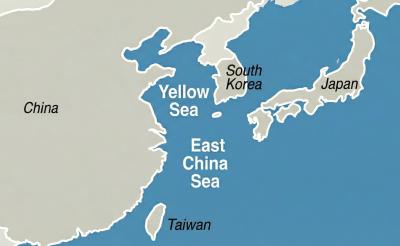
China has reserved offshore airspace in the Yellow Sea and East China Sea from March 27 to May 6, issuing alerts usually used to warn of military exercises, although no such exercises have been announced, the Wall Street Journal (WSJ) reported yesterday. Reserving such a large area for 40 days without explanation is an “unusual step,” as military exercises normally only last a few days, the paper said. These alerts, known as Notice to Air Missions (Notams), “are intended to inform pilots and aviation authorities of temporary airspace hazards or restrictions,” the article said. The airspace reserved in the alert is

South Korea is planning to revise its controversial electronic arrival card, a step Taiwanese officials said prompted them to hold off on planned retaliatory measures, a South Korean media report said yesterday. A Yonhap News Agency report said that the South Korean Ministry of Foreign Affairs is planning to remove the “previous departure place” and “next destination” fields from its e-arrival card system. The plan, reached after interagency consultations, is under review and aims to simplify entry procedures and align the electronic form with the paper version, a South Korean ministry official said. The fields — which appeared only on the electronic form

A bipartisan group of US senators has introduced a bill to enhance cooperation with Taiwan on drone development and to reduce reliance on supply chains linked to China. The proposed Blue Skies for Taiwan Act of 2026 was introduced by Republican US senators Ted Cruz and John Curtis, and Democratic US senators Jeff Merkley and Andy Kim. The legislation seeks to ease constraints on Taiwan-US cooperation in uncrewed aerial systems (UAS), including dependence on China-sourced components, limited access to capital and regulatory barriers under US export controls, a news release issued by Cruz on Wednesday said. The bill would establish a "Blue UAS
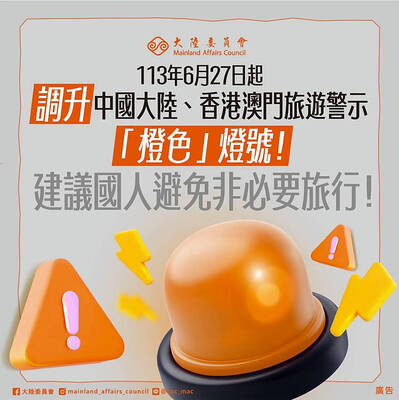
More than 6,000 Taiwanese students have participated in exchange programs in China over the past two years, despite the Mainland Affairs Council’s (MAC) “orange light” travel advisory, government records showed. The MAC’s publicly available registry showed that Taiwanese college and university students who went on exchange programs across the Strait numbered 3,592 and 2,966 people respectively. The National Immigration Agency data revealed that 2,296 and 2,551 Chinese students visited Taiwan for study in the same two years. A review of the Web sites of publicly-run universities and colleges showed that Taiwanese higher education institutions continued to recruit students for Chinese educational programs without


 RSS
RSS