


Doctors warned people with hay fever to be cautious as the pigweed season is at its peak.
Pigweed can cause serious health threats to people with hay fever, or pollinosis, because it sheds large amounts of pollen when it blooms in July and August, said Hsu Ling-ming (徐玲明), an assistant research fellow with the Council of Agriculture (COA).
A single pigweed plant can release a million pollen grains per day and pigweed pollen can be carried up to several hundred kilometers by the wind, Hsu said.
People with hay fever have allergic reactions when the density of pollen reaches 20 to 40 grains per square meter.
Some common allergic reactions caused by pigweed include irritated eyes, sneezing, a runny nose and sometimes allergic rhinitis — an inflammation of the mucous membrane that lines the nose — or asthma, said Tsai Chao-chi (蔡肇基), an allergy specialist at Taichung Veterans General Hospital.
While pigweed is a common allergen in Western countries, in Taiwan it originally only grew on the northwest coast. It can now be found in Taichung County and is also spreading to the northeastern part of the country, COA studies showed.
In the past, pigweed has caused health problems in Kinmen, as it covers large areas of the island. Pigweed has been listed as one of the 20 most threatening invasive vegetation species since it was first found on Taiwan proper more than 10 years ago, said Huang Shih-yuan (黃士元), another COA assistant research fellow.
Huang suggested that pigweed may have arrived in Taiwan with imports of grains.
Nowadays, pigweed can be easily spotted in abandoned lots or along roads in rural areas in Taipei, Taoyuan, Hsinchu and Miaoli counties.
According to Tsai’s own study, 80 percent of allergy cases in Kinmen are caused by pigweed, and as it continues to spread in Taiwan proper, it may soon become a top threat for allergy patients, he said.
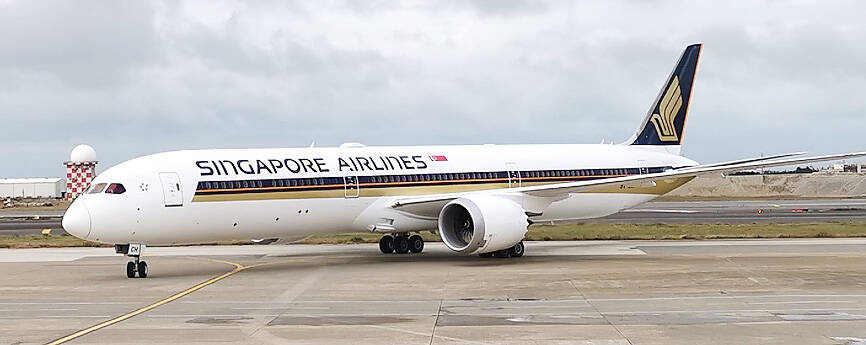
INCREASED CAPACITY: The flights on Mondays, Wednesdays, Fridays and Sundays would leave Singapore in the morning and Taipei in the afternoon Singapore Airlines is adding four supplementary flights to Taipei per week until May to meet increased tourist and business travel demand, the carrier said on Friday. The addition would raise the number of weekly flights it operates to Taipei to 18, Singapore Airlines Taiwan general manager Timothy Ouyang (歐陽漢源) said. The airline has recorded a steady rise in tourist and business travel to and from Taipei, and aims to provide more flexible travel arrangements for passengers, said Ouyang, who assumed the post in July last year. From now until Saturday next week, four additional flights would depart from Singapore on Monday, Wednesday, Friday
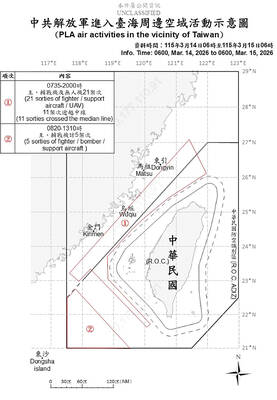
The Ministry of National Defense yesterday reported the return of large-scale Chinese air force activities after their unexplained absence for more than two weeks, which had prompted speculation regarding Beijing’s motives. China usually sends fighter jets, drones and other military aircraft around the nation on a daily basis. Interruptions to such routine are generally caused by bad weather. The Ministry of National Defense said it had detected 26 Chinese military aircraft in the Taiwan Strait over the previous 24 hours. It last reported that many aircraft on Feb. 25, when it spotted 30 aircraft, saying Beijing was carrying out another “joint combat

Taiwan successfully defended its women’s 540 kilogram title and won its first-ever men’s 640 kg title at the 2026 World Indoor Tug of War Championships in Taipei yesterday. In the women’s event, Taiwan’s eight-person squad reached the final following a round-robin preliminary round and semifinals featuring teams from Ukraine, Japan, Thailand, Vietnam, the Basque Country and South Korea. In the finals, they swept the Basque team 2-0, giving the team composed mainly of National Taiwan Normal University students and graduates its second championship in a row, and its fourth in five years. Team captain

Taiwan’s three major international carriers are increasing booking fees, with EVA Airways having already increased the charge to US$28 per flight segment from US$25, while China Airlines (CAL) and Starlux Airlines are set to follow suit. Booking fees are charged by airlines through a global distribution system (GDS) and passed on to passengers. Carriers that apply the fees include CAL, EVA, Starlux and Tigerair Taiwan. A GDS is a computerized network operated by a company that connects airlines with travel agents and ticketing platforms, allowing reservations to be made and processed in real time. Major players include Amadeus, Sabre and Travelport. EVA Air began


 RSS
RSS