


Taipei Times: As you look back, how would you rate your actions during the past year or so that you have been the de facto ambassador? What were your biggest problems? And your biggest accomplishments? What did you enjoy most?
Joseph Wu (吳釗燮): I would say that the biggest difficulties for me in Washington, DC, and I don’t want to seem like I’m criticizing the administration, but I should point out that Taiwan and the United States do not have formal diplomatic relations with each other, and that can be difficult sometimes.
The United States does recognize Taiwan or the Republic of China as a country even though Taiwan is functioning as a de facto country, like an independent country.
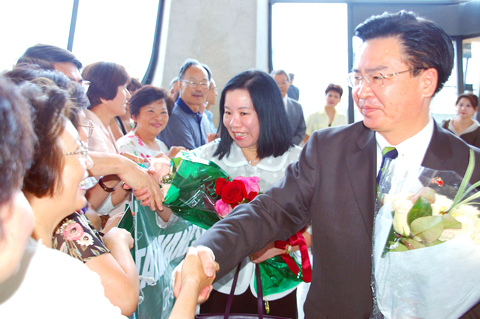
PHOTO: CNA
So, the two perspectives are not in line with each other. At the same time China is rising economically, politically, diplomatically and militarily.
The United States needs the support and agreement of China and the cooperation of China in dealing with some of the issues.
Taiwan, as a major adversary of China, may suffer even though the United States continues to tell us that they will not compromise in dealing with Taiwan when they have to get China’s cooperation.
But the problem Taiwan faces is that China, through its growing strength around the world, is trying to deal with Taiwan from strength and tries to grab our diplomatic allies, tries to squeeze Taiwan out of international forums, tries to keep Taiwan out of informational organizations, and these kind of things.
Additionally, China has been increasing its military might across the Taiwan Strait geared specifically at Taiwan. Taiwan is being put under more pressure than before in its relations with the United States and its relations with the rest of the world because of the growing Chinese strength.
Some people have even started to think that because of the overwhelming Chinese military strength across the Taiwan Strait that we have to think about a new strategy in dealing with the situation.
Taiwan is in an unfortunate situation under this changing international power configuration.
So this is the second factor in the difficulties I have had to deal with in Washington, DC.
This is not the only thing I have to deal with. In fact, it is what the whole foreign policy establishment in Taiwan has to think very seriously about.
TT: With Ma Ying-jeou’s (馬英九) opening to China, do you think your successor, Jason Yuan (袁健生), is going to have an easier job, or do you think that he is basically going to face the same problems?
Wu: Basically, he is going to inherit the same structural problems that I had to deal with. Taiwan and the United States do not have formal diplomatic relations, and I don’t think that Jason is going to be able to go to the State Department or the White House or to be present in some of the formal events held by the administration.
And even though Taiwan and China have started to have better relations because of the negotiations on charter flights and the tourism issue, if you look at the broader structures between Taiwan and China, China continues to strive to squeeze Taiwan out of international play and China continues to strengthen its military deployment against Taiwan.
I’m sure you remember that only two or three weeks ago, the vice chairman of the Central Military Commission, Xu Caihou (徐才厚), said that China will not reduce its military deployment against Taiwan.
So you can see that the difficulties are still there.
Basically, Jason is going to have to deal with the same issues that we have had to deal with. I inherited all these structural problems, which have been there for years and years, and I believe that those structural problems are still there for Taiwan to reckon with, and there’s no easy way out.
TT: What should Jason Yuan’s basic priorities be? What should he try to do first?
Wu: It’s going to be premature to think that a change of administration in Taiwan, changing from one party to another party, is going to solve everything. The truth is that it will not, because what we faced is going to remain the same. If you look at the transit of President Ma, for example: When President Chen [Shui-bian, 陳水扁]was in power, he faced some difficult transiting issues, and we all know the reasons why.
And I believe President Ma is also going to face some restrictions in his transit activities and I think the reasons are pretty similar to what we faced before.
The United States is facing international crises.
There are so many issues that the United States has to deal with, and China is probably the one country that the United States is counting on right now.
Therefore, we cannot expect that Taiwan and the United States can work based upon a very different kind of international environment.
In fact, the international environment is still the same, and therefore we need to take our American friends’ situation into consideration.
So, when we face the same difficulties, or we face the same restrictions, we shouldn’t despair. It’s not entirely Taiwan’s problem. It is the structural problem that we have been facing.
TT: Some people in Taiwan, especially in the pan-green camp, feel that Ma Ying-jeou is going too far in improving relations with Beijing, and that he might be compromising Taiwan’s sovereignty. Do you think that this feeling is shared here in Washington? Have you expressed such concerns to policymakers here, and have they expressed concerns to you about that?
Wu: We have been asking the same question in Washington, DC, ever since President Ma took office.
From administration officials, we haven’t heard anything that would show their concern with Taiwan’s rapprochement with China.
But some of the think tank scholars in Washington have started to express their curiosity or doubts or concerns over where Taiwan is going.
They don’t seem to see the end picture of Taiwan’s rapprochement, and they don’t know what is going to evolve.
Of course, Washington, DC, is such a pluralistic society that it is not surprising to hear such views.
They don’t know where cross-strait relations are heading and they seem to have some doubts or curiosity or even concerns over developments.
Many people are also expecting that other than economic issues, the two sides may touch upon political issues, but when the two sides touch upon political issues, maybe real difficulties can be found at that point.
TT: Could you share with us what you expect from a Barack Obama presidency, or from a John McCain presidency in terms of policy toward Taiwan?
Wu: Taiwan cannot and should not express its preference over any particular camp, because Taiwan makes friends with both Republicans and Democrats, and Taiwan does have very important friends in two camps, and what we wish for is that whoever is the new president of the United States, Taiwan looks forward to the continuing cooperation with the new administration.
From our perspective, Taiwan should have no problem working with either a Democratic administration or a Republican administration.
We have quite a few friends in either camp.
TT: Overall, how do you rate Washington’s relations with Taipei?
Wu: I would say that Washington’s relationship with Taipei is still very good and very solid, but faces challenges.
It’s very good and solid based on three perspectives.
The first is that Taiwan is already a democracy, and this kind of democracy is the guideline of US foreign policy in dealing with the rest of the world.
Whenever there is a country that is a democracy, the United States considers it an ally. At least it can be an ally of values.
And Taiwan is one country that is already a full democracy and the United States recognizes that Taiwan and the United States share that basic value of the respect of human rights, freedom and democracy.
The second perspective is that bilateral economic relations are very good, and continue to improve in trade and other economic relations. And we can also expect that the TIFA [Trade and Investment Framework Agreement] talks between Taiwan and the United States continue to evolve into a framework for the two sides to work even closer with each other.
And the third aspect is in security cooperation.
Other than the fact that Taiwan is buying arms from the United States and the United States is providing assistance to Taiwan security, Taiwan also works with the United States in the global war against terror.
The United States has a container security initiative, and Taiwan continues to be praised by administration officials as the most cooperative country in the world in helping US container security to make sure that all the containers that come into the United States do not contain any material that can be used by terrorists.
And we also try to work with the United States in passenger security to make sure that the two sides share basic information on a very timely basis.
Therefore, you can see that Taiwan and the United States are very good friends. Some people even describe the two sides as allies without the formality of being security allies.
But at the same time, Taiwan continues to face challenges in its relationship with the United States.
And the reason is that China is growing and thinks about ways to squeeze Taiwan out of international politics, and China doesn’t want to see Taiwan and the United States have dealings in any kind of official manner.
Also, it looks like China is going to continue to squeeze Taiwan out of the WHO and the UN, and these are very emotional issues for the Taiwan people.
And, of course by the mere fact that Taiwan is a democracy continues to pose a challenge to Taiwan-US relations.
The definition of democracy is that the top leaders cannot make a final decision for the people, for all the people at this moment or all the people in the future.
Taiwan is not an authoritarian country any more, unlike the situation when Taiwan was ruled by Chiang Kai-shek (蔣介石).
Because Taiwan is a democracy, elections might turn out a result in which the United States has a disagreement with some of the policy agenda of the Taiwan government. That might become a challenge.
We don’t know whether the Kuomintang [Chinese Nationalist Party, KMT] is going to be for American interests or the DPP government is going to be for American interests.
And so the new guys will have to talk about those issues which the two sides may not agree on.
For the KMT side right now, many people are still wondering whether the KMT’s actions in the past few years in blocking the arms sales is still the policy of the current administration.
The Taiwan government needs to continue to persuade the American friends and the administration that the current government is determined to fulfill its own defense needs.
And any future KMT government needs to frankly and honestly tell the American friends of their perspective on cross-strait relations, and their determination to safeguard the status quo or their determination to prevent the status quo from being upset by any outside forces.

PRAISE: Japanese visitor Takashi Kubota said the Taiwanese temple architecture images showcased in the AI Art Gallery were the most impressive displays he saw Taiwan does not have an official pavilion at the World Expo in Osaka, Japan, because of its diplomatic predicament, but the government-backed Tech World pavilion is drawing interest with its unique recreations of works by Taiwanese artists. The pavilion features an artificial intelligence (AI)-based art gallery showcasing works of famous Taiwanese artists from the Japanese colonial period using innovative technologies. Among its main simulated displays are Eastern gouache paintings by Chen Chin (陳進), Lin Yu-shan (林玉山) and Kuo Hsueh-hu (郭雪湖), who were the three young Taiwanese painters selected for the East Asian Painting exhibition in 1927. Gouache is a water-based
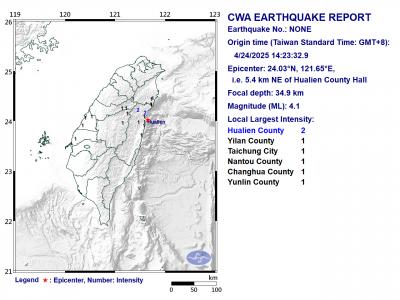
A magnitude 4.1 earthquake struck eastern Taiwan's Hualien County at 2:23pm today, according to the Central Weather Administration (CWA). The epicenter of the temblor was 5.4 kilometers northeast of Hualien County Hall, at a depth of 34.9 km, according to the CWA. The earthquake's intensity, which gauges the actual effect of a temblor, was the highest in Hualien County, where it measured 2 on Taiwan's 7-tier intensity scale. The quake also measured an intensity of 1 in Yilan county, Taichung, Nantou County, Changhua County and Yunlin County, the CWA said. There were no immediate reports of damage or injuries.
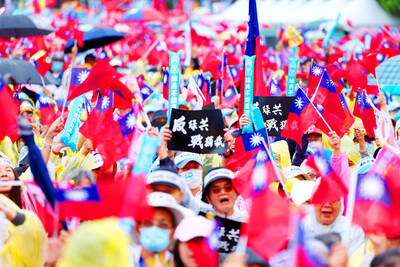
‘WORSE THAN COMMUNISTS’: President William Lai has cracked down on his political enemies and has attempted to exterminate all opposition forces, the chairman said The legislature would motion for a presidential recall after May 20, Chinese Nationalist Party (KMT) Chairman Eric Chu (朱立倫) said yesterday at a protest themed “against green communists and dictatorship” in Taipei. Taiwan is supposed to be a peaceful homeland where people are united, but President William Lai (賴清德) has been polarizing and tearing apart society since his inauguration, Chu said. Lai must show his commitment to his job, otherwise a referendum could be initiated to recall him, he said. Democracy means the rule of the people, not the rule of the Democratic Progressive Party (DPP), but Lai has failed to fulfill his
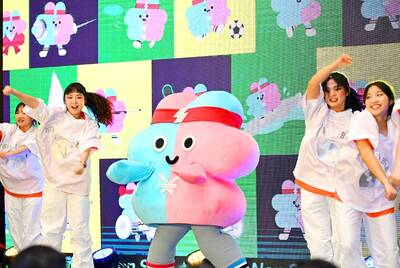
OFF-TARGET: More than 30,000 participants were expected to take part in the Games next month, but only 6,550 foreign and 19,400 Taiwanese athletes have registered Taipei city councilors yesterday blasted the organizers of next month’s World Masters Games over sudden timetable and venue changes, which they said have caused thousands of participants to back out of the international sporting event, among other organizational issues. They also cited visa delays and political interference by China as reasons many foreign athletes are requesting refunds for the event, to be held from May 17 to 30. Jointly organized by the Taipei and New Taipei City governments, the games have been rocked by numerous controversies since preparations began in 2020. Taipei City Councilor Lin Yen-feng (林延鳳) said yesterday that new measures by


 RSS
RSS