


Taiwan will have to take extra precautions to safeguard its relations with Japan now that Beijing’s former ambassador to Tokyo, Wang Yi (王毅), is head of the Taiwan Affairs Office (TAO), Taiwan’s former representative to Japan Koh Sei-kai (�?�) said at a seminar in Taipei yesterday.
The TAO is Beijing’s official agency on cross-strait affairs.
Speaking at the Taiwan New Century Foundation, Koh, an expert on Japanese culture and politics, said that based on his experience dealing with Wang, China will take every chance to sabotage relations between Taiwan and Japan, which could include adding anti-Taiwan conditions in any future China-Japan joint ventures.
“China’s strategy is to ask Japan for whatever Taiwan seeks from Tokyo. If Tokyo rejects China’s request, then Beijing will use Japan’s adherence to the ‘one-China’ policy as an excuse to say that if Tokyo fails to grant China’s requests, then it certainly cannot grant Taiwan’s requests,” Koh said.
Koh said that although Japan-China relations appeared to be improving, an increasing number of Diet members were starting to see the “true colors” of China, such as the sustained double-digit military budget buildup over the past decade.
Taiwan-Japan ties were put to the test early last month after a Japanese coast guard vessel rammed into and sank a Taiwanese fishing boat in the waters surrounding the disputed Diaoyutai (釣魚台) islands, an area claimed by China, Japan, and Taiwan.
Taiwan demanded that Japan provide compensation, release all the men on the fishing boat and publicly apologize for the mishap, conditions that were met by Tokyo just as the Ministry of Foreign Affairs was recalling Koh from Tokyo.
A group of pan-blue lawmakers accused Koh of being a “traitor” and alleged he was “siding with the Japanese” in his handling of the incident.
“During the negotiations, many prominent Japanese officials — including three former foreign ministers — agreed that the cherished Taiwan-Japan relationship should not be affected over the incident,” said Koh, adding that the Japanese government had made many exceptions to ensure that the matter was concluded on friendly terms.
In a recent interview with the Japanese Sankei Shimbun, former Japanese representative to Taiwan Tadashi Ikeda said Taiwan-Japan relations could deteriorate as the new government focuses on improving relations with China, saying that anti-Japanese sentiment could easily be stirred up in Taiwan by sensational news reports.
Ministry spokesman Henry Chen (陳銘政) said Taiwan highly values its relations with Japan and would seek to strengthen them.

LOUD AND PROUD Taiwan might have taken a drubbing against Australia and Japan, but you might not know it from the enthusiasm and numbers of the fans Taiwan might not be expected to win the World Baseball Classic (WBC) but their fans are making their presence felt in Tokyo, with tens of thousands decked out in the team’s blue, blowing horns and singing songs. Taiwanese fans have packed out the Tokyo Dome for all three of their games so far and even threatened to drown out home team supporters when their team played Japan on Friday. They blew trumpets, chanted for their favorite players and had their own cheerleading squad who dance on a stage during the game. The team struggled to match that exuberance on the field, with
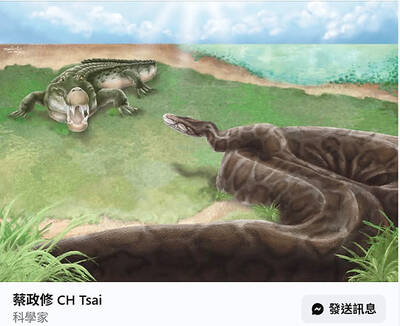
Taiwanese paleontologists have discovered fossil evidence that pythons up to 4m long inhabited Taiwan during the Pleistocene epoch, reporting their findings in the international scientific journal Historical Biology. National Taiwan University (NTU) Institute of Ecology and Evolutionary Biology associate professor Tsai Cheng-hsiu (蔡政修) led the team that discovered the largest snake fossil ever found in Taiwan. The single trunk vertebra was discovered in Tainan at the Chiting Formation, dated to between 400,000 and 800,000 years ago in the Middle Pleistocene, the paper said. The area also produced Taiwan’s first avian fossil, as well as crocodile, mammoth, saber-toothed cat and rhinoceros fossils, it said. Discoveries

Taiwanese paleontologists have discovered fossil evidence that pythons up to 4m long inhabited Taiwan during the Pleistocene epoch, reporting their findings in the international scientific journal Historical Biology. National Taiwan University (NTU) Institute of Ecology and Evolutionary Biology associate professor Tsai Cheng-hsiu (蔡政修) led the team that discovered the largest snake fossil ever found in Taiwan. A single trunk vertebra was discovered in Tainan at the Chiting Formation, dated to between 800,000 to 400,000 years ago in the Middle Pleistocene, the paper said. The area also produced Taiwan’s first avian fossil, as well as crocodile, mammoth, sabre-toothed cat and rhinoceros fossils, it said. Discoveries

Whether Japan would help defend Taiwan in case of a cross-strait conflict would depend on the US and the extent to which Japan would be allowed to act under the US-Japan Security Treaty, former Japanese minister of defense Satoshi Morimoto said. As China has not given up on the idea of invading Taiwan by force, to what extent Japan could support US military action would hinge on Washington’s intention and its negotiation with Tokyo, Morimoto said in an interview with the Liberty Times (sister paper of the Taipei Times) yesterday. There has to be sufficient mutual recognition of how Japan could provide


 RSS
RSS